

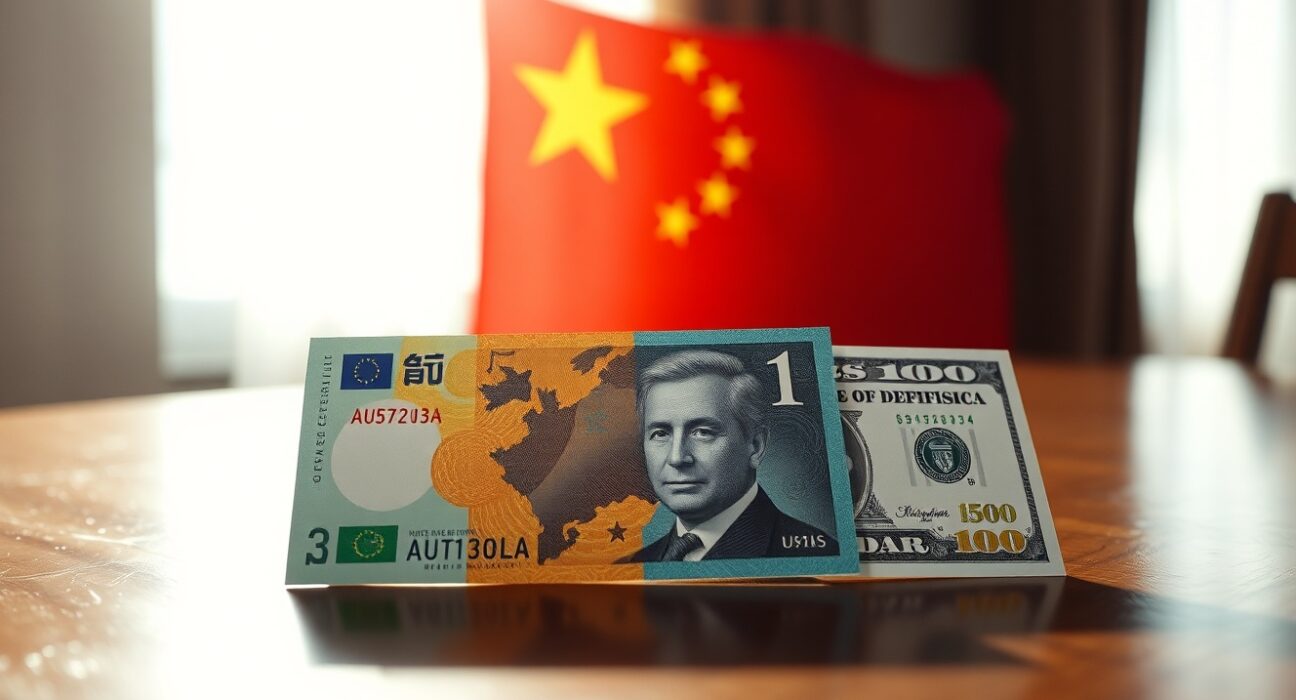
The Australian dollar is treading water, caught between the gravitational pull of China’s economic engine and the policy signals emanating from Washington. For currency traders and import-export businesses alike, the current range-bound movement of the AUD/USD pair reflects a market waiting for clarity on two fronts: the trajectory of US interest rates and the strength of Chinese demand.
A Currency Caught Between Two Poles
Australia’s economy is uniquely exposed to the policies of both the United States and China. The US Federal Reserve’s decisions on interest rates directly influence the value of the US dollar, against which the Australian dollar is measured. Meanwhile, China’s status as Australia’s largest trading partner means that any shift in Beijing’s economic stimulus or trade policy has an outsized impact on Australian export revenues and, by extension, the currency’s value.
Recent data shows the AUD/USD pair oscillating within a narrow band, suggesting that neither bullish nor bearish forces have yet gained the upper hand. This stalemate is typical of periods when markets are pricing in multiple, conflicting scenarios. On one hand, expectations of a softer US dollar, driven by potential Fed rate cuts, provide support for the Aussie. On the other, concerns about a slowdown in Chinese industrial production and property investment cap any significant upside.
Trade Flows and the Commodity Link
The Australian dollar is often viewed as a proxy for global risk appetite, largely due to its strong correlation with commodity prices. Iron ore, coal, and natural gas—Australia’s top exports—are heavily dependent on Chinese demand. When Beijing signals further economic support, such as infrastructure spending or looser monetary policy, it tends to lift commodity prices and, consequently, the AUD.
However, the relationship is not always straightforward. US trade policy, particularly regarding tariffs on Chinese goods, adds a layer of unpredictability. Any escalation in trade tensions between Washington and Beijing tends to hurt the Australian dollar, as it threatens the very trade flows that underpin the Australian economy. The market is currently watching for any signs of de-escalation or new tariffs, which could provide the catalyst for a decisive move in the currency.
What This Means for Businesses and Investors
For Australian exporters, a weaker dollar is generally beneficial, as it makes their goods cheaper on global markets. Conversely, importers and Australian consumers face higher costs for foreign goods and travel when the dollar is soft. Investors holding US-dollar-denominated assets are also sensitive to these fluctuations.
The current period of low volatility may present opportunities for hedging or strategic positioning, but it also carries the risk of a sudden, sharp move if either the Fed or the People’s Bank of China surprises the market. The key takeaway is that the Australian dollar is not just a reflection of Australia’s economic health, but a barometer of the broader geopolitical and economic relationship between the world’s two largest economies.
Conclusion
The Australian dollar’s current wait-and-see posture is a rational response to an uncertain environment. Until clearer signals emerge from either Washington on interest rates or Beijing on economic stimulus, the currency is likely to remain in its recent trading range. For those with exposure to the AUD, patience and a close watch on both US and Chinese data releases will be essential.
FAQs
Q1: Why is the Australian dollar so sensitive to the US dollar?
The Australian dollar is traded against the US dollar (AUD/USD), making the pair one of the most actively traded in the forex market. Changes in US interest rates or economic data directly affect the relative value of the two currencies.
Q2: How does China’s economy affect the Australian dollar?
China is Australia’s largest trading partner, buying the majority of its iron ore, coal, and other commodities. When China’s economy grows, demand for these exports rises, supporting the Australian dollar. A slowdown in China typically weakens the AUD.
Q3: What should businesses do during periods of currency uncertainty?
Businesses with exposure to currency risk should consider hedging strategies, such as forward contracts or options, to lock in exchange rates. Consulting with a financial advisor or currency specialist is recommended to tailor a strategy to specific needs.
Disclaimer: The information provided is not trading advice, Bitcoinworld.co.in holds no liability for any investments made based on the information provided on this page. We strongly recommend independent research and/or consultation with a qualified professional before making any investment decisions.
