

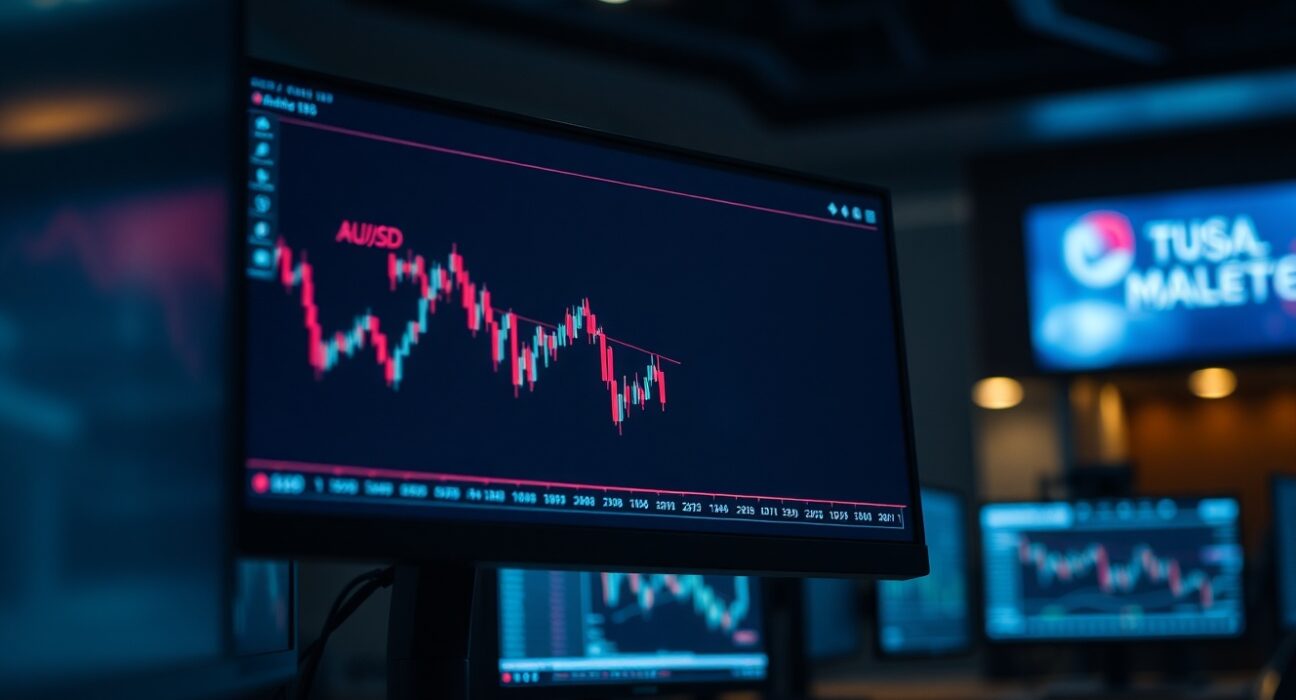
The Australian dollar weakened against a broadly firmer US dollar on Tuesday, slipping below the 0.6900 threshold following the release of disappointing manufacturing data from China, Australia’s largest trading partner. The AUD/USD pair traded around 0.6875 in the Asian session, extending its recent pullback from multi-month highs.
China PMI Miss Fuels Risk Aversion
China’s official Manufacturing Purchasing Managers’ Index (PMI) for April came in at 49.2, contracting for the first time in three months and falling short of market expectations of 50.3. The reading, which indicates a contraction in factory activity, reignited concerns about the pace of economic recovery in the world’s second-largest economy. The data weighed on risk-sensitive currencies like the Australian dollar, while the US dollar benefited from safe-haven flows.
The Aussie dollar is particularly sensitive to Chinese economic data due to Australia’s reliance on commodity exports to China. A slowdown in Chinese manufacturing typically reduces demand for Australian resources such as iron ore and coal, putting downward pressure on the currency.
US Dollar Strength and Fed Expectations
The US dollar index (DXY) rose 0.3% on the day, recovering from recent losses as market participants reassessed the Federal Reserve’s interest rate trajectory. Stronger-than-expected US durable goods orders data released last week has reinforced the narrative that the US economy remains resilient, potentially giving the Fed room to keep rates higher for longer.
This divergence in economic outlooks—a slowing China versus a resilient US—is creating headwinds for the Australian dollar. Traders are now pricing in a higher probability of another rate hike by the Federal Reserve in June, which would further widen the interest rate differential favoring the US dollar.
Impact on Traders and Importers
The AUD/USD decline has implications for Australian importers and travelers, who now face a stronger US dollar. For forex traders, the 0.6900 level has become a key psychological resistance, with the next support level seen around 0.6830. A sustained break below that could open the door for a test of the 0.6700 region.
Meanwhile, the Reserve Bank of Australia (RBA) is scheduled to meet next week. Market expectations are split, with some economists predicting a pause in the tightening cycle, while others anticipate a 25-basis-point rate hike. The RBA’s decision will be crucial in determining the near-term direction of the Australian dollar.
Conclusion
The Australian dollar’s decline below 0.6900 reflects a confluence of factors: disappointing Chinese economic data, renewed US dollar strength, and shifting expectations for central bank policy. While the currency may find some support from elevated commodity prices, the near-term outlook remains cautious. Traders will be closely watching the upcoming RBA meeting and further Chinese economic indicators for directional cues.
FAQs
Q1: Why is the Australian dollar falling?
The Australian dollar is falling due to weaker-than-expected Chinese manufacturing PMI data, which signals a slowdown in China’s economy. This reduces demand for Australian exports and increases risk aversion, strengthening the US dollar as a safe haven.
Q2: What is the key support level for AUD/USD?
The next key support level for AUD/USD is around 0.6830. If that level breaks, the pair could decline further toward the 0.6700 region. Resistance is now at the 0.6900 psychological level.
Q3: How does the RBA meeting affect the Australian dollar?
The RBA’s interest rate decision directly impacts the Australian dollar. A rate hike would typically support the AUD by attracting yield-seeking capital, while a pause could weaken it if markets interpret it as a dovish signal.
Disclaimer: The information provided is not trading advice, Bitcoinworld.co.in holds no liability for any investments made based on the information provided on this page. We strongly recommend independent research and/or consultation with a qualified professional before making any investment decisions.
