
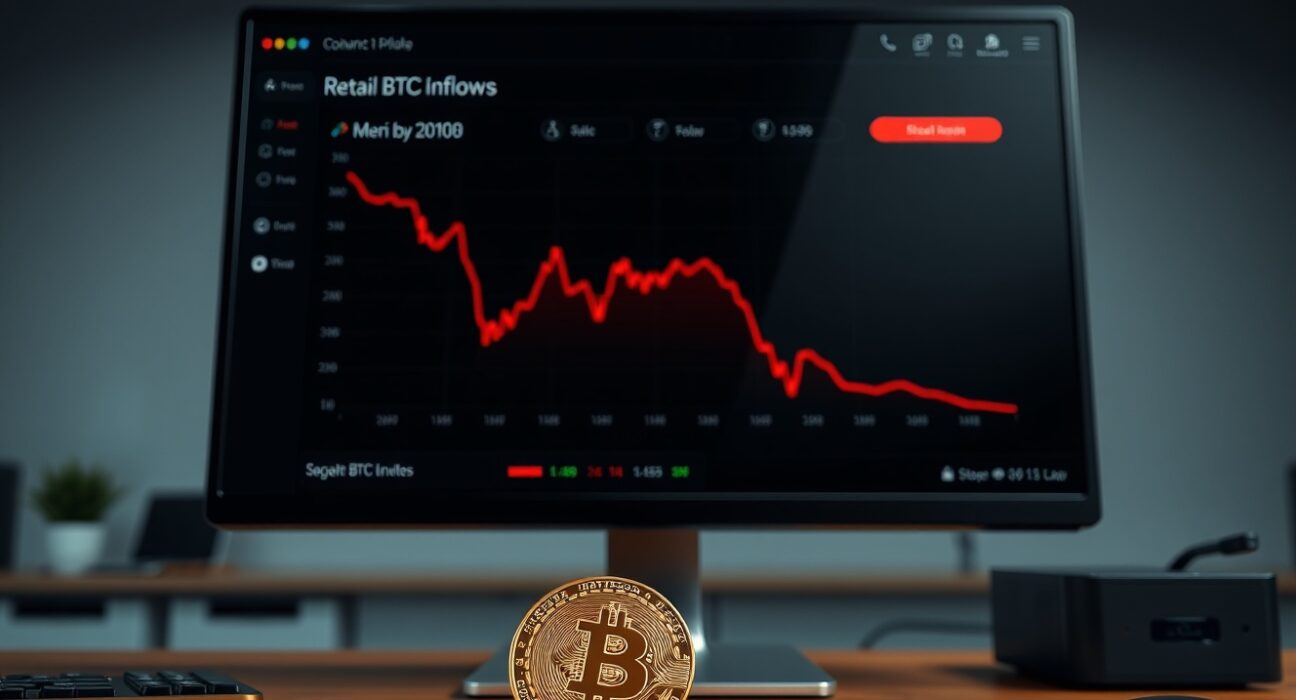
New data reveals a startling collapse in Bitcoin retail investment activity, with inflows to major exchanges hitting their lowest point in nearly a decade. This dramatic shift, first identified in a recent CryptoQuant analysis, suggests a fundamental change in cryptocurrency market structure. Consequently, experts are now examining the long-term implications for Bitcoin’s decentralized ethos. The trend coincides directly with the explosive growth of institutional investment vehicles like spot Bitcoin ETFs.
Bitcoin Retail Inflows Hit Historic Low
CryptoQuant contributor Darkfost’s analysis provides the core evidence for this market shift. Specifically, the report tracks inflows of less than 1 BTC to Binance, using them as a proxy for retail investor behavior. The 30-day moving average for these small-scale inflows has plummeted to just 332 BTC. This figure represents the lowest level recorded since Binance’s launch in 2017. For clear context, the monthly average for similar retail inflows in January 2024 was approximately 1,000 BTC. Therefore, current activity sits at roughly one-third of its level from just over a year ago.
This metric serves as a crucial barometer for small investor participation. Historically, retail inflows provided consistent liquidity and trading volume. Their near-disappearance marks a significant departure from previous market cycles. Market analysts consistently monitor these flows to gauge sentiment and predict price movements. The current data indicates a profound disengagement from the traditional retail base.
The Driving Forces Behind the Retail Exodus
Several interconnected factors are contributing to this pronounced decline in retail exchange activity. First, the regulatory landscape for cryptocurrency exchanges has intensified globally. Stricter Know Your Customer (KYC) and Anti-Money Laundering (AML) policies have added friction for casual users. Second, the macroeconomic environment of high interest rates has redirected disposable income. Many potential retail investors are prioritizing savings and debt repayment over speculative assets.
Third, and most significantly, is the impact of spot Bitcoin Exchange-Traded Funds (ETFs). These financial products, approved in the United States in early 2024, offer a regulated, familiar avenue for exposure to Bitcoin. Investors can now buy shares through traditional brokerage accounts without managing private keys or navigating crypto exchanges. This convenience factor cannot be overstated for mainstream adoption.
- Regulatory Hurdles: Increased compliance demands on exchanges deter casual users.
- Economic Pressure: High inflation and interest rates reduce risk appetite.
- ETF Accessibility: Spot Bitcoin ETFs provide a simpler, regulated alternative.
- Market Maturity: The asset class is shifting from speculative trading to long-term holding.
Expert Analysis on Ownership Concentration
Darkfost’s report raises a critical concern: the potential centralization of Bitcoin ownership. When retail investors move their holdings off exchanges or access Bitcoin solely through ETFs, ownership consolidates. The ETFs themselves hold massive Bitcoin reserves in custody for their shareholders. This process fundamentally alters the distribution of the network’s native asset. While Bitcoin’s protocol remains decentralized, its ownership structure may be trending toward concentration.
Historical data supports this observation. Previous bull markets featured strong retail inflows during price peaks. The absence of such activity now, despite higher price levels, is unprecedented. This suggests a new paradigm where institutional capital dictates market direction. The table below illustrates the stark contrast in inflow patterns.
| Period | Approx. Retail Inflow (30-day avg.) | Market Context |
|---|---|---|
| Jan 2024 | ~1,000 BTC | Pre-ETF approval speculation |
| Present (2025) | ~332 BTC | Post-ETF, mature market phase |
| 2017 Peak | Multiple thousands of BTC | Retail-driven mania phase |
Broader Market Implications and Future Trajectory
The decline in retail exchange inflows carries substantial implications for market dynamics. Exchange liquidity, particularly on the bid side, may become more fragile without consistent small deposits. This could potentially lead to increased volatility during sell-offs. Furthermore, exchange revenue models reliant on retail trading fees face new pressures. Platforms may need to pivot further toward institutional services and custody solutions.
However, this trend does not necessarily signal retail abandonment of Bitcoin. Instead, it may indicate a migration to alternative holding strategies. Many investors are likely moving coins into self-custody solutions like hardware wallets. Others are gaining exposure through the ETF wrapper. The on-chain metric of ‘exchange net flow’—the difference between inflows and outflows—provides a fuller picture. Recent data often shows net outflows, meaning more Bitcoin is leaving exchanges than entering, a sign of accumulation.
The long-term health of the Bitcoin network depends on broad-based ownership. Centralized ownership by a few large entities could, in theory, impact network security and governance perceptions. While the proof-of-work consensus mechanism prevents control of the ledger, concentrated ownership might influence development funding and ecosystem priorities. Community advocates emphasize the importance of continued efforts to improve user-friendly self-custody.
Conclusion
The data on Bitcoin retail inflows presents a clear and transformative market signal. Activity from small-scale investors on major exchanges has effectively vanished, reaching a nine-year low. This trend is largely driven by the successful introduction of spot Bitcoin ETFs, which offer a superior user experience for mainstream investors. While this maturation brings legitimacy and capital, it also raises valid questions about ownership distribution. The market is now navigating a new equilibrium, balancing institutional dominance with the decentralized principles upon which Bitcoin was founded. Monitoring these Bitcoin retail inflows will remain essential for understanding the evolving structure of the entire digital asset ecosystem.
FAQs
Q1: What does “retail inflow” mean in this context?
In this analysis, a “retail inflow” refers to a transaction sending less than 1 Bitcoin (BTC) to a centralized exchange like Binance. Analysts use this threshold to approximate the activity of individual, small-scale investors as opposed to institutions or whales.
Q2: Why are spot Bitcoin ETFs causing lower retail exchange inflows?
Spot Bitcoin ETFs allow people to buy shares that track Bitcoin’s price through a traditional stock brokerage. This is easier and more familiar than using a crypto exchange, which requires setting up a separate account, navigating wallets, and managing private keys. Many investors are choosing the ETF route instead.
Q3: Does low exchange inflow mean retail investors are selling their Bitcoin?
Not necessarily. Low inflow primarily means fewer small investors are depositing Bitcoin *onto* exchanges. This could mean they are holding Bitcoin in personal wallets (self-custody), buying through ETFs instead, or simply not transactively. It is a sign of decreased trading intent, not solely of selling.
Q4: What is the risk of Bitcoin ownership becoming centralized?
If a very small number of entities (like large ETF issuers or funds) hold a majority of Bitcoin, it could, in theory, create systemic risks. It might influence market prices more easily and could lead to conflicts of interest regarding network development and governance, though the underlying blockchain protocol remains decentralized.
Q5: How does this trend affect Bitcoin’s price and volatility?
With fewer retail traders providing constant liquidity on exchanges, the market may become more susceptible to large orders from institutions, potentially increasing short-term volatility. However, long-term price may be more driven by macroeconomic factors and institutional adoption cycles rather than retail trading sentiment.
Disclaimer: The information provided is not trading advice, Bitcoinworld.co.in holds no liability for any investments made based on the information provided on this page. We strongly recommend independent research and/or consultation with a qualified professional before making any investment decisions.