

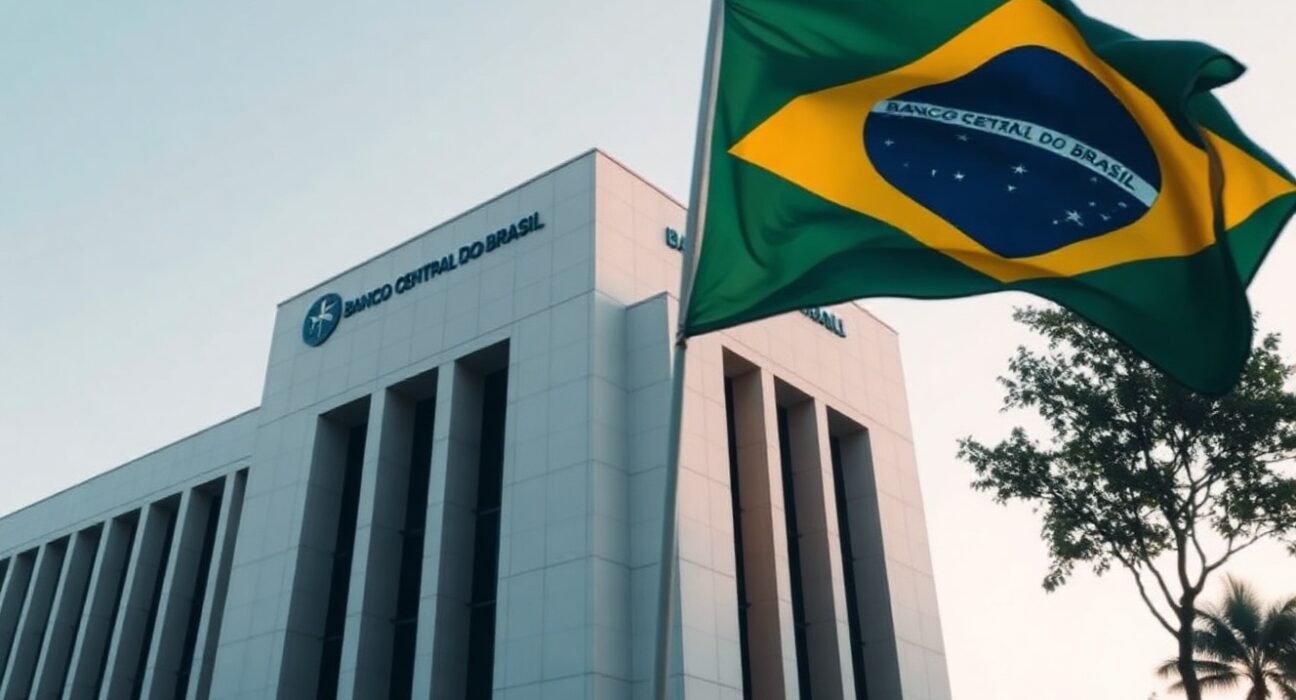
Brazil’s central bank kept its benchmark interest rate unchanged at 14% on Wednesday, in line with market forecasts, as policymakers balance slowing growth against persistent inflation pressures.
Copom Decision in Focus
The Monetary Policy Committee (Copom) unanimously voted to hold the Selic rate at 14% per year, pausing after a series of hikes that began in late 2024. The decision was widely anticipated by analysts, with a Bloomberg survey showing a consensus for no change.
In its statement, the committee signaled that the current level is appropriate for now, but stressed that future moves will depend on inflation data and the evolution of the global economic outlook. The bank has been under pressure to contain inflation, which remains above the official target of 3%, with a tolerance band of 1.5 percentage points.
Inflation and Growth: A Delicate Balance
Brazil’s inflation rate, as measured by the IPCA, stood at 4.5% year-on-year as of January, according to the Brazilian Institute of Geography and Statistics (IBGE). While this is a slowdown from earlier peaks, it still exceeds the central bank’s target, keeping policymakers cautious.
At the same time, economic growth has shown signs of cooling. The central bank’s own Focus report, released earlier this week, projects GDP growth of 1.8% for 2026, down from an estimated 3.5% in 2025. The global environment adds another layer of complexity, with trade tensions and monetary policy shifts in major economies affecting emerging markets.
Why This Matters
For businesses and consumers, the hold means borrowing costs remain high, affecting everything from mortgages to corporate credit. For investors, it signals that the central bank is prioritizing inflation control, even at the risk of slowing growth further. The real has remained relatively stable against the dollar, partly supported by the high interest rate differential.
Market Reaction and Outlook
Following the announcement, the Brazilian real traded slightly stronger, while the benchmark Bovespa stock index showed marginal gains. Analysts at major banks, including Itaú Unibanco and Bradesco, expect the Selic rate to remain at 14% through mid-2026, with a possible cut in the second half if inflation continues to ease.
The central bank’s next meeting is scheduled for May, and all eyes will be on the inflation data due in the coming weeks. The committee reiterated that it will act ‘if needed’ to ensure inflation converges to the target, keeping the door open for either a hike or a cut depending on incoming data.
Conclusion
Brazil’s decision to hold rates at 14% reflects a cautious approach, balancing the need to tame inflation against a slowing economy. With inflation still above target and growth moderating, the central bank is likely to remain on hold for the coming months, awaiting clearer signals from both domestic and international fronts.
FAQs
Q1: Why did Brazil keep its interest rate unchanged at 14%?
The central bank’s Copom held the Selic rate steady to assess the impact of previous hikes on inflation and growth, while signaling it remains vigilant to price pressures.
Q2: What is the current inflation rate in Brazil?
As of January, Brazil’s annual inflation rate was 4.5%, above the official target of 3% but within the tolerance range of 1.5 to 4.5 percentage points.
Q3: What are the expectations for Brazil’s interest rate in 2026?
Most analysts expect the Selic rate to remain at 14% until mid-2026, with a possible reduction in the second half if inflation continues to ease and the economy shows signs of recovery.
Disclaimer: The information provided is not trading advice, Bitcoinworld.co.in holds no liability for any investments made based on the information provided on this page. We strongly recommend independent research and/or consultation with a qualified professional before making any investment decisions.
