

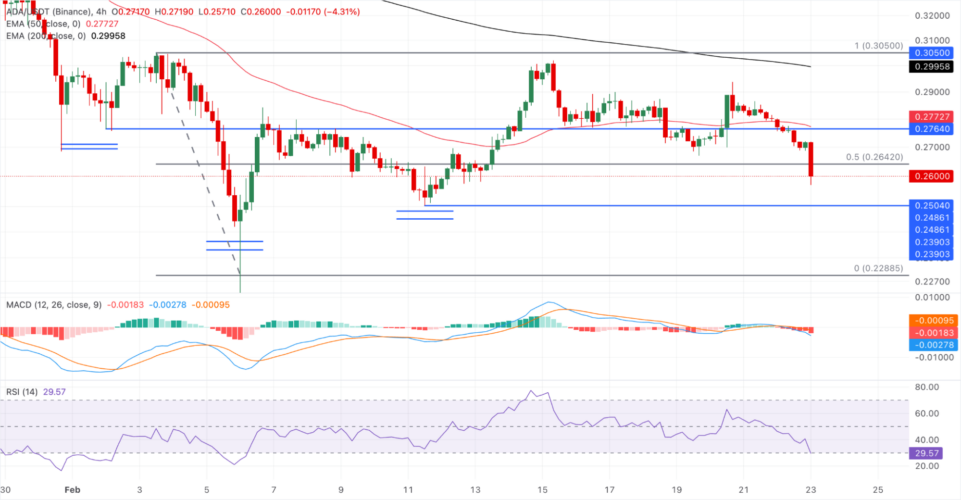
Cardano is extending its losses for a third straight day, trading 4% lower amid macroeconomic uncertainty rattling crypto markets. Fresh concerns over US tariff policies are driving capital out of risk assets, with ADA derivatives data showing forced liquidations of long positions and a funding rate dropping to -0.0138%, indicating traders are increasingly betting on further declines.
Open interest has fallen 4.25% to $424 million, signaling capital withdrawal rather than accumulation. Technical indicators reinforce the bearish picture, with ADA breaking below short-term support and approaching the critical $0.25 level. If that fails, the next floor sits near $0.22, leaving holders searching for alternatives with stronger fundamentals.
Cardano Faces Mounting Headwinds
The broader market correction tied to tariff uncertainties is exposing weaknesses in assets that rely heavily on speculation rather than functional infrastructure. ADA’s price action reflects this, with the 50-period EMA crossing below the 200-period EMA, a pattern traders associate with sustained downside momentum. The Relative Strength Index sits at 30, testing oversold territory, but declining open interest suggests buyers remain hesitant to step in.
Unlike projects generating actual revenue through lending activity or protocol fees, Cardano’s value depends largely on development timelines and narrative momentum, both of which struggle during periods of macro-driven selling pressure. When institutional money rotates away from speculative plays, assets without live revenue models often suffer the deepest cuts.
V1 Protocol Debut
While Cardano traders watch charts for support levels, Mutuum Finance has moved beyond theory into practical execution. The project’s V1 Protocol is now live on the Sepolia testnet, giving users direct access to lending and borrowing mechanics without risking real funds. This testnet version supports USDT, ETH, LINK, and WBTC, allowing participants to explore how the platform handles deposits, collateral management, and automated liquidations.
Users can supply test assets to liquidity pools and receive mtTokens, which are yield-bearing receipts that track interest accrual over time. The borrowing side issues debt tokens that record principal and interest in real time, maintaining transparent on-chain accounting. A built-in stability factor system continuously monitors collateral levels, triggering liquidations if positions fall below required thresholds.
This live testing environment, combined with a completed Halborn Security audit, gives investors confidence that the protocol functions as designed before mainnet deployment. Mutuum Finance is currently priced at $0.04, with more than $20.7 million in funds committed to the project. Over 19,070 investors hold the token.
How Mutuum Finance Works
Mutuum Finance is a decentralized lending protocol that allows users to lend their crypto and earn interest. The protocol uses two lending models:
- Peer-to-Contract (P2C) lending
- Peer-to-Peer (P2P) lending
Peer-to-Contract (P2C) Lending
Peer-to-Contract lending is pool-based. Lenders deposit their assets into shared liquidity pools managed by smart contracts. These funds are then made available to borrowers, who pay interest to access liquidity. In return, the lender earns passive income. If they, for example, deposit $13,000 USDT into the protocol, Mutuum Finance mints 13,000 mtUSDT at a 1:1 ratio. These mtUSDT tokens accrue interest as borrowers repay their loans. If the lending APY is 10%, the lender earns $1,300 in one year. They can withdraw their funds at any time, along with the earned interest, by redeeming the mtUSDT.
Peer-to-Peer (P2P) Lending
Mutuum Finance also supports Peer-to-Peer lending, where lenders and borrowers agree on custom terms. For example, a borrower may lock $30,000 worth of Dogecoin as collateral and borrow $15,000 USDT from a lender at 15% APY for 3 months. The lender earns interest, while the borrower gets liquidity without selling their DOGE.
Staking Rewards Through Buyback Mechanism
Mutuum Finance also offers passive income opportunities through its buyback-and-redistribute model. A portion of protocol revenue generated from lending fees enters the open market to purchase MUTM tokens. These purchased tokens are then distributed to participants who stake mtTokens in designated safety module contracts. This mechanism rewards long-term contributors with additional MUTM tokens without requiring them to sell their original positions.
As Cardano tests support levels amid tariff-driven uncertainty, Mutuum Finance advances with its V1 protocol now live. The testnet launch gives investors a chance to test core platform features, while the token’s fixed supply model protects against dilution, and the buyback mechanism rewards protocol stakers directly.
Disclaimer: The information provided is not trading advice, Bitcoinworld.co.in holds no liability for any investments made based on the information provided on this page. We strongly recommend independent research and/or consultation with a qualified professional before making any investment decisions.