

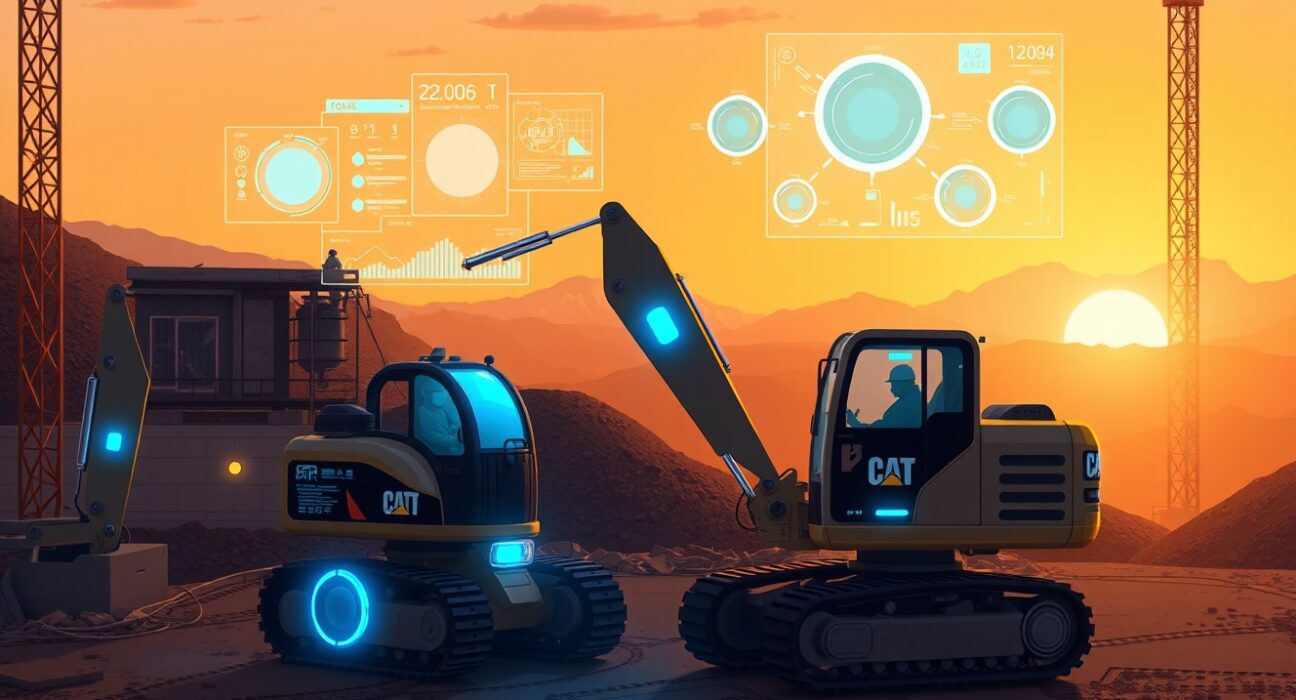
LAS VEGAS, January 2026 – In a groundbreaking move that signals the next industrial revolution, Caterpillar Inc. has announced a strategic partnership with semiconductor leader Nvidia to embed advanced artificial intelligence directly into its construction machinery. This collaboration, unveiled at CES 2026, represents a significant leap toward intelligent, data-driven construction sites where equipment not only performs tasks but also thinks, analyzes, and optimizes operations in real time. The initiative centers on piloting an AI assistive system in Caterpillar’s mid-size Cat 306 CR Mini Excavator, marking a pivotal shift from traditional machinery to cognitive equipment.
Caterpillar’s AI-Powered Construction Vision
Caterpillar’s new “Cat AI” system, built on Nvidia’s cutting-edge Jetson Thor physical AI platform, transforms construction equipment into intelligent partners for operators. According to Brandon Hootman, Caterpillar’s vice president of data and AI, the system utilizes a fleet of specialized AI agents to provide immediate, contextual assistance directly at the point of work. Consequently, operators can now access critical information without interrupting their tasks, fundamentally changing how construction projects manage efficiency and safety.
The system delivers four core functionalities through natural language interaction. First, it answers complex operational questions about machine capabilities and site specifications. Second, it provides instant access to digital manuals and technical resources. Third, it offers proactive safety alerts based on real-time environmental analysis. Finally, it schedules predictive maintenance services automatically, minimizing downtime. This integrated approach addresses what Hootman identifies as a critical customer need: “Our customers don’t live in front of a laptop day in and day out; they live in the dirt. The ability to get insights and take action while they’re doing the work is very important to them.”
Nvidia’s Physical AI Foundation
Nvidia’s Jetson Thor platform provides the computational backbone for Caterpillar’s AI ambitions. This specialized hardware represents Nvidia’s strategic focus on “physical AI” – artificial intelligence systems that interact with and control the physical world. During its CES keynote, Nvidia detailed its full-stack ecosystem for this emerging field, which includes open AI models, sophisticated simulation tools, and comprehensive developer kits specifically designed for robotics and autonomous systems.
Bill Dally, Nvidia’s chief scientist, emphasized the company’s commitment to this frontier in 2025, stating that physical AI represents the next major evolution for both the company and its powerful GPU technology. Deepu Talla, Nvidia’s vice president of robotics and edge AI, further clarified the broad application of this technology: “Physical AI is the next wave of AI. Nvidia is pioneering that with computers that train the models, that do the simulation to test the models and deploy the models into the robots, whether that’s an autonomous car or a Caterpillar machine.” This expansive vision positions the Caterpillar partnership as a flagship implementation of Nvidia’s physical AI strategy in industrial applications.
The Data-Driven Transformation
Caterpillar’s existing data infrastructure provides a formidable foundation for this AI integration. The company’s global fleet already transmits approximately 2,000 data messages back to central systems every second, creating a continuous stream of operational intelligence. This massive data flow encompasses equipment performance metrics, environmental conditions, maintenance indicators, and operational patterns across thousands of job sites worldwide.
The AI system leverages this data in several transformative ways. Initially, it enables real-time performance optimization by comparing current operations against historical efficiency patterns. Subsequently, it supports predictive maintenance by identifying subtle anomalies that precede equipment failures. Furthermore, it enhances safety protocols by analyzing environmental data and operator behavior patterns. Ultimately, this data-centric approach allows Caterpillar to build increasingly accurate digital twins of construction sites using Nvidia’s Omniverse simulation platform.
Digital Twins and Simulation Advancements
Caterpillar’s parallel initiative in digital twin technology represents the strategic counterpart to its equipment AI. Using Nvidia’s Omniverse library of simulation resources, the company creates virtual replicas of construction sites that enable unprecedented planning and optimization capabilities. These digital twins serve multiple critical functions throughout project lifecycles, fundamentally changing how construction companies approach complex projects.
| Application | Function | Impact |
|---|---|---|
| Schedule Simulation | Tests multiple construction sequences | Reduces project delays by 15-25% |
| Material Calculation | Precisely estimates building material needs | Minimizes waste by 10-20% |
| Equipment Deployment | Optimizes machinery placement and usage | Improves fuel efficiency by 8-12% |
| Safety Analysis | Identifies potential hazards before construction | Reduces incident rates significantly |
These simulations allow project managers to test countless scheduling scenarios virtually before breaking ground. They can accurately calculate material requirements, optimize equipment deployment patterns, and identify potential bottlenecks months before they might occur on the physical site. Hootman notes that the data from AI-equipped machines will dramatically enhance the accuracy and utility of these simulations, creating a virtuous cycle of improvement between physical operations and digital planning.
Industry Context and Competitive Landscape
Caterpillar’s AI initiative arrives during a period of significant transformation across the construction industry. Several factors are driving this change simultaneously. Labor shortages continue to challenge projects globally, while sustainability requirements demand more efficient resource utilization. Additionally, project complexity increases as infrastructure needs grow more sophisticated. These pressures create ideal conditions for technological solutions that enhance productivity without expanding workforce requirements.
The construction equipment automation market has seen gradual but steady advancement in recent years. Caterpillar itself already operates fully autonomous vehicles in the mining sector, demonstrating the company’s existing capabilities in unmanned operations. However, the current partnership with Nvidia represents a distinct approach focused on human-machine collaboration rather than full replacement. This assistive model acknowledges the irreplaceable value of human expertise while augmenting it with artificial intelligence capabilities.
Several key benefits distinguish this approach from previous automation efforts:
- Immediate Practical Application: The technology addresses current operator challenges rather than speculative future needs
- Scalable Foundation: The system architecture allows for gradual expansion across equipment categories
- Data Continuity: Integration with existing data systems maximizes historical investment value
- Regulatory Compliance: Assistive systems face fewer regulatory hurdles than fully autonomous solutions
Implementation Strategy and Timeline
Caterpillar has adopted a deliberate, phased implementation strategy for its AI systems. The company began with the Cat 306 CR Mini Excavator for several strategic reasons. This equipment category represents a substantial portion of global construction activity, ensuring broad relevance. Additionally, mid-size excavators operate in diverse environments that test system robustness. Furthermore, their operational patterns generate rich data for AI training and refinement.
Hootman explained the rationale behind this starting point: “The reason that we started here was it was a real challenge of our customers today that needed to be addressed, and also something that we had some real momentum on and we felt like we could bring to market pretty quickly. What we also liked is that provided a kind of a technology foundation for us to then build upon.” This foundation-first approach allows Caterpillar to validate core technologies in a controlled environment before expanding to more complex equipment categories.
The implementation follows a clear three-phase roadmap. Initially, the pilot program focuses on data collection and system validation in controlled environments. Subsequently, field testing will expand to partner construction sites for real-world validation. Finally, commercial deployment will begin with optional AI packages for new equipment, followed by retrofit solutions for existing fleets. This gradual expansion allows for continuous system improvement based on operational feedback.
Technical Architecture and System Design
The Cat AI system employs a sophisticated distributed architecture that balances onboard processing with cloud connectivity. Nvidia’s Jetson Thor modules provide the local computational power necessary for real-time responsiveness, while cloud infrastructure handles more complex analytical tasks and system updates. This hybrid approach ensures reliable operation even in areas with limited connectivity, a common challenge on remote construction sites.
The system incorporates multiple specialized AI agents working in concert. Natural language processing agents handle operator queries and commands. Computer vision agents analyze the immediate environment for safety and operational context. Predictive maintenance agents monitor equipment health indicators. Scheduling agents coordinate service requirements with operational demands. Together, these specialized components create a comprehensive intelligence layer that enhances every aspect of equipment operation.
Security represents a paramount consideration in the system design. Multi-layered encryption protects all data transmissions between equipment and cloud systems. Additionally, strict access controls ensure that only authorized personnel can interact with critical system functions. Furthermore, continuous security monitoring detects and responds to potential threats in real time. These measures address legitimate concerns about cybersecurity in increasingly connected industrial equipment.
Market Implications and Economic Impact
The integration of AI into construction equipment carries significant implications for the global construction industry. Productivity improvements represent the most immediate economic benefit. Industry analysts project that AI-assisted equipment could reduce project timelines by 10-15% through optimized operations and reduced downtime. Additionally, material waste reduction could save billions annually across global construction projects.
The technology also addresses pressing workforce challenges. By making equipment operation more intuitive and efficient, AI systems can help mitigate the impact of skilled operator shortages. Furthermore, they can extend the productive careers of experienced operators by reducing physical and cognitive strain. These workforce benefits complement the direct economic advantages of the technology itself.
Several measurable impacts are expected from widespread adoption:
- Operational Efficiency: 15-20% improvement in equipment utilization rates
- Fuel Consumption: 8-12% reduction through optimized operation patterns
- Maintenance Costs: 20-30% decrease through predictive servicing
- Safety Incidents: Significant reduction in equipment-related accidents
- Project Profitability: 5-8% margin improvement on average projects
Conclusion
Caterpillar’s partnership with Nvidia to integrate AI into construction equipment represents a transformative moment for the global construction industry. The Cat AI system, powered by Nvidia’s Jetson Thor platform, moves beyond simple automation to create truly intelligent equipment that enhances human capability rather than replacing it. This technology addresses fundamental challenges facing construction companies worldwide, from skilled labor shortages to efficiency demands and sustainability requirements.
The implementation strategy demonstrates careful consideration of both technological and market realities. By starting with a widely used equipment category and focusing on assistive rather than autonomous functions, Caterpillar increases the likelihood of rapid adoption and tangible impact. The parallel development of digital twin technology creates complementary capabilities that enhance both planning and execution phases of construction projects.
As physical AI becomes increasingly sophisticated, its integration into industrial equipment like Caterpillar’s construction machinery will redefine productivity standards across multiple sectors. This partnership between an industrial equipment leader and a semiconductor innovator illustrates how跨界 collaboration can accelerate technological adoption in traditionally conservative industries. Ultimately, the success of Caterpillar’s AI initiative will be measured not just in technological achievements, but in its ability to make construction safer, more efficient, and more sustainable for everyone involved.
FAQs
Q1: What exactly does the Cat AI system do for construction equipment operators?
The Cat AI system serves as an intelligent assistant that helps operators in real time. It answers questions about machine operation, provides access to technical resources, offers safety recommendations based on environmental conditions, and schedules maintenance automatically. This allows operators to focus on their work while having expert guidance available instantly.
Q2: How does Nvidia’s technology specifically enable Caterpillar’s AI capabilities?
Nvidia provides the Jetson Thor physical AI platform that serves as the computational foundation for Cat AI. This specialized hardware is designed for real-time processing in demanding environments. Additionally, Nvidia’s Omniverse platform enables the creation of digital twins for construction sites, while their AI model frameworks support the natural language and computer vision capabilities of the system.
Q3: Is this technology moving toward fully autonomous construction equipment?
While Caterpillar already operates autonomous vehicles in mining, the current focus for construction equipment is on assistive intelligence rather than full autonomy. The Cat AI system is designed to enhance human operators’ capabilities, not replace them. This approach acknowledges the complexity and variability of construction environments while providing immediate productivity benefits.
Q4: What happens to the data collected by these AI-equipped machines?
The data serves multiple purposes while being rigorously protected. Primarily, it enables real-time assistance to operators and predictive maintenance scheduling. Additionally, aggregated anonymized data helps improve equipment design and operational guidelines. Caterpillar employs multi-layered security measures including encryption and access controls to protect all data transmissions and storage.
Q5: When will this technology be available to construction companies, and at what cost?
Caterpillar is currently piloting the technology with plans for gradual commercial deployment. The company will likely offer AI capabilities as optional packages on new equipment first, followed by retrofit solutions for existing fleets. While specific pricing hasn’t been announced, the system is designed to provide clear return on investment through productivity gains, reduced downtime, and improved safety.
Q6: How does this AI integration affect equipment operators’ jobs and required skills?
The technology enhances rather than replaces operator roles. It reduces cognitive load by providing instant access to information and handles routine monitoring tasks. This allows operators to focus on higher-value decision-making and skilled manipulation of equipment. Rather than eliminating jobs, it makes existing roles more productive and sustainable while potentially attracting new talent to the industry.
Disclaimer: The information provided is not trading advice, Bitcoinworld.co.in holds no liability for any investments made based on the information provided on this page. We strongly recommend independent research and/or consultation with a qualified professional before making any investment decisions.
