
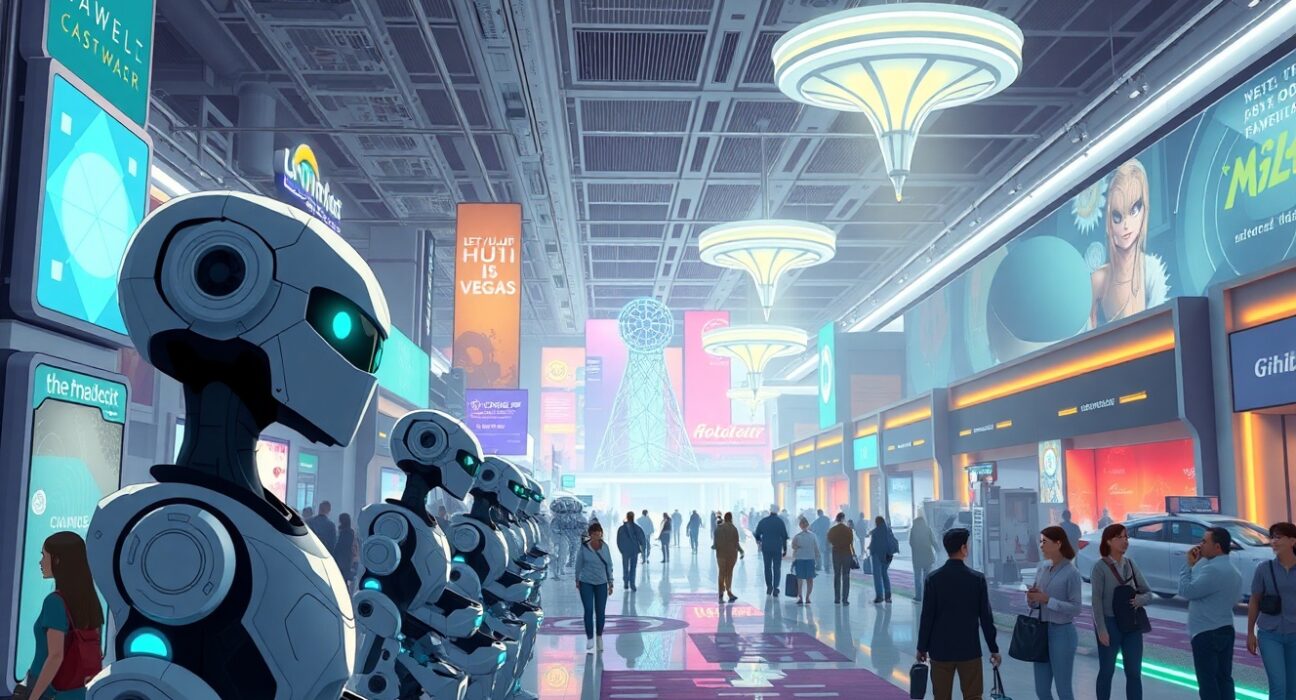
LAS VEGAS, January 9, 2026 – The Consumer Electronics Show 2026 concludes today with unprecedented demonstrations of artificial intelligence integration and robotics that promise to transform daily life. Bitcoin World’s on-ground reporting team captured every significant development from the Las Vegas Convention Center, where AI dominated conversations across hardware, transportation, and home automation sectors. Major announcements from industry leaders like Nvidia, AMD, Amazon, and Google established clear trajectories for AI’s physical world applications throughout the coming decade.
CES 2026 Establishes AI Robotics as Mainstream Reality
The convention floor demonstrated remarkable progress in practical robotics applications. LG’s CLOi home robot represents a significant leap toward automated domestic management. This AI-powered assistant handles complex household tasks including laundry folding, meal preparation, and home security monitoring. Industry analysts note that CLOi’s capabilities reflect five years of accelerated development in computer vision and manipulative robotics. Consequently, manufacturers now target mainstream consumer adoption within three years. Similarly, multiple startups displayed specialized service robots for healthcare, retail, and logistics applications. These developments indicate robotics transitioning from industrial settings into everyday environments.
Transportation Breakthroughs Redefine Electric Mobility
Electric vehicle technology witnessed transformative announcements at CES 2026. Finnish startup Donut Lab unveiled its production-ready solid-state battery that achieves full charge in five minutes. This breakthrough addresses the most significant barrier to EV adoption: charging time anxiety. Solid-state batteries utilize solid electrolytes instead of liquid ones, providing greater energy density and enhanced safety. Donut Lab’s battery delivers 600 kilometers per charge while maintaining stability across extreme temperatures. The technology will debut in Verge Motorcycles’ TS Pro and TS Ultra models this year. Meanwhile, Ford announced its forthcoming AI assistant for vehicle integration by 2027. The automaker also previewed its next-generation BlueCruise advanced driver-assistance system, targeting eyes-off highway driving by 2028.
| Company | Technology | Availability |
|---|---|---|
| Donut Lab | Solid-State EV Battery | 2026 |
| Ford | AI Vehicle Assistant | 2027 |
| Infinite Machine | P1 Electric Scooter | Available Now |
| Waymo | Zeekr Robotaxi Rebrand | 2026 |
Industry Experts Weigh AI’s Ethical Implications
Beyond product announcements, CES 2026 featured crucial discussions about artificial intelligence’s societal impact. Actor and entrepreneur Joseph Gordon-Levitt delivered pointed criticism during the Variety Entertainment Summit. He emphasized that business incentives, not technology itself, potentially lead toward problematic outcomes. Gordon-Levitt specifically addressed content theft concerns surrounding large language model training. His comments resonated with audience members who applauded his call for consent and compensation frameworks. These conversations reflect growing industry awareness about responsible AI development. Meanwhile, Aurora CEO Chris Urmson and Hirschbach Motor Lines president Richard Stocking discussed autonomous trucking’s regulatory and implementation challenges. Their dialogue highlighted the complex intersection of technology, infrastructure, and policy required for widespread adoption.
Consumer Electronics Embrace AI Integration
Manufacturers demonstrated sophisticated AI integration across consumer products. Anker’s eufyMake E1 UV printer represents accessible customization technology for small businesses. The $2,299 device prints directly onto various materials using UV-curable inks. Kickstarter funding exceeded $46 million, indicating strong market demand. Similarly, Vocci entered the competitive note-taking ring market with a device featuring five-meter range and eight-hour recording. The under-$200 product targets professionals seeking discreet meeting documentation. Viaim expanded beyond AI earbuds with a battery-powered conference room speaker offering real-time transcription and translation. These products illustrate AI’s transition from novelty to utility across multiple price points.
- Accessibility: Premium technologies now reach broader consumer markets
- Specialization: Products target specific professional and personal use cases
- Interconnectivity: Devices increasingly function within integrated ecosystems
- Sustainability: Energy efficiency and durability receive greater emphasis
Entertainment and Media Adapt to Streaming Realities
The entertainment sector revealed strategic adaptations to fragmented viewing habits. Fox Entertainment CMO Darren Schillace detailed multi-platform distribution strategies during his CES presentation. He explained how Fox places content across broadcast, streaming services, and YouTube to maximize audience reach. The executive specifically cited “Doc” as a successful case study. The medical drama initially attracted older viewers through traditional broadcast before finding younger audiences on Netflix and Hulu. Schillace emphasized total viewership metrics over demographic exclusivity. This approach reflects broader industry recognition that content must travel where audiences already congregate. Meanwhile, AMC Networks previewed its Silicon Valley-focused series, indicating continued interest in tech-themed entertainment.
Gaming and Computing Push Performance Boundaries
Gaming hardware manufacturers announced significant expansions at CES 2026. Backbone confirmed plans to move beyond mobile controllers with its upcoming Backbone Pro device. The company’s founder indicated 2026 would mark a major business phase transition. Although details remain confidential, industry observers anticipate expanded compatibility with consoles and cloud gaming services. Simultaneously, Nvidia and AMD made substantial AI hardware announcements that will influence gaming and professional applications. These developments suggest converging trajectories between consumer entertainment and professional computation markets. The increased processing power enables more sophisticated AI features within games and creative software.
Conclusion
CES 2026 established artificial intelligence and robotics as foundational technologies across consumer electronics, transportation, and home automation. The Las Vegas event demonstrated remarkable progress toward practical, accessible implementations that address genuine consumer needs. From five-minute EV charging to AI-powered home assistants, the showcased innovations promise tangible lifestyle improvements within immediate timeframes. However, concurrent discussions about ethical development and appropriate compensation frameworks indicate industry maturation beyond pure technological advancement. As CES 2026 concludes, the clear trajectory points toward increasingly integrated, intelligent, and responsive technologies that will redefine human-machine interaction throughout the coming decade.
FAQs
Q1: What was the most significant announcement at CES 2026?
Donut Lab’s solid-state EV battery represents the most transformative announcement, potentially eliminating charging time as a barrier to electric vehicle adoption with its five-minute full charge capability.
Q2: How does LG’s CLOi robot differ from previous home assistants?
CLOi demonstrates advanced manipulative capabilities for physical tasks like laundry folding and meal preparation, moving beyond voice interaction to actual household chore automation.
Q3: When will Ford’s AI assistant become available in vehicles?
Ford plans to debut its AI assistant in smartphone apps first, with vehicle integration scheduled for 2027 models, followed by enhanced autonomous features in 2028.
Q4: What makes solid-state batteries superior to lithium-ion batteries?
Solid-state batteries offer greater energy density, faster charging, improved safety with non-flammable electrolytes, better performance in extreme temperatures, and longer lifespan before degradation.
Q5: How are entertainment companies adapting to changing viewer habits?
Major networks like Fox now employ multi-platform distribution strategies, placing content across broadcast, multiple streaming services, and social platforms to reach fragmented audiences where they already consume media.
Disclaimer: The information provided is not trading advice, Bitcoinworld.co.in holds no liability for any investments made based on the information provided on this page. We strongly recommend independent research and/or consultation with a qualified professional before making any investment decisions.