
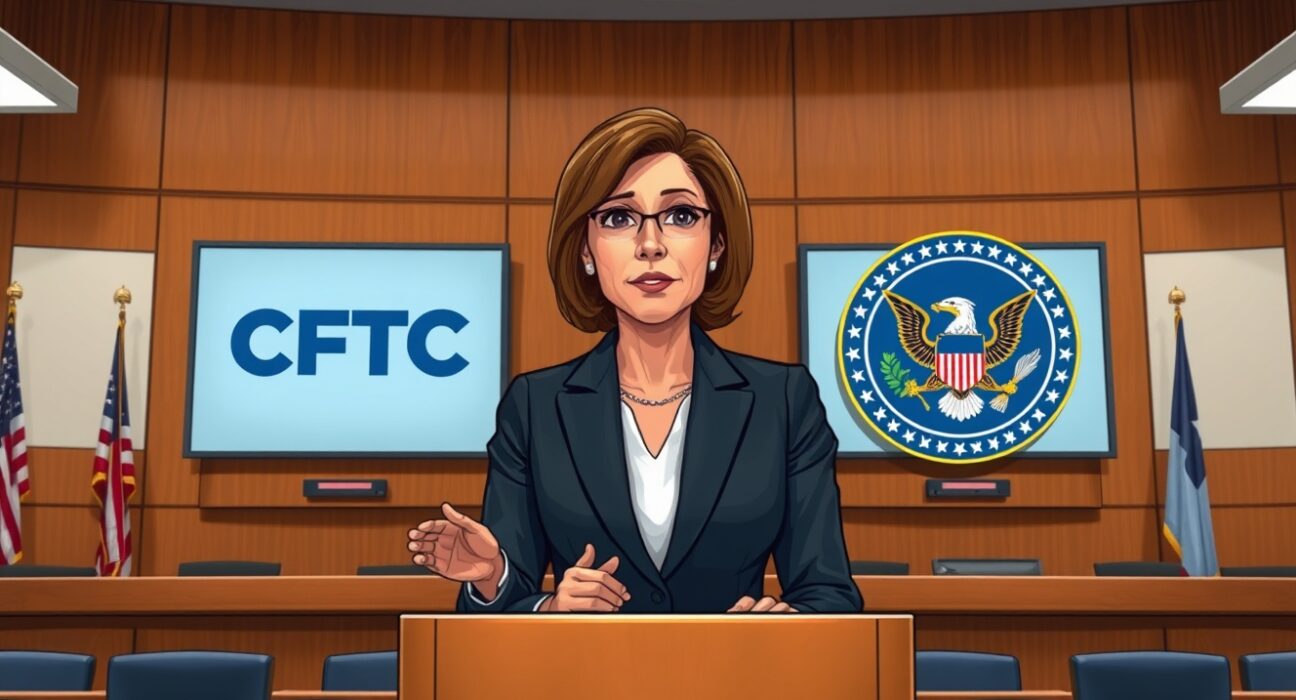
In a significant development for United States financial regulation, CFTC Commissioner Caroline Pham has articulated six compelling reasons why her agency must strengthen cooperation with the Securities and Exchange Commission, particularly regarding digital assets. This call for collaboration, made in Washington D.C. in early 2025, comes amid ongoing confusion over cryptocurrency classification and aims to position America as the global leader in financial innovation.
CFTC Commissioner Outlines Path for SEC Cooperation
Commissioner Caroline Pham recently delivered detailed remarks about the necessity for enhanced collaboration between America’s two primary financial regulators. The Commodity Futures Trading Commission and the Securities and Exchange Commission have historically operated with overlapping yet distinct jurisdictions. This situation has created substantial regulatory uncertainty for market participants, especially within the rapidly evolving cryptocurrency sector. Pham’s framework specifically addresses this challenge by proposing concrete areas for joint action.
Her proposal arrives at a pivotal moment for digital asset markets. Regulatory clarity remains the single largest request from industry participants and institutional investors. Furthermore, the global competitive landscape for financial technology continues to intensify. Jurisdictions like the European Union, with its comprehensive Markets in Crypto-Assets (MiCA) framework, and Singapore have made deliberate efforts to attract blockchain businesses. Pham’s vision directly responds to this competition by advocating for a coherent, modernized U.S. regulatory approach.
The Historical Context of Regulatory Overlap
The relationship between the CFTC and SEC features a long history of jurisdictional discussions. Congress established the SEC in 1934 to regulate securities markets, while the CFTC, created in 1974, oversees commodity futures and derivatives. The digital asset revolution blurred these traditional lines, as tokens can exhibit characteristics of both securities and commodities. This ambiguity has led to high-profile enforcement actions and legal battles, creating a climate of uncertainty that Pham’s proposal seeks to resolve.
Six Pillars of Proposed Regulatory Cooperation
Commissioner Pham’s framework rests on six foundational pillars designed to streamline oversight and foster innovation. Each pillar addresses a specific pain point in the current regulatory environment.
1. Clarifying Commodity and Security Definitions
The foremost issue involves the fundamental classification of digital assets. Pham advocates for joint interpretation and rulemaking to end the persistent confusion over whether a specific token constitutes a security or a commodity. This clarity would provide market participants with the certainty needed for long-term investment and product development. A collaborative approach could prevent contradictory statements from the two agencies, which have previously sowed confusion among entrepreneurs and investors.
2. Modernizing Clearing, Margin, and Collateral Frameworks
Pham’s second point focuses on updating legacy systems for clearing, margin, and collateral. Modernizing these frameworks would allow for greater capital efficiency, which in turn improves market liquidity and leads to better pricing for all participants. This modernization is especially critical for crypto derivatives and complex financial products that do not fit neatly into traditional models. Enhanced efficiency could make U.S. markets more attractive relative to offshore venues.
| Framework | Current Challenge | Potential Benefit of Cooperation |
|---|---|---|
| Clearing | Fragmented, asset-specific systems | Unified standards for digital asset settlements |
| Margin | Inconsistent requirements across venues | Risk-based, product-agnostic models |
| Collateral | Limited acceptance of digital assets | Clear rules for tokenized collateral |
3. Reducing Friction for Dually Registered Entities
Many exchanges, trading platforms, and intermediaries operate under both CFTC and SEC registration. Pham identifies reducing regulatory friction for these entities as a top priority. Overlapping or contradictory requirements create unnecessary burdens and compliance costs. Streamlined processes for dually registered firms would alleviate over-regulation without compromising investor protection. This efficiency could directly lower costs for end-users and encourage more firms to operate within the regulated U.S. ecosystem.
4. Creating a Fit-for-Purpose Crypto Framework
The fourth pillar calls for a regulatory framework specifically designed for cryptocurrency and new technologies. Pham argues that applying decades-old statutes to novel technology creates inefficiencies and stifles innovation. A tailored framework, developed through interagency cooperation, would provide clear rules of the road. This clarity is essential for making the United States the undisputed capital for cryptocurrency innovation and investment, recapturing momentum that has shifted overseas due to regulatory uncertainty.
5. Streamlining Regulatory Reporting
Data reporting represents a significant cost center for regulated firms. Pham proposes coordinating regulatory reporting for transaction data, customer funds, and intermediary activities. A unified or harmonized reporting system would reduce compliance costs dramatically while simultaneously improving the quality and consistency of data available to regulators. Better data enhances market surveillance and systemic risk monitoring, creating a safer environment for all participants.
6. Coordinating Examinations and Enforcement
The final pillar emphasizes operational coordination. Pham advocates for joint cross-market examinations, shared economic analysis, coordinated risk monitoring, and aligned surveillance and enforcement efforts. She notes that cooperation in these areas is inherently stronger, faster, and cheaper than parallel, uncoordinated actions. This approach would maximize regulatory resources and send a consistent message to the market, deterring bad actors more effectively.
The Path Forward: From Memorandum to Action
Commissioner Pham’s remarks build upon a foundation of existing agreements between the agencies. Former SEC Chairman Paul Atkins previously stated that the jurisdictional conflict between the SEC and CFTC had ended, noting the two agencies signed a memorandum of understanding to enhance cooperation. Pham’s six-point plan provides a concrete roadmap to transform that MOU from a statement of intent into actionable policy.
The impact of successful implementation would be profound. Market participants could operate with greater certainty, reducing legal risks and compliance overhead. Investors would benefit from clearer protections and more efficient markets. Perhaps most significantly, the United States could establish a predictable, innovation-friendly regulatory environment that attracts blockchain talent and capital from around the world.
Industry observers note that while the vision is clear, execution will require sustained commitment from leadership at both agencies and potential legislative support from Congress. The detailed nature of Pham’s proposal, however, marks a significant step beyond general statements of cooperation and toward a workable blueprint for the future of U.S. financial regulation.
Conclusion
CFTC Commissioner Caroline Pham has provided a detailed, six-part framework for deepening cooperation between the CFTC and SEC. This proposal directly addresses the critical need for regulatory clarity in cryptocurrency markets while aiming to modernize broader financial frameworks. By focusing on definitional clarity, operational efficiency, and coordinated oversight, the plan seeks to reduce burdens on legitimate businesses and position the United States as the global leader in financial technology. The success of this vision for CFTC and SEC cooperation will significantly influence America’s competitive standing in the digital economy for years to come.
FAQs
Q1: What is the main goal of Commissioner Pham’s proposal for CFTC-SEC cooperation?
The primary goal is to create regulatory clarity and operational efficiency, specifically for cryptocurrency markets, by having the two agencies work together on rulemaking, oversight, and enforcement to eliminate confusion and redundancy.
Q2: Why is clarifying whether a token is a security or a commodity so important?
This classification determines which regulator has primary oversight, what rules apply, and what disclosures are required. Ambiguity creates legal risk for projects, uncertainty for investors, and can stifle innovation as businesses fear enforcement action.
Q3: How would this cooperation help the United States compete globally in crypto?
A clear, coherent regulatory framework developed by the CFTC and SEC would make the U.S. a more attractive jurisdiction for blockchain businesses and investment, helping to reclaim leadership from regions like the EU and Singapore that have moved faster on regulation.
Q4: What did former SEC Chairman Paul Atkins say about agency conflict?
Atkins stated that the jurisdictional conflict between the SEC and CFTC had ended, highlighting that the agencies had already signed a memorandum of understanding to enhance cooperation, which Pham’s plan seeks to operationalize.
Q5: What are “dually registered” entities and how would they benefit?
These are exchanges, brokers, or other intermediaries registered with both the CFTC and SEC. They would benefit from reduced friction through harmonized rules, coordinated examinations, and streamlined reporting, lowering their compliance costs and complexity.
Disclaimer: The information provided is not trading advice, Bitcoinworld.co.in holds no liability for any investments made based on the information provided on this page. We strongly recommend independent research and/or consultation with a qualified professional before making any investment decisions.