

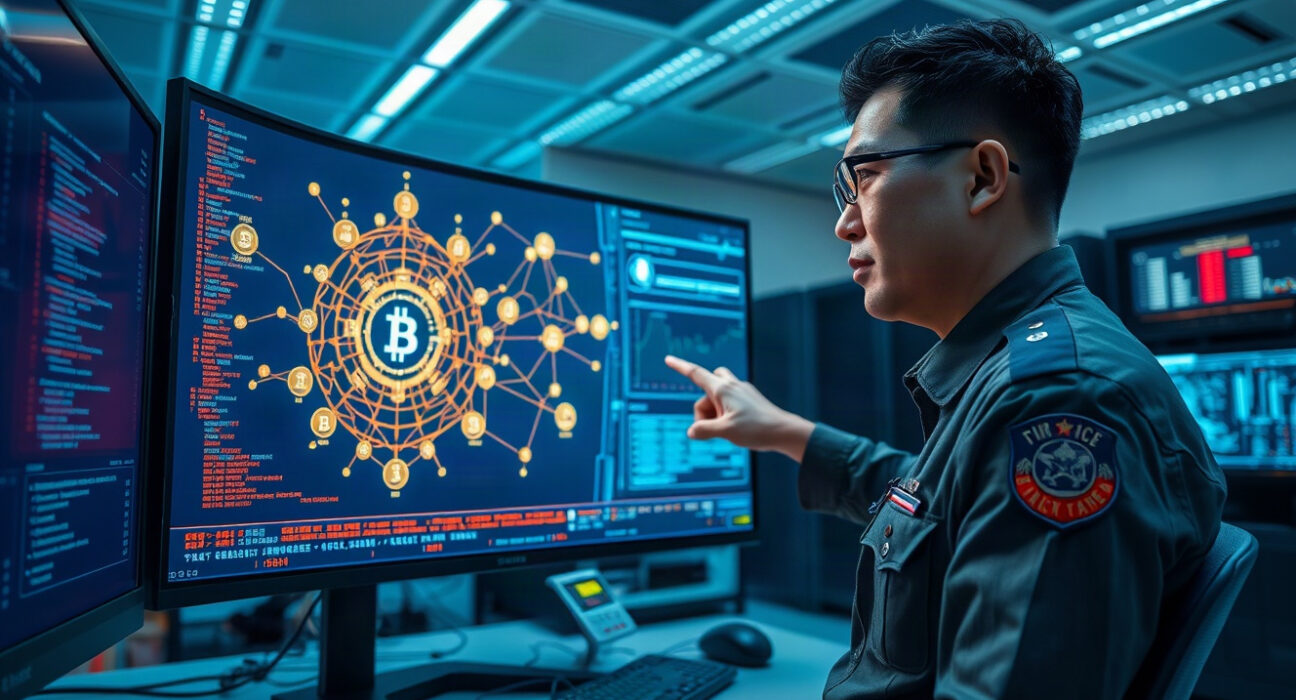
Researchers at China’s National Police University, operating under the Ministry of Public Security, have developed a detection framework that combines artificial intelligence with large language models to identify money laundering and economic crimes involving virtual assets like Bitcoin. According to a report by the South China Morning Post, the system achieves roughly 90% accuracy in flagging suspicious transactions.
How the detection framework works
The algorithm integrates AI-driven pattern recognition with LLM capabilities to analyze transaction flows across blockchain networks. It is designed to spot anomalies indicative of layering, structuring, and other laundering techniques that criminals use to obscure the origin of illicit funds. The system can process vast amounts of on-chain data, identifying behavioral patterns that traditional rule-based systems might miss.
China’s Supreme People’s Procuratorate reported that in 2025 alone, 3,259 people were prosecuted on suspicion of money laundering involving virtual assets and underground finance. This highlights the growing scale of crypto-related financial crime in the country, despite strict government bans on cryptocurrency trading.
Why this matters for global crypto enforcement
The development signals a significant advancement in the use of AI for financial crime detection. While China has taken a hardline stance against cryptocurrency trading, its law enforcement agencies are investing heavily in blockchain forensics. This dual approach—restricting public access while enhancing investigative tools—reflects a broader global trend where regulators and police forces are building sophisticated capabilities to trace digital assets.
For international observers, the algorithm’s reported accuracy could set a benchmark for similar initiatives in other jurisdictions. Western agencies, including the FBI and Europol, have also deployed AI-based tracing tools, but China’s state-backed research may offer a different scale of integration with national security infrastructure.
Implications for financial crime prevention
The use of LLMs in this context is particularly notable. These models can interpret unstructured data, such as transaction memos or communication patterns, to provide context that pure statistical analysis lacks. This allows investigators to build more complete narratives around suspicious activity, improving case preparation and prosecution outcomes.
However, experts caution that the accuracy rate, while impressive, does not imply zero false positives. In practice, law enforcement must still validate algorithmic flags with manual review and legal processes. The system is a tool, not a substitute for judicial oversight.
Conclusion
China’s new AI-powered detection algorithm represents a meaningful step in the fight against crypto money laundering. By combining machine learning with language models, it offers a more nuanced approach to identifying illicit financial flows. As virtual asset crime continues to evolve, such tools will likely become central to global enforcement strategies, even as the regulatory landscape remains fragmented.
FAQs
Q1: How does the algorithm detect crypto laundering?
The algorithm analyzes blockchain transaction data using AI pattern recognition and large language models to identify anomalies typical of money laundering, such as rapid layering or unusual transaction sizes, with about 90% accuracy.
Q2: Is cryptocurrency legal in China?
Cryptocurrency trading and mining are banned in China, but the government has not criminalized holding digital assets. The new detection tool is used to combat illegal activities like money laundering and fraud involving virtual assets.
Q3: What is the significance of the 3,259 prosecutions in 2025?
The figure, reported by China’s Supreme People’s Procuratorate, underscores the scale of virtual asset-related financial crime in the country, demonstrating the need for advanced detection tools and legal enforcement.
Disclaimer: The information provided is not trading advice, Bitcoinworld.co.in holds no liability for any investments made based on the information provided on this page. We strongly recommend independent research and/or consultation with a qualified professional before making any investment decisions.
