

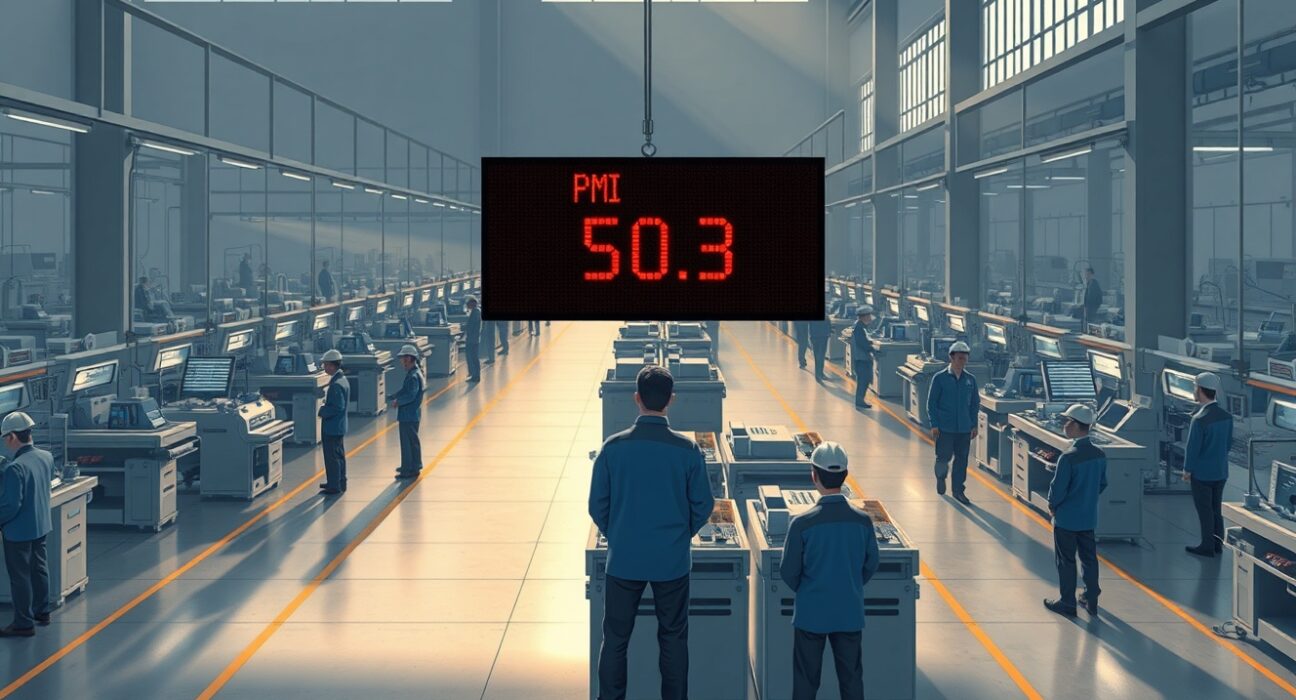
China’s National Bureau of Statistics (NBS) released its latest Purchasing Managers’ Index (PMI) data on April 30, revealing a decline in the Manufacturing PMI to 50.3 in April from 50.8 in March. This drop signals a slowdown in the country’s factory activity. The Non-Manufacturing PMI fell to 49.4, down from 50.6 in the previous month. This marks the first contraction in the services and construction sector since December 2023.
China’s Manufacturing PMI Declines to 50.3: Key Details
The NBS Manufacturing PMI landed at 50.3 for April. This figure remains above the 50-point threshold that separates expansion from contraction. However, the decline from March’s reading indicates weakening momentum in the industrial sector. Analysts had expected a reading closer to 50.5. The actual result fell short of these projections.
Breaking down the sub-indices reveals deeper insights. The production index dropped to 52.2 from 52.7. The new orders index fell to 50.4 from 51.4. The new export orders index slipped to 49.6, entering contraction territory. This suggests that external demand for Chinese goods is softening. The employment index also declined to 48.1, indicating continued job shedding in the manufacturing sector.
Supply chain pressures eased slightly. The supplier delivery time index rose to 50.4, indicating faster deliveries. This reflects lower demand pressures on logistics networks. Raw material inventory levels also fell, with the index dropping to 48.2. This suggests manufacturers are cautious about stockpiling inputs.
Non-Manufacturing PMI Falls to 49.4: Services and Construction in Contraction
The Non-Manufacturing PMI dropped to 49.4 in April, down from 50.6 in March. This reading falls below the 50-point mark. It signals contraction in the services and construction sectors. This is a significant development. The non-manufacturing sector has been a key driver of China’s post-pandemic recovery.
The services business activity index fell to 49.5 from 51.2. This marks the first contraction in services since early 2023. Sectors such as retail, hospitality, and transportation reported weaker demand. The construction index also declined to 49.3 from 50.9. This reflects a slowdown in infrastructure and real estate projects.
New orders in the non-manufacturing sector fell to 47.8. This indicates weak demand. The employment index dropped to 47.6, highlighting ongoing layoffs. Input prices rose to 51.5, suggesting cost pressures persist. However, selling prices fell to 49.1, squeezing profit margins for businesses.
Impact on China’s Economic Recovery
The dual decline in both manufacturing and non-manufacturing PMIs raises concerns about the pace of China’s economic recovery. The country’s GDP grew 5.3% in the first quarter of 2025. However, these April PMI figures suggest that momentum is fading. The property sector remains under pressure. Consumer confidence is fragile. External demand is weakening due to global trade tensions.
The Chinese government has implemented several stimulus measures in recent months. These include infrastructure spending, tax cuts, and monetary easing. However, the PMI data suggests that these measures have not yet fully translated into stronger business activity. The decline in new export orders points to headwinds from global markets. The European Union and the United States have imposed tariffs on Chinese goods. This is affecting export-oriented manufacturers.
Historical Context: Comparing April 2025 with Previous Months
To understand the significance of the April data, it helps to look at recent trends:
- January 2025: Manufacturing PMI 49.1 (contraction), Non-Manufacturing PMI 50.7
- February 2025: Manufacturing PMI 50.1 (expansion), Non-Manufacturing PMI 51.4
- March 2025: Manufacturing PMI 50.8, Non-Manufacturing PMI 50.6
- April 2025: Manufacturing PMI 50.3, Non-Manufacturing PMI 49.4
The manufacturing sector has struggled to maintain consistent expansion. The February reading barely crossed the 50-point threshold. The March reading showed improvement. However, April’s decline suggests that the recovery remains uneven. The non-manufacturing sector’s slide into contraction is particularly concerning. It indicates that domestic demand is weakening.
Expert Analysis: What Economists Are Saying
Economists point to several factors behind the PMI declines. Dr. Li Wei, an economist at the China Center for International Economic Exchanges, noted that “the manufacturing sector is facing headwinds from both domestic and external demand. The property market downturn continues to weigh on construction activity. Consumer spending is not recovering as quickly as expected.”
Zhang Ming, a researcher at the Chinese Academy of Social Sciences, highlighted the impact of trade tensions. “Export orders are declining. This is hurting small and medium-sized manufacturers. The Non-Manufacturing PMI contraction reflects weakness in the services sector. This is linked to lower consumer confidence.”
International institutions have also revised their forecasts. The International Monetary Fund (IMF) recently lowered its 2025 growth projection for China to 4.8%. The World Bank estimates growth at 4.9%. These figures are below the Chinese government’s target of around 5%.
Broader Implications for Global Markets
China’s PMI data has significant implications for global financial markets. The country is the world’s second-largest economy. It is a major trading partner for many nations. A slowdown in China affects commodity prices, supply chains, and global demand.
Oil prices fell following the PMI release. Brent crude dropped 1.2% to $87 per barrel. Copper prices also declined by 1.5%. This reflects concerns about weaker industrial demand from China. Stock markets in Asia showed mixed reactions. The Shanghai Composite Index fell 0.8%. The Hang Seng Index in Hong Kong dropped 1.1%. However, export-oriented markets like South Korea and Taiwan saw gains. This suggests that investors are repositioning their portfolios.
The Chinese yuan weakened slightly against the US dollar. The onshore yuan traded at 7.24 per dollar. This is near its weakest level in five months. A weaker yuan helps Chinese exporters. However, it also increases import costs and capital outflow pressures.
Government Response and Policy Outlook
The Chinese government is expected to respond to the weakening PMI data with additional stimulus measures. The People’s Bank of China (PBOC) has room to cut interest rates further. The reserve requirement ratio (RRR) for banks could also be reduced. These actions would increase liquidity in the financial system.
Fiscal policy measures are also likely. The government may accelerate infrastructure spending. It could also expand tax relief for businesses. Support for the property sector is expected to continue. This includes measures to stabilize housing prices and support developer financing.
However, policymakers face constraints. Inflation, while low, is not a major concern. The consumer price index (CPI) rose just 0.3% year-on-year in March. This gives the PBOC room to ease monetary policy. However, the government is also focused on financial stability. It wants to avoid excessive debt accumulation. This limits the scale of potential stimulus.
Regional Variations: PMI Trends Across Chinese Provinces
The national PMI data masks significant regional variations. Coastal manufacturing hubs like Guangdong, Jiangsu, and Zhejiang reported PMI readings below 50. This indicates contraction. These provinces are heavily reliant on exports. They are feeling the impact of global trade slowdowns.
In contrast, inland provinces like Sichuan and Chongqing reported PMI readings above 50. This suggests that domestic demand is supporting activity in these regions. The government’s push to develop the western regions is showing some results. However, the overall trend is negative.
Sector-Specific Analysis: Manufacturing Sub-Industries
Within the manufacturing sector, performance varied by industry:
- High-tech manufacturing: PMI 52.1 (expansion). This includes electronics, semiconductors, and new energy vehicles. These sectors continue to benefit from government support.
- Consumer goods: PMI 49.8 (contraction). Weak consumer spending is hurting this sector.
- Raw materials: PMI 48.9 (contraction). Lower demand from downstream industries is affecting this segment.
- Equipment manufacturing: PMI 50.6 (expansion). This sector is supported by infrastructure spending.
The divergence between high-tech and traditional manufacturing is notable. It reflects China’s ongoing industrial transformation. The government is prioritizing high-tech industries. However, traditional sectors are struggling.
Comparison with Other Major Economies
China’s PMI data should be viewed in a global context. The US Manufacturing PMI stood at 50.0 in April. The Eurozone Manufacturing PMI was 45.7. Japan’s Manufacturing PMI was 49.2. India’s Manufacturing PMI was 58.8. This shows that China’s manufacturing sector is performing better than many developed economies. However, it is lagging behind India’s strong expansion.
The global manufacturing landscape is mixed. The US economy is showing resilience. Europe is in a prolonged downturn. Asia is experiencing uneven growth. China’s slowdown is a concern. However, it is not an isolated phenomenon.
Conclusion
China’s NBS Manufacturing PMI declined to 50.3 in April. The Non-Manufacturing PMI fell to 49.4. These figures indicate that the country’s economic recovery is losing momentum. The manufacturing sector is still expanding, but at a slower pace. The services and construction sectors have entered contraction. External demand is weakening. Domestic confidence is fragile. The government is expected to implement additional stimulus measures. However, the effectiveness of these measures remains uncertain. The coming months will be critical for China’s economic trajectory. Investors and policymakers will closely watch the May PMI data for signs of stabilization or further deterioration.
FAQs
Q1: What does a PMI reading above 50 mean?
A PMI reading above 50 indicates expansion in the manufacturing or services sector compared to the previous month. A reading below 50 signals contraction.
Q2: Why did China’s Non-Manufacturing PMI fall below 50 in April?
The Non-Manufacturing PMI fell to 49.4 due to weak demand in services and construction. The property sector downturn, lower consumer spending, and reduced infrastructure activity contributed to the decline.
Q3: How does China’s PMI data affect global markets?
China is the world’s second-largest economy. Weak PMI data signals lower demand for commodities and imports. This can lead to falling oil, metal, and stock prices globally. It also affects currencies and trade flows.
Q4: What is the difference between NBS PMI and Caixin PMI?
The NBS PMI surveys large, state-owned enterprises. The Caixin PMI focuses on small and medium-sized private firms. Both provide insights into China’s economic health, but they often show different trends due to their sample compositions.
Q5: Will the Chinese government take action to boost the economy?
Yes, the government is expected to implement more stimulus measures. These may include interest rate cuts, lower bank reserve requirements, increased infrastructure spending, and further support for the property sector.
Disclaimer: The information provided is not trading advice, Bitcoinworld.co.in holds no liability for any investments made based on the information provided on this page. We strongly recommend independent research and/or consultation with a qualified professional before making any investment decisions.
