
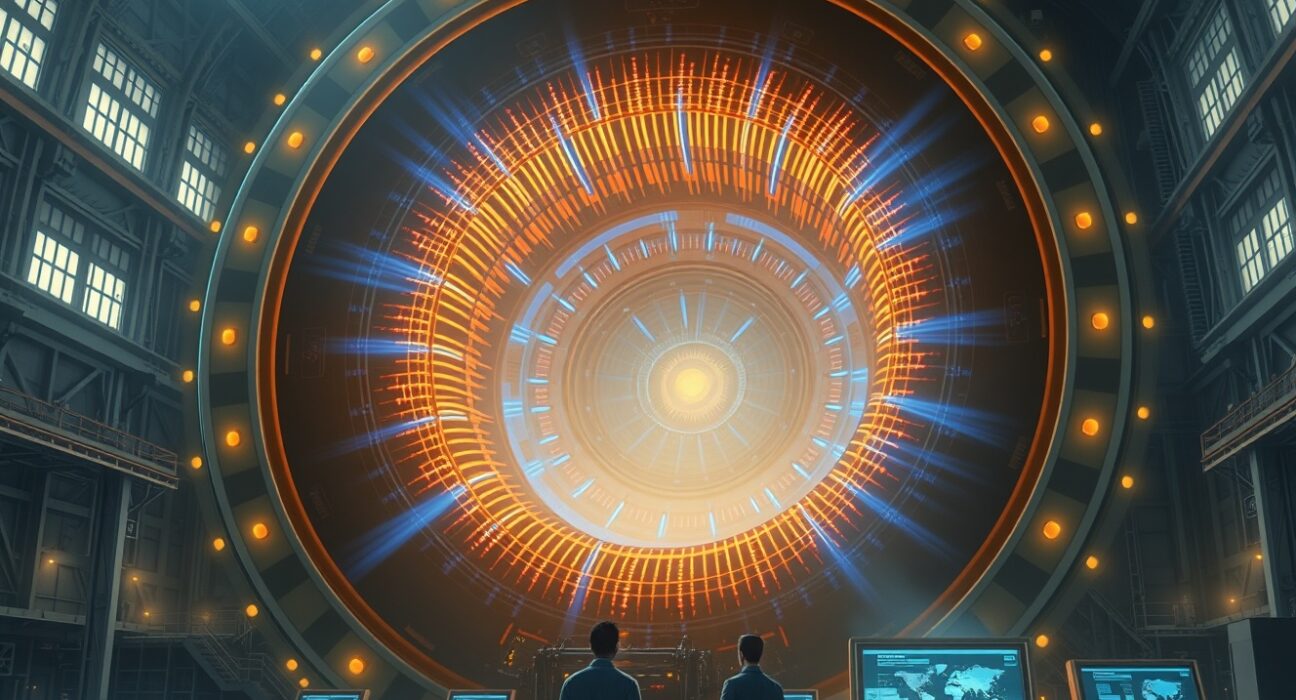
In a significant milestone for clean energy technology, Commonwealth Fusion Systems (CFS) announced at CES 2026 in Las Vegas this Tuesday the installation of the first magnet in its groundbreaking Sparc fusion reactor. This development marks a crucial step toward achieving net energy gain from nuclear fusion, potentially unlocking a nearly limitless source of clean power. Simultaneously, the company revealed a strategic partnership with technology giants Nvidia and Siemens to create a comprehensive digital twin of the reactor, accelerating development through advanced simulation.
Fusion Power Advances with Critical Magnet Installation
Commonwealth Fusion Systems has successfully installed the first of 18 massive magnets that will form the core of its Sparc demonstration reactor. According to CFS co-founder and CEO Bob Mumgaard, this installation represents the beginning of an intensive assembly phase. “It’ll go bang, bang, bang throughout the first half of this year as we put together this revolutionary technology,” Mumgaard stated during the CES announcement. The company anticipates completing all magnet installations by summer’s end, positioning Sparc for potential activation next year.
Each D-shaped magnet presents extraordinary engineering specifications. Weighing 24 tons apiece, these components can generate a magnetic field of 20 tesla—approximately thirteen times stronger than a typical MRI machine. “It’s the type of magnet that you could use to, like, lift an aircraft carrier,” Mumgaard explained. To achieve this remarkable strength, engineers must cool the magnets to -253°C (-423°F), enabling them to safely conduct over 30,000 amps of current while containing plasma burning at temperatures exceeding 100 million degrees Celsius within the reactor’s doughnut-shaped chamber.
The Engineering Marvel of Fusion Containment
The magnet system represents one of fusion energy’s most significant technical challenges: confining superheated plasma long enough for fusion reactions to occur. When complete, the 18 magnets will create a powerful magnetic field that compresses and contains the plasma, preventing it from contacting the reactor walls. This magnetic confinement approach, known as tokamak design, has been refined over decades of international research. CFS’s implementation utilizes high-temperature superconducting tape, a material breakthrough that enables stronger magnetic fields in more compact spaces compared to conventional superconductors.
These magnets mount on a substantial 24-foot wide, 75-ton stainless steel cryostat, which was positioned last March. The cryostat maintains the ultra-cold environment necessary for superconducting operation. This careful engineering balances extreme temperatures—from near-absolute zero for the magnets to stellar temperatures for the plasma—within a single integrated system. Successful operation would demonstrate net energy production, where the fusion reaction releases more energy than required to initiate and sustain it.
Digital Twin Partnership with Nvidia and Siemens
Alongside physical construction, CFS announced a collaborative effort with Nvidia and Siemens to develop a comprehensive digital twin of the Sparc reactor. Siemens provides design and manufacturing software, while Nvidia contributes its Omniverse platform for creating and connecting virtual simulations. This digital replica will run parallel to the physical reactor, allowing engineers to test parameters, predict outcomes, and troubleshoot potential issues before implementing changes on the actual device.
“These are no longer isolated simulations that are just used for design,” Mumgaard emphasized. “They’ll be alongside the physical thing the whole way through, and we’ll be constantly comparing them to each other.” The digital twin approach represents an evolution from previous simulation methods, which examined reactor components in isolation. By creating an integrated virtual model, researchers can better understand how different systems interact under operational conditions.
The partnership leverages Nvidia’s expertise in artificial intelligence and high-performance computing alongside Siemens’ industrial automation experience. This collaboration reflects a growing trend in complex engineering projects, where digital twins reduce development time, lower costs, and improve safety by identifying potential problems before they manifest physically. For fusion energy specifically, where experimental time on actual reactors is extremely valuable and limited, virtual testing provides crucial additional research capacity.
Accelerating Fusion Development Through Simulation
Digital twin technology offers particular advantages for fusion energy development. Fusion reactors operate under conditions so extreme that comprehensive instrumentation proves challenging. Sensors cannot survive inside the plasma chamber, creating data gaps that simulations can help fill. By combining limited physical measurements with detailed computational models, researchers gain more complete understanding of reactor behavior.
CFS has already conducted numerous simulations predicting various reactor components’ performance. However, these existing efforts provided results in isolation. The new integrated digital twin will connect these separate models, creating a holistic virtual representation. “It will run alongside so we can learn from the machine even faster,” Mumgaard noted. This accelerated learning curve could prove crucial in the competitive fusion landscape, where multiple companies race to deliver the first commercially viable fusion power plant.
The company believes artificial intelligence and machine learning advancements will further enhance this approach. “As the machine learning tools get better, as the representations get more precise, we can see it go even faster,” Mumgaard explained, adding urgency stems from climate change imperatives. “Which is good because we have an urgency for fusion to get to the grid.”
The Broader Fusion Energy Landscape
Commonwealth Fusion Systems operates within a rapidly evolving fusion energy sector experiencing unprecedented investment and progress. Multiple private companies and international collaborations now compete to achieve net energy gain and eventually commercial fusion power. The global fusion industry attracted over $6 billion in private investment since 2021, with CFS itself raising nearly $3 billion to date, including an $863 million Series B2 round last August that included investments from Nvidia, Google, and approximately thirty other investors.
This financial backing reflects growing confidence in fusion’s potential to address climate change and energy security concerns. Unlike current nuclear fission reactors, fusion produces minimal long-lived radioactive waste and cannot experience meltdown accidents. Fusion fuel—primarily isotopes of hydrogen—exists abundantly in seawater, offering essentially limitless supply. Successful commercialization could provide constant, carbon-free electricity complementing intermittent renewable sources like solar and wind.
The table below illustrates key differences between fusion and current energy technologies:
| Technology | Fuel Source | Carbon Emissions | Waste Products | Intermittency |
|---|---|---|---|---|
| Fusion Power | Hydrogen isotopes | None during operation | Short-lived radioactive materials | Constant baseload power |
| Nuclear Fission | Uranium/Plutonium | None during operation | Long-lived radioactive waste | Constant baseload power |
| Solar Power | Sunlight | None during operation | Panel disposal challenges | Daytime dependent |
| Natural Gas | Methane | High carbon emissions | Air pollutants | Dispatchable |
Despite promising fundamentals, fusion energy faces substantial challenges before commercialization. Key hurdles include:
- Materials Science: Developing materials that withstand decades of neutron bombardment
- Engineering Scale: Building reactors large enough for net energy production but small enough for economic viability
- Fuel Cycle: Creating sustainable tritium breeding systems (tritium being a hydrogen isotope used in fusion reactions)
- Economics: Reducing costs to compete with established energy sources
CFS’s Development Timeline and Commercial Vision
Commonwealth Fusion Systems follows a phased development approach. The Sparc reactor serves as a proof-of-concept device designed to achieve net energy gain (Q>1). Following successful Sparc operation, CFS plans to build Arc, its first commercial-scale power plant. The company estimates Arc will require several billion dollars in additional investment but could demonstrate fusion’s commercial viability.
CFS and competitors target delivering the first fusion electrons to the electrical grid during the early 2030s. This ambitious timeline represents acceleration from historical fusion projections, driven by technological advances in superconductors, materials, and computing. Private sector involvement has particularly increased development pace, applying startup methodologies to what was traditionally government-led research.
The company’s strategy emphasizes modularity and learning from each development phase. Digital twin technology plays a crucial role in this approach, enabling knowledge transfer between Sparc and subsequent designs. By continuously comparing virtual and physical reactor performance, engineers can refine models that inform future iterations, potentially reducing development cycles for commercial plants.
Conclusion
The dual announcements from Commonwealth Fusion Systems at CES 2026—physical magnet installation and digital twin partnership—represent complementary advances toward practical fusion power. The magnet milestone demonstrates tangible progress in building hardware capable of containing star-like temperatures, while the Nvidia and Siemens collaboration showcases how digital innovation accelerates complex engineering projects. Together, these developments move fusion energy closer to its potential as a transformative clean power source. As the global race to commercialize fusion intensifies, such integrated approaches combining physical engineering with digital simulation may prove decisive in achieving the long-sought goal of limitless, carbon-free energy.
FAQs
Q1: What is the significance of Commonwealth Fusion Systems installing the first magnet in its Sparc reactor?
The magnet installation marks a crucial construction milestone for the experimental fusion device. These magnets create the powerful magnetic field necessary to contain superheated plasma, enabling fusion reactions. Successful operation could demonstrate net energy gain, where fusion produces more power than required to initiate it.
Q2: How does the partnership with Nvidia and Siemens accelerate fusion development?
The collaboration creates a digital twin—a virtual replica of the physical reactor running in real-time simulation. This allows engineers to test parameters, predict outcomes, and identify potential issues computationally before implementing changes on the actual device, significantly accelerating development and learning cycles.
Q3: What makes fusion power different from current nuclear energy?
Fusion combines light atomic nuclei (typically hydrogen isotopes) to release energy, mimicking processes in stars. Unlike nuclear fission (current reactors that split heavy atoms), fusion produces minimal long-lived radioactive waste, uses abundant fuel from seawater, and presents no risk of meltdown accidents.
Q4: When might fusion power become commercially available?
Multiple companies, including Commonwealth Fusion Systems, target delivering electricity to the grid in the early 2030s. However, this timeline depends on successfully demonstrating net energy gain, solving materials challenges, and achieving economic competitiveness with other energy sources.
Q5: Why is fusion energy considered important for addressing climate change?
Fusion could provide constant, carbon-free baseload electricity to complement intermittent renewables like solar and wind. With essentially limitless fuel supply and enhanced safety characteristics compared to fission, successful fusion commercialization would significantly contribute to decarbonizing global energy systems.
Disclaimer: The information provided is not trading advice, Bitcoinworld.co.in holds no liability for any investments made based on the information provided on this page. We strongly recommend independent research and/or consultation with a qualified professional before making any investment decisions.