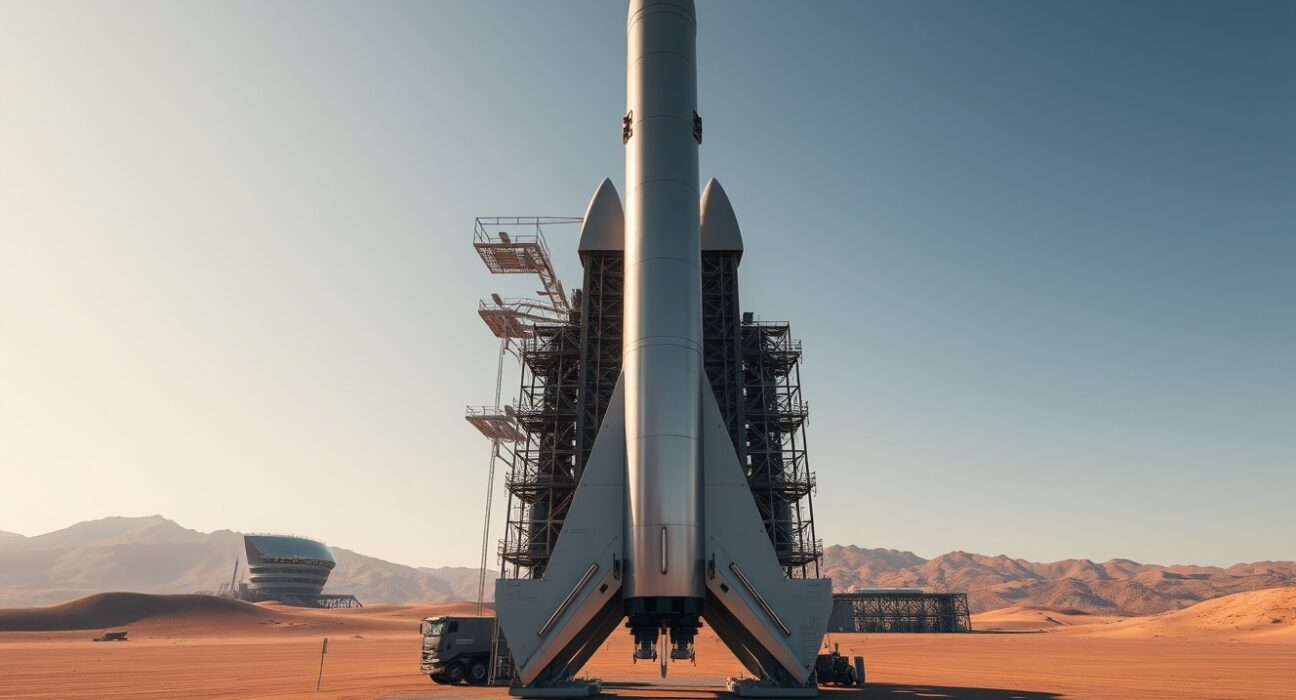
Space-based data centers promise unlimited solar power and low-latency AI compute, but they face a fundamental bottleneck: there simply aren’t enough rockets to put them in orbit. Cowboy Space Corporation, a startup founded by Robinhood co-founder Baiju Bhatt, is tackling that problem head-on by building its own launch vehicles.
A $275 million bet on orbital infrastructure
Today, Cowboy Space announced the close of a $275 million Series B funding round at a post-money valuation of $2 billion. The round was led by Index Ventures, with participation from Breakthrough Energy Ventures, Construct Capital, IVP, and SAIC. The capital will fund the development of a purpose-built rocket designed to deliver data centers directly into low Earth orbit.
Bhatt launched the startup in 2024 under the name Aetherflux, originally focused on beaming solar energy from space to Earth. But the company pivoted after realizing that the same orbital infrastructure could power AI data centers more efficiently. The shift in strategy led to a new name and a far more ambitious engineering challenge: building a rocket from scratch.
Why existing rockets won’t work
Bhatt told Bitcoin World that he spent months talking to launch providers, hoping to find a path where his company could focus solely on building satellites. Instead, he found a market that is already oversubscribed. SpaceX’s Starship, widely seen as the future of heavy lift, is still in testing and may not be commercially available for years due to SpaceX’s own internal satellite deployment needs. Blue Origin’s New Glenn failed to deliver a satellite during its third launch in April, and other startups like Stoke Space, Firefly Aerospace, and Relativity Space have yet to reach operational status.
“There’s a lot of new rockets that are coming online, but as we look three, four years out, it’s still very, very scarce,” Bhatt said. “I think you’re going to see a lot of the first party rocket providers actually specialize into their own payloads.”
That scarcity leaves space data center ventures with two options: target the mid-2030s, as Google’s Suncatcher project is doing, or start with edge processing for space sensors, as Starcloud plans. Cowboy Space chose a third path: vertical integration.
Building data centers into rocket stages
Cowboy Space plans to integrate its data centers directly into the second stage of its rocket, a design that echoes the earliest U.S. satellite, Explorer 1, which was built as the final stage of a Juno rocket. Each satellite will have a mass of 20,000 to 25,000 kilograms and generate 1 megawatt of power for nearly 800 onboard GPUs. That makes the rocket slightly more powerful than SpaceX’s Falcon 9, though smaller than Starship.
Bhatt says the booster will eventually be reusable, and the company has hired veterans from Blue Origin and SpaceX, including former Blue Origin propulsion engineer Warren Lamont and former SpaceX launch director Tyler Grinne. Cowboy Space is also developing its own rocket engine, the most complex and expensive component of any launch vehicle.
The competitive landscape
By building its own rockets, Cowboy Space enters direct competition with SpaceX and Blue Origin, the two most advanced private launch providers in the world. Bhatt acknowledges the challenge but argues that the market is large enough to support multiple players.
“The prize here, and the size of this market, is big enough that there’s room for many players to succeed,” he said. “I see the demand for AI getting more and more acute, and I see the options on Earth getting more and more limited.”
The company still needs to secure facilities for testing, manufacturing, and launching its rockets, and Bhatt expects the first launch before the end of 2028.
Conclusion
Cowboy Space’s $275 million raise represents a high-stakes bet that the future of AI compute lies in orbit, and that the only way to get there is to build the rockets yourself. With launch capacity constrained and demand for AI accelerating, the company’s vertical integration strategy may prove prescient — or it may join the long list of ambitious rocket startups that never reached orbit. Either way, the bet signals that the intersection of space and AI is becoming one of the most capital-intensive frontiers in technology.
FAQs
Q1: Why can’t existing rockets be used for space data centers?
Launch capacity is extremely limited. SpaceX’s Starship is still in testing and may not be commercially available for years, while Blue Origin’s New Glenn has faced repeated delays. Other startups have yet to deliver operational systems, making it difficult for data center operators to secure reliable, cost-effective launches.
Q2: How does Cowboy Space plan to make its rockets cost-effective?
The company is integrating data centers directly into the rocket’s second stage, eliminating the need for a separate satellite deployment system. It also plans to make the booster reusable, which should reduce per-launch costs over time.
Q3: When will Cowboy Space’s first rocket launch?
CEO Baiju Bhatt expects the first launch before the end of 2028. The company is still working on securing testing, manufacturing, and launch facilities.
Disclaimer: The information provided is not trading advice, Bitcoinworld.co.in holds no liability for any investments made based on the information provided on this page. We strongly recommend independent research and/or consultation with a qualified professional before making any investment decisions.