

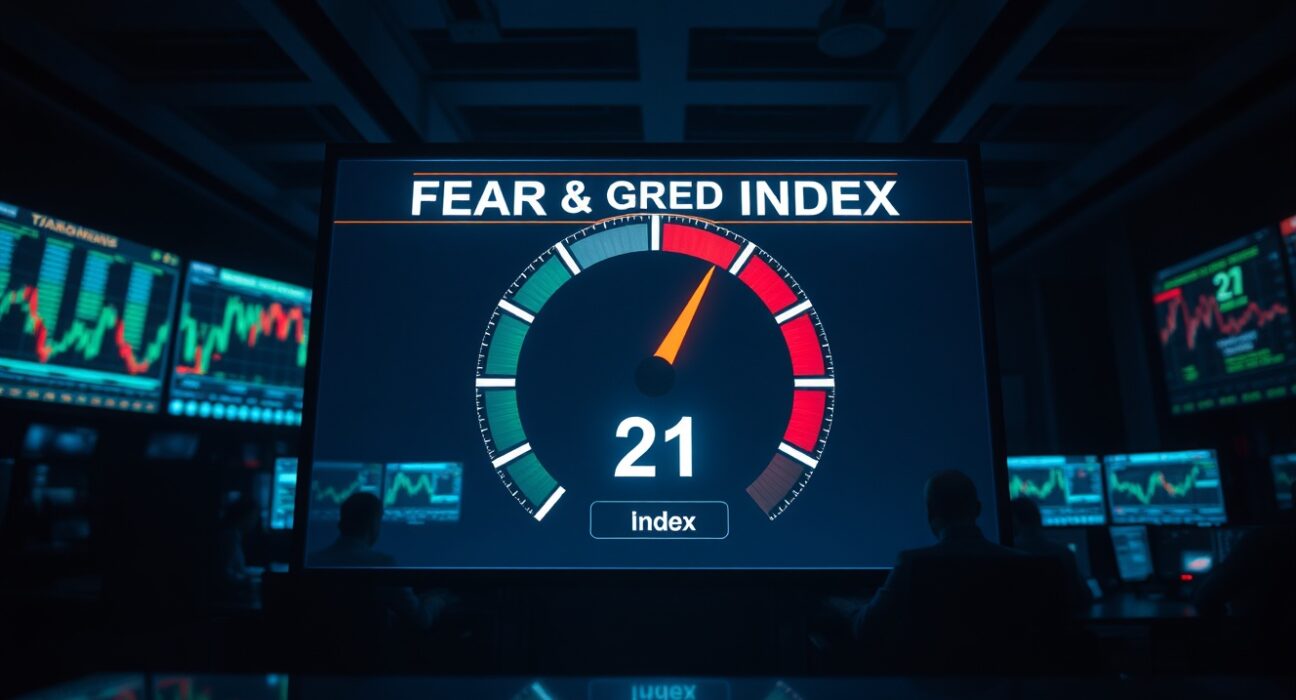
The cryptocurrency market is flashing a caution signal. The Crypto Fear & Greed Index, a widely followed barometer of investor sentiment, has moved to 21, placing it firmly in the ‘fear’ zone. The reading, provided by data aggregator CoinMarketCap, marks a notable shift from the ‘extreme fear’ territory seen in recent weeks, though it still reflects deep unease among market participants.
Understanding the Fear & Greed Index
CoinMarketCap’s index compresses a range of market data into a single, digestible score from 0 to 100. A score of 0 indicates ‘extreme fear,’ suggesting investors are overly pessimistic and potentially selling in panic. Conversely, a score of 100 signals ‘extreme greed,’ a sign of market euphoria that often precedes corrections. The current reading of 21, while still low, represents a slight improvement from the lower reaches of extreme fear, indicating that some of the most acute panic may be easing.
What Factors Drove the Reading
The index is not a single data point but a composite of several weighted factors. According to CoinMarketCap’s methodology, the calculation includes:
- Price Momentum: The deviation of current prices from their moving averages for the top 10 cryptocurrencies by market capitalization.
- Market Volatility: Recent price fluctuations, with higher volatility contributing to a lower score.
- Derivatives Data: The put/call ratio from major exchanges, which measures the volume of bearish bets against bullish ones.
- Stablecoin Supply Ratio (SSR): The ratio of stablecoin supply to Bitcoin’s market cap, indicating potential buying power.
- Search Volume: CoinMarketCap’s proprietary analysis of search trends related to cryptocurrencies.
The move from ‘extreme fear’ to ‘fear’ suggests that while sentiment remains negative, the intensity of the sell-off may be moderating. However, a score of 21 is still historically low and points to a market that is fragile and susceptible to further downside.
Why This Matters for Investors
For traders and long-term holders alike, the Fear & Greed Index serves as a contrarian signal. Historically, periods of extreme fear have often presented buying opportunities for those with a longer time horizon, as they can indicate that the market has priced in the worst-case scenarios. Conversely, extreme greed has frequently preceded market tops. The current ‘fear’ reading suggests that the market is pricing in significant risk, which could stem from macroeconomic headwinds, regulatory uncertainty, or sector-specific events. Investors should view this as a signal to conduct thorough due diligence rather than make impulsive decisions.
Context Within the Broader Market
The shift to ‘fear’ at 21 comes amid a period of sustained volatility across digital assets. Bitcoin, the largest cryptocurrency by market cap, has experienced notable price swings, dragging the broader market with it. Regulatory developments in key jurisdictions, coupled with concerns about interest rates and liquidity, have kept investors on edge. The index’s recalculation, which uses a 30-day rolling average for some components, means that the current reading reflects accumulated stress rather than a single day’s event.
Conclusion
The Crypto Fear & Greed Index at 21 serves as a clear indicator that market sentiment remains predominantly fearful. While a move out of ‘extreme fear’ may offer a glimmer of stabilization, the low score underscores the persistent uncertainty gripping the cryptocurrency space. For readers, the key takeaway is not to trade on sentiment alone but to use such metrics as one tool among many for understanding market psychology and positioning.
FAQs
Q1: What is the Crypto Fear & Greed Index?
The Crypto Fear & Greed Index is a tool that measures the current sentiment in the cryptocurrency market on a scale from 0 (extreme fear) to 100 (extreme greed). It is calculated by CoinMarketCap using factors like price momentum, volatility, derivatives data, and search trends.
Q2: What does a reading of 21 mean?
A reading of 21 falls into the ‘fear’ category, indicating that investors are currently pessimistic. While it is a step above ‘extreme fear,’ it still suggests a high level of caution and potential selling pressure in the market.
Q3: How often is the index updated?
CoinMarketCap updates the Fear & Greed Index daily, reflecting the latest market data. However, some underlying components, such as price momentum, use a 30-day rolling average to smooth out short-term noise.
Frequently Asked Questions
What does a Crypto Fear & Greed Index score of 21 mean?
A score of 21 means the market is in the ‘fear’ zone, indicating that investors are pessimistic and uneasy, though it’s a slight improvement from the lower ‘extreme fear’ levels.
How is the Crypto Fear & Greed Index calculated?
It’s a composite of factors including price momentum, market volatility, derivatives data (put/call ratio), stablecoin supply ratio, and search volume trends.
Is a score of 21 a good time to buy or sell crypto?
A low score like 21 often signals potential buying opportunities for contrarian investors, but it also indicates the market is fragile and could drop further.
Why did the index move from ‘extreme fear’ to ‘fear’?
The move suggests that while sentiment remains negative, the most acute panic may be easing, as some selling pressure has moderated.
Does the index predict future price movements?
No, it measures current sentiment, not future prices; historically, extreme fear can precede recoveries, but it’s not a reliable timing tool.
Disclaimer: The information provided is not trading advice, Bitcoinworld.co.in holds no liability for any investments made based on the information provided on this page. We strongly recommend independent research and/or consultation with a qualified professional before making any investment decisions.
