

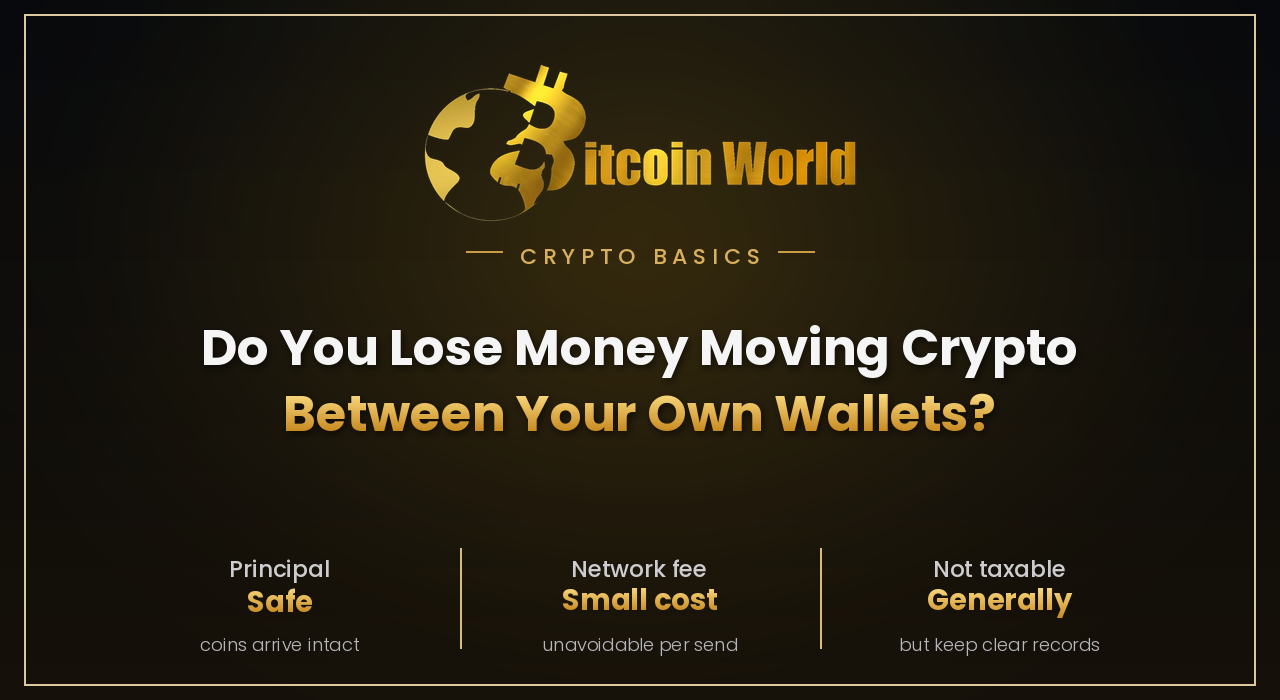
Does Someone Lose Money Every Time They Move Crypto Between Their Own Wallets?
Moving crypto between your own wallets does cost a small amount each time, but not in the way most beginners fear. You never lose the principal – the coins always arrive intact. The only cost is the unavoidable network fee, which goes to miners or validators, not into a void. This article breaks down what you actually pay, why the principal is always safe, what counts as a genuine loss, and the tax position for Indian users.
Does Someone Lose Money Every Time They Move Crypto Between Their Own Wallets?
Moving crypto between your own wallets costs you a network fee each time – but your principal arrives at the destination in full. You’re not losing money; you’re paying a small processing cost.
- Principal is safe: The amount you send reaches your own address intact.
- Fee is the only cost: A small gas or transaction fee is deducted, paid to the network.
- No middleman markup: Unlike a bank transfer, there’s no platform fee on top – just the raw network cost.
- Repeated moves add up: Frequent self-transfers compound the fee cost, so batching is smarter.
What Exactly Do You Pay When Moving Between Your Own Wallets?
The fee structure is simple, but it varies by network.
- Bitcoin: A flat satoshis-per-byte fee based on transaction size, not value.
- Ethereum: A gas fee (base fee + priority tip) set by current network demand.
- Cheap alternatives: Moving USDT on TRC-20 or using a Layer 2 network can cut fees to near zero.
- No recurring charges: Once the transfer confirms, there are no holding fees or custody charges.
When Does Moving Between Own Wallets Actually Hurt?
For small balances, fees can be disproportionate – but the coins themselves are never at risk.
- High fees on small balances: Paying ₹200 in gas to move ₹500 worth of a token is a real cost.
- Frequent unnecessary moves: Every extra hop accumulates fees without adding value.
- Wrong network costs: A network mismatch doesn’t cause principal loss directly but may require additional transfers to fix.
- Smart habit: Consolidate small balances and move infrequently on expensive networks.
What Do Indian Users Need to Know About Fees and Tax?
For users in India, self-transfers have both a cost and a record-keeping implication.
- Not a taxable sale: Moving crypto between your own wallets is generally not a sale and doesn’t trigger income tax – but document both addresses clearly as yours.
- Fees are a real cost: Track your fee spending; it adds up over time and forms part of your cost basis.
- Tax rules evolve: India’s crypto tax framework changes – always confirm the current position with a qualified tax professional.
- Minimize on-chain hops: Use exchanges’ internal transfers or low-fee networks to reduce the cumulative fee drain.
Frequently Asked Questions
Do you lose your actual crypto when you transfer between your own wallets?
No – the principal always arrives intact at your destination address when you move crypto between your own wallets. The only amount you lose is the small network fee paid to miners or validators for processing the transaction. Choosing a low-cost network minimises even that.
How much does it typically cost to transfer crypto between your own wallets?
It depends entirely on the network – Bitcoin fees vary with congestion, Ethereum gas fees can range from a few cents to several dollars, while TRC-20 or Layer 2 transfers often cost fractions of a cent. The fee reflects network demand and transaction complexity, not the amount you’re moving. Checking the estimated fee before confirming is always a good habit.
Is moving crypto between your own wallets taxable in India?
Moving crypto between wallets you own is generally not treated as a sale and shouldn’t trigger income tax, since no profit is realised. However, India’s crypto tax rules are evolving, so keeping clear records that both wallets belong to you is important. Always confirm the current tax position with a qualified professional rather than relying on general guidance.
Conclusion: Why Fees Are a Cost, Not a Loss
The honest answer to whether moving crypto between your own wallets loses you money is: only the network fee, never the principal. For Indian users, that means the coins always arrive safely, the real discipline is minimising unnecessary hops and choosing low-fee networks, and the main record-keeping task is proving both wallets are yours. Treat each self-transfer as a small operating cost to manage wisely, and the math stays firmly in your favour.
Disclaimer: The information provided is not trading advice, Bitcoinworld.co.in holds no liability for any investments made based on the information provided on this page. We strongly recommend independent research and/or consultation with a qualified professional before making any investment decisions.
