

Does Someone Have to Pay Tax If They Only Hold Crypto in India and Never Sell?
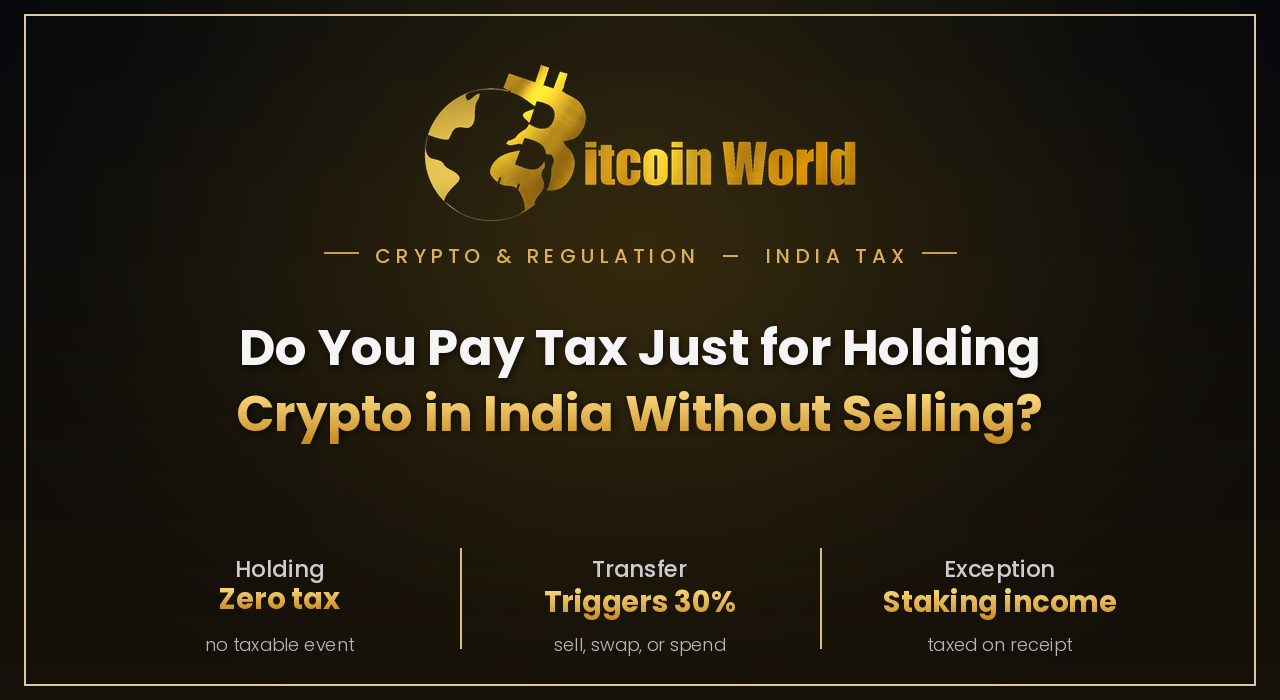
Holding crypto without selling in India triggers zero tax liability – the Income Tax Act 2025 taxes the transfer of a Virtual Digital Asset, not its ownership or appreciation. You can buy Bitcoin today, watch it grow for a decade, and owe the Indian government nothing until the moment you sell, swap, spend, or gift it. This article explains precisely what “holding” means under Indian law, which events do create tax even without selling, and what pure holders are still required to declare in their ITR. Verified against Income Tax Act 2025 and Budget 2026-27.
Does Holding Crypto Without Selling Attract Tax in India?
No – holding crypto without selling creates zero tax liability. The taxable event under Section 115BBH is the transfer of a VDA, not the act of owning one.
- Ownership ≠ taxable event: Buying and holding Bitcoin, Ethereum, or any VDA for any period attracts no tax.
- Unrealised gains not taxed: Even if your portfolio has appreciated by ₹50 lakh on paper, no tax is owed until you dispose of it.
- No wealth tax: India abolished wealth tax in 2015 – there is no annual charge on the value of assets held, including crypto.
- No holding-period advantage: Unlike equity, there is no LTCG benefit for holding longer – the 30% rate applies whenever you eventually sell, whether after one month or ten years.
What Counts as a Taxable “Transfer” – and What Doesn’t?
The critical distinction is between holding and transferring. Many actions beyond a straightforward INR sale constitute a taxable transfer.
- Selling for INR: The clearest case – selling crypto on an exchange and receiving rupees.
- Crypto-to-crypto swap: Exchanging Bitcoin for Ethereum or USDT for Solana – explicitly a taxable transfer, even with no rupees involved.
- Spending crypto: Using crypto to pay for goods or services is a disposal at Fair Market Value.
- Gifting crypto: Transferring crypto as a gift is a taxable transfer for the sender above exemption thresholds.
- Moving between your own wallets: Not a transfer – but you must maintain clear evidence that both wallets belong to you.
When Is Tax Due Even Without a Sale?
A few income events create tax liability before any disposal occurs.
- Staking rewards: Taxable as income from other sources at your applicable slab rate when received – before any sale.
- Mining income: Taxable as income from other sources at slab rates on the date of receipt.
- Airdrops: Free token distributions are taxable at their Fair Market Value on receipt.
- Gifts received above ₹50,000: Crypto received as a gift from a non-relative worth more than ₹50,000 is taxable as income from other sources.
- In all these cases: The FMV at receipt becomes the cost of acquisition for any future transfer.
What Must Pure Holders Still Report in Their ITR?
Holding with no taxable events in the year doesn’t mean zero reporting obligations in all circumstances.
- No Schedule VDA if no transfers: If you bought crypto and made no transfers during the financial year, there is no VDA income to declare in Schedule VDA.
- Foreign asset disclosure required: Holding crypto on a foreign exchange (Binance, Coinbase, Kraken) – if total foreign assets exceed ₹20 lakh – must be disclosed in Schedule FA of the ITR.
- Staking and airdrop income: Must be declared as income from other sources even without any sale.
- Record-keeping is mandatory: Maintain purchase records – date, INR price, exchange, transaction ID – because these form the cost of acquisition for any eventual transfer.
Frequently Asked Questions
Is there any tax in India for holding Bitcoin for multiple years without selling?
No – holding Bitcoin or any other VDA for any period without selling, swapping, spending, or gifting it creates zero tax liability in India. The Income Tax Act 2025 taxes income arising from the transfer of a VDA, not the unrealised appreciation of one. Your tax obligation begins only when you decide to dispose of the asset, regardless of how much it has grown in value.
Does the India crypto tax apply to unrealised gains in a portfolio?
No – India does not tax unrealised crypto gains. Only realised gains arising from an actual VDA transfer are subject to the 30% flat tax under Section 115BBH. Unrealised gains on paper in your wallet or exchange account – profits you haven’t converted or transferred – are not a taxable event under current Indian law.
Does receiving staking rewards in India attract tax even if you don’t sell them?
Yes – staking rewards are taxable as income from other sources at your applicable slab rate at the time of receipt, regardless of whether you sell them. The Fair Market Value of the staking reward on the date credited to your wallet is the taxable amount. Any subsequent sale of those staking rewards is then also subject to the 30% VDA transfer tax on appreciation above that FMV at receipt.
Conclusion: Holding Is Tax-Free – but Every Transfer Comes at a Cost
The answer to whether holding crypto without selling in India attracts tax is clear and reassuring – it does not. But the Income Tax Act 2025 is designed to catch every form of disposal, from obvious INR sales to crypto-to-crypto swaps to spending on goods. For Indian holders, the practical discipline is straightforward: hold as long as you choose, maintain purchase records from day one, declare foreign holdings in Schedule FA where required, and treat every transfer – however informal it feels – as a taxable event. The holding period is free; every exit has a cost.
Disclaimer: The information provided is not trading advice, Bitcoinworld.co.in holds no liability for any investments made based on the information provided on this page. We strongly recommend independent research and/or consultation with a qualified professional before making any investment decisions.
