

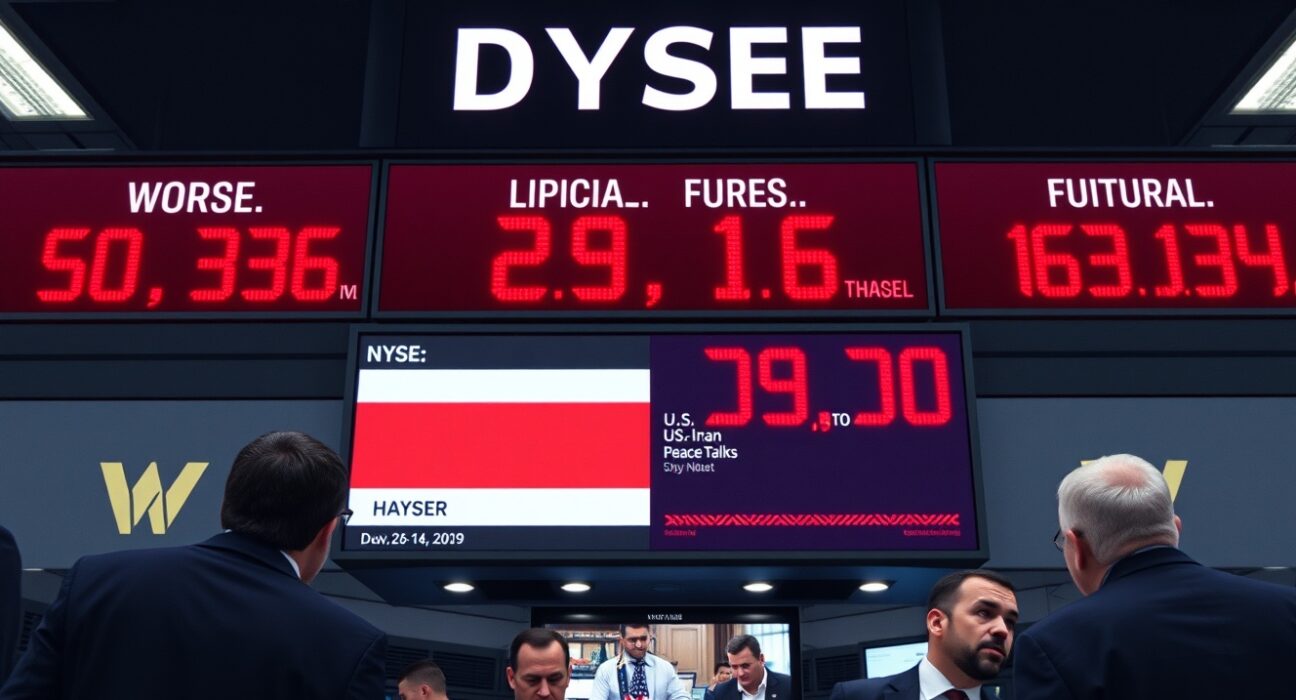
Dow Jones futures remain subdued today as stalled US-Iran peace efforts inject fresh uncertainty into global markets. Investors closely monitor the lack of diplomatic progress, which threatens to escalate geopolitical tensions and disrupt oil supply chains.
Dow Jones Futures Reflect Geopolitical Strain
Stock market futures point to a cautious open for Wall Street. The Dow Jones Industrial Average futures hover near flat, signaling a lack of conviction among traders. The S&P 500 and Nasdaq futures also show minimal movement. This hesitation stems directly from the stalled US-Iran peace efforts. Without a clear path to de-escalation, markets price in higher risk premiums.
Geopolitical risk now dominates trading narratives. Investors shift focus from corporate earnings to diplomatic headlines. The lack of progress in US-Iran talks creates a cloud of uncertainty. This uncertainty suppresses risk appetite across equities. As a result, Dow Jones futures fail to gain upward momentum.
Oil prices climb on the news. Brent crude rises above $85 per barrel. West Texas Intermediate follows suit. Higher energy costs threaten to fuel inflation. This scenario complicates the Federal Reserve’s policy path. Consequently, rate-sensitive sectors like technology and housing face additional pressure.
US-Iran Peace Efforts: A Timeline of Stalled Diplomacy
The US-Iran peace efforts have seen multiple rounds of indirect talks. These negotiations aim to revive the 2015 nuclear deal. However, recent discussions in Vienna hit a deadlock. Key sticking points include sanctions relief and uranium enrichment levels. Iran demands full removal of sanctions. The US insists on verifiable compliance first.
This stalemate prolongs regional instability. Iran’s proxy forces in Yemen, Syria, and Iraq remain active. Attacks on commercial shipping in the Red Sea increase. The US military responds with airstrikes. Each escalation reduces the chance of a diplomatic breakthrough. For markets, this means sustained uncertainty.
Historical context matters. The 2015 deal took two years to negotiate. Its collapse in 2018 triggered oil price spikes. Now, a similar pattern emerges. Traders remember the 2019 attack on Saudi Aramco facilities. That event briefly wiped out 5% of global oil supply. Such memories keep Dow Jones futures anchored to geopolitical news.
Impact on Energy and Defense Stocks
Energy stocks outperform in this environment. Exxon Mobil and Chevron gain in pre-market trading. Defense contractors like Lockheed Martin also attract buyers. These sectors benefit from geopolitical tension. Conversely, airline and cruise stocks face headwinds. Higher fuel costs squeeze their margins.
A short table illustrates sector performance:
| Sector | Pre-Market Change | Key Driver |
|---|---|---|
| Energy | +1.2% | Oil price surge |
| Defense | +0.8% | Geopolitical risk premium |
| Airlines | -0.5% | Fuel cost concerns |
| Technology | -0.3% | Rate hike fears |
This rotation reflects a classic risk-off trade. Investors favor defensive assets. Gold prices edge higher. The US dollar strengthens against emerging market currencies. Bond yields dip as traders seek safety. Dow Jones futures reflect this broader caution.
Oil Prices and Inflation: The Dual Threat
Stalled US-Iran peace efforts directly impact oil markets. Iran holds the world’s fourth-largest oil reserves. Its full return to global markets could add 1.5 million barrels per day. Without a deal, this supply remains offline. The resulting tightness supports prices.
Higher oil prices feed into inflation data. The Consumer Price Index already shows sticky price pressures. The Fed’s preferred inflation gauge, the PCE index, remains above the 2% target. Energy costs ripple through transportation, manufacturing, and utilities. This dynamic complicates the Fed’s rate-cutting timeline.
Market expectations for rate cuts shift. Three months ago, traders priced in four cuts by year-end. Now, only two cuts seem likely. The first cut may not come until September. This repricing weighs on equity valuations. Growth stocks, especially in tech, suffer most. Dow Jones futures capture this sentiment shift.
Expert analysts weigh in. Goldman Sachs strategists note that geopolitical risk typically fades within weeks. However, they warn that the current standoff lacks a clear resolution catalyst. JPMorgan echoes this view. They advise clients to hedge against prolonged uncertainty. Options market activity confirms this advice. Put volume on the S&P 500 rises above the 20-day average.
Global Markets React in Sympathy
European markets open lower. The Stoxx 600 index drops 0.4%. Asian markets also decline. Japan’s Nikkei 225 falls 0.6%. China’s Shanghai Composite slips 0.3%. This global selloff mirrors the US futures weakness. International investors share the same concern about US-Iran peace efforts.
Currency markets reflect risk aversion. The Japanese yen strengthens against the dollar. The Swiss franc also gains. Both currencies serve as traditional safe havens. Emerging market currencies, particularly the Turkish lira and Indian rupee, weaken. Capital flows out of riskier assets into developed market bonds.
Commodity markets show mixed signals. Gold rises 0.5% to $2,050 per ounce. Silver follows suit. Industrial metals like copper dip slightly. This divergence highlights the flight to safety. Agricultural commodities remain stable. Wheat and corn prices hold steady, as Middle East tensions do not directly affect grain supplies.
Technical Analysis of Dow Jones Futures
From a technical perspective, Dow Jones futures trade near key support levels. The 34,000 mark acts as a psychological floor. A break below this level could trigger stop-loss selling. The 50-day moving average sits at 34,200. The 200-day moving average lies at 33,800. Futures currently hover around 34,100.
Volume remains below average. This suggests indecision rather than panic. The Relative Strength Index reads 48, neutral territory. The MACD indicator shows a bearish crossover. These signals warn of potential downside. However, oversold conditions have not yet developed. Traders wait for a clear catalyst.
Options market data provides additional insight. The put/call ratio for Dow futures rises to 1.2, above the 0.7 neutral level. This indicates bearish sentiment. Implied volatility increases slightly. The VIX, Wall Street’s fear gauge, edges above 16. This level suggests moderate anxiety, not panic.
What Comes Next: Scenarios for Traders
Several scenarios could unfold. First, diplomatic progress could resume. A breakthrough would likely trigger a relief rally. Dow Jones futures could jump 200-300 points. Energy stocks would retreat. Airlines and consumer stocks would benefit. This remains the best-case outcome for bulls.
Second, the stalemate could continue. This would keep markets range-bound. Dow Jones futures would oscillate between 33,800 and 34,500. Sector rotation would persist. Energy and defense stocks would maintain their outperformance. This scenario favors active traders who can navigate volatility.
Third, tensions could escalate. A direct military confrontation would shock markets. Dow Jones futures could drop 500-800 points. Oil prices could spike above $100. The Fed would face a stagflation dilemma. This tail risk, while low-probability, keeps defensive positioning attractive.
Each scenario carries different implications for portfolio construction. Conservative investors may increase cash holdings. Aggressive traders may buy put options. Long-term investors should stay the course. Historical data shows that geopolitical shocks rarely derail multi-year bull markets.
Conclusion
Dow Jones futures remain subdued as stalled US-Iran peace efforts create a fog of uncertainty. Investors navigate a complex landscape of geopolitical risk, oil price volatility, and shifting rate expectations. The lack of diplomatic progress keeps markets on edge. Energy and defense stocks benefit, while growth sectors struggle. Traders should monitor diplomatic headlines closely. A breakthrough could unlock significant upside. Until then, caution prevails. The Dow Jones futures market reflects this delicate balance between hope and fear.
FAQs
Q1: Why are Dow Jones futures subdued today?
Dow Jones futures are subdued because stalled US-Iran peace efforts increase geopolitical uncertainty. Investors hesitate to take large positions until the diplomatic outlook becomes clearer.
Q2: How do US-Iran peace efforts affect oil prices?
Stalled US-Iran peace efforts keep Iranian oil off global markets. This tightens supply and supports higher oil prices. A deal could add 1.5 million barrels per day, lowering prices.
Q3: What sectors benefit from geopolitical tension?
Energy and defense sectors typically benefit. Companies like Exxon Mobil and Lockheed Martin see increased demand. Conversely, airlines and consumer discretionary stocks often suffer.
Q4: Could stalled peace talks lead to a market crash?
A full-blown market crash is unlikely unless tensions escalate into direct military conflict. Historically, geopolitical events cause short-term volatility but rarely derail long-term trends.
Q5: How should investors position themselves during this uncertainty?
Investors should consider defensive sectors like energy, healthcare, and utilities. Increasing cash reserves and hedging with put options can also protect portfolios. Long-term investors should avoid panic selling.
Disclaimer: The information provided is not trading advice, Bitcoinworld.co.in holds no liability for any investments made based on the information provided on this page. We strongly recommend independent research and/or consultation with a qualified professional before making any investment decisions.
