
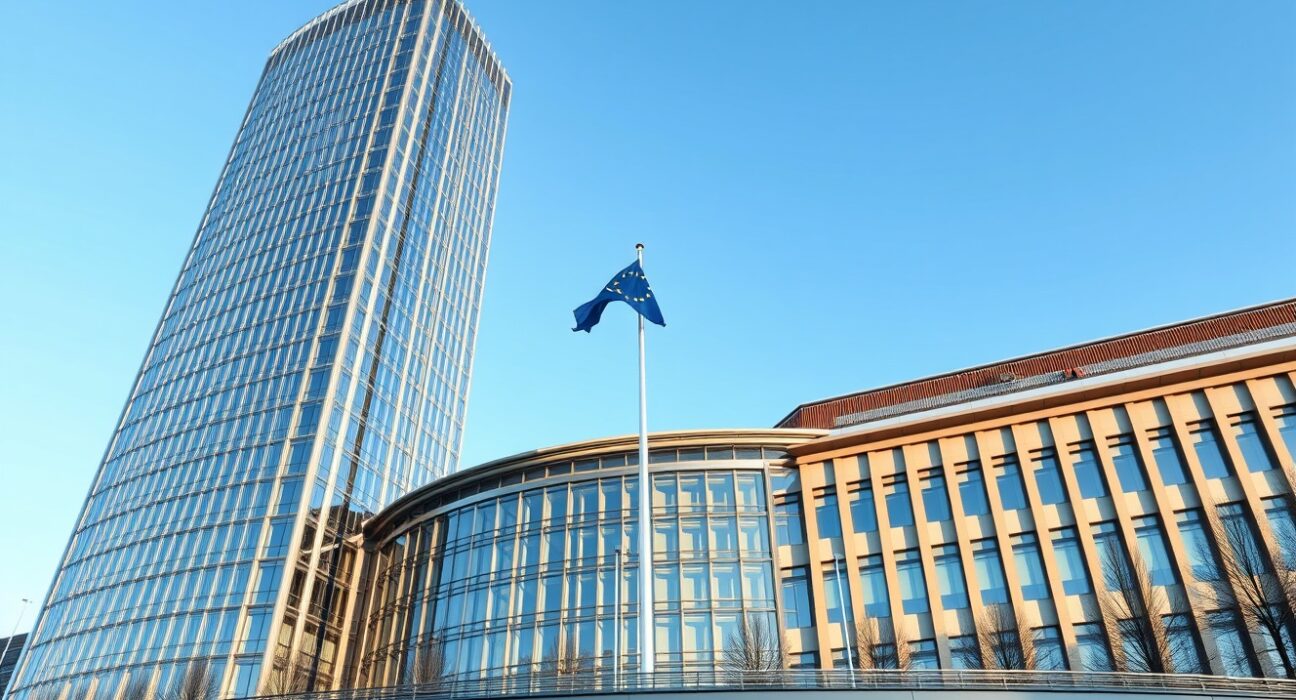
FRANKFURT, Germany — October 15, 2025: The European Central Bank maintains its key interest rates unchanged today, as policymakers confront mounting economic uncertainty stemming from the ongoing Middle East conflict. This decision represents the fourth consecutive meeting where the Governing Council has held borrowing costs steady, reflecting a delicate balancing act between persistent inflation concerns and geopolitical risks that threaten to destabilize global energy markets and supply chains.
European Central Bank Maintains Steady Monetary Policy
The ECB’s Governing Council announced its decision following a two-day meeting in Frankfurt. Consequently, the main refinancing operations rate remains at 4.25%, while the deposit facility rate stays at 3.75%. These levels represent the highest borrowing costs in the Eurozone since the 2008 financial crisis. President Christine Lagarde emphasized the institution’s data-dependent approach during her subsequent press conference. She specifically noted that recent economic indicators show mixed signals, requiring careful monitoring before any policy adjustments.
Market analysts had widely anticipated this outcome, with futures markets pricing in a 92% probability of unchanged rates. However, the accompanying statement revealed subtle shifts in language regarding inflation risks. The ECB removed previous references to “upside risks” while adding cautionary language about “external geopolitical factors.” This linguistic adjustment signals growing concern about conflict-driven volatility. Furthermore, the statement highlighted continued vigilance regarding wage growth and corporate pricing power within the Eurozone.
Middle East Conflict Creates Global Economic Headwinds
The ongoing military conflict in the Middle East presents significant challenges for European monetary policymakers. Energy markets have experienced heightened volatility since hostilities intensified three months ago. Brent crude oil prices have fluctuated between $85 and $105 per barrel during this period. Natural gas prices in Europe have shown similar instability, with Dutch TTF futures experiencing 15% weekly swings on multiple occasions. These fluctuations complicate inflation forecasting and monetary policy calibration.
Shipping routes through critical waterways have faced disruptions, according to maritime tracking data. Container shipping costs from Asia to Northern Europe have increased by approximately 40% since the conflict began. Insurance premiums for vessels transiting affected regions have tripled. These supply chain pressures threaten to reignite goods inflation across the Eurozone. Manufacturing surveys already indicate lengthening delivery times and rising input costs for European factories.
Inflation Dynamics and Economic Growth Projections
Eurozone inflation currently stands at 2.8%, according to the latest Harmonised Index of Consumer Prices data. This represents significant progress from the 10.6% peak recorded in October 2022. However, core inflation excluding energy and food remains stubbornly elevated at 3.1%. Services inflation persists at 4.2%, reflecting strong wage growth and resilient consumer demand in certain sectors. The ECB’s updated economic projections reveal several key trends:
- 2025 GDP Growth: Revised downward to 0.8% from 1.2% previously projected
- 2025 Inflation Forecast: Maintained at 2.3% with widened uncertainty bands
- 2026 Inflation Forecast: Adjusted to 2.1% from 2.0%
- Unemployment Rate: Expected to rise gradually to 7.0% by year-end
Expert Analysis: Monetary Policy in Uncertain Times
Financial economists emphasize the complexity of the ECB’s current position. Dr. Klaus Schmidt, Chief Economist at Frankfurt Economic Research Institute, explains, “The ECB faces a classic policy dilemma. Domestic inflation pressures suggest maintaining restrictive policy, while external geopolitical shocks argue for caution. Their communication today reflects this tension perfectly.” Schmidt notes that forward guidance has become increasingly challenging as traditional economic models struggle to incorporate conflict-related variables.
Historical comparisons provide useful context. During the 1990 Gulf War, the Bundesbank maintained relatively stable rates despite oil price spikes. Conversely, the 2014 conflict in Eastern Ukraine prompted more aggressive monetary easing from the ECB. The current situation differs fundamentally because inflation remains above target while growth slows simultaneously. This stagflationary environment limits policy options and increases the importance of precise calibration.
Market Reactions and Forward Guidance Implications
Financial markets responded cautiously to the ECB’s announcement. The euro initially strengthened against the dollar before paring gains. European government bond yields edged lower, particularly at the longer end of the curve. Equity markets showed minimal reaction, suggesting the decision was fully priced in. However, interest rate futures now indicate a reduced probability of rate cuts before March 2026. This represents a significant shift from expectations just two months ago.
President Lagarde’s press conference provided additional clarity on several points. She confirmed that discussions about reducing the ECB’s balance sheet will continue at future meetings. The Pandemic Emergency Purchase Programme portfolio continues to decline at a measured pace of €15 billion monthly. Furthermore, she reiterated that the ECB remains committed to returning inflation to its 2% medium-term target. The institution will continue to follow a meeting-by-meeting approach without pre-committing to any specific policy path.
Regional Economic Divergence Within the Eurozone
The Middle East conflict affects Eurozone economies unevenly due to their varying energy dependencies and trade exposures. Germany’s manufacturing sector faces particular vulnerability given its reliance on Middle Eastern energy imports and Asian components shipped through affected routes. French and Spanish economies show greater resilience due to their nuclear energy capacity and diversified trade relationships. Southern European nations express concern about tourism impacts, as travel advisories have reduced visitor numbers from key markets.
| Country | Inflation Rate | GDP Growth | Energy Import Dependency |
|---|---|---|---|
| Germany | 2.9% | 0.5% | 64% |
| France | 2.7% | 0.9% | 45% |
| Italy | 3.1% | 0.6% | 73% |
| Spain | 2.6% | 1.2% | 68% |
| Netherlands | 2.8% | 0.7% | 56% |
Global Central Bank Coordination Challenges
The ECB’s decision occurs within a complex global monetary policy landscape. The U.S. Federal Reserve maintains its own restrictive stance, having raised rates to 5.25-5.50%. The Bank of England recently held rates at 5.25% amid similar inflation concerns. However, several emerging market central banks have begun easing cycles as their inflation dynamics improve more rapidly. This divergence creates potential currency volatility and capital flow disruptions that the ECB must monitor carefully.
International coordination faces particular challenges during geopolitical crises. Central banks typically share economic assessments and policy approaches through established channels like the Bank for International Settlements. However, conflict situations introduce national security considerations that can limit information sharing. Energy market interventions by governments further complicate the policy environment, as fiscal measures interact unpredictably with monetary tools.
Conclusion
The European Central Bank’s decision to maintain unchanged interest rates reflects prudent caution amid extraordinary uncertainty. While domestic inflation trends show gradual improvement, external geopolitical risks from the Middle East conflict create substantial downside risks. The ECB must now navigate between preventing inflation resurgence and avoiding unnecessary economic damage. Future policy decisions will depend critically on energy market developments, supply chain resilience, and conflict resolution prospects. The institution’s credibility rests on maintaining this delicate balance while communicating clearly with markets and the public.
FAQs
Q1: Why did the European Central Bank keep interest rates unchanged?
The ECB maintained rates due to persistent inflation concerns combined with economic uncertainty from the Middle East conflict. Policymakers need more data before adjusting monetary policy.
Q2: How does the Middle East conflict affect European monetary policy?
The conflict creates energy market volatility, supply chain disruptions, and economic uncertainty. These factors complicate inflation forecasting and increase risks of both inflationary shocks and growth slowdowns.
Q3: What are the current ECB interest rates?
The main refinancing rate is 4.25%, the marginal lending facility rate is 4.50%, and the deposit facility rate is 3.75%. These represent the highest levels since 2008.
Q4: When might the ECB consider cutting interest rates?
Most analysts expect the first rate cut no earlier than March 2026, assuming inflation continues declining toward the 2% target and geopolitical risks stabilize.
Q5: How does this decision affect European consumers and businesses?
Borrowing costs remain elevated for mortgages, business loans, and consumer credit. Savers continue earning higher returns on deposits. The strong euro makes imports cheaper but exports less competitive.
Disclaimer: The information provided is not trading advice, Bitcoinworld.co.in holds no liability for any investments made based on the information provided on this page. We strongly recommend independent research and/or consultation with a qualified professional before making any investment decisions.