

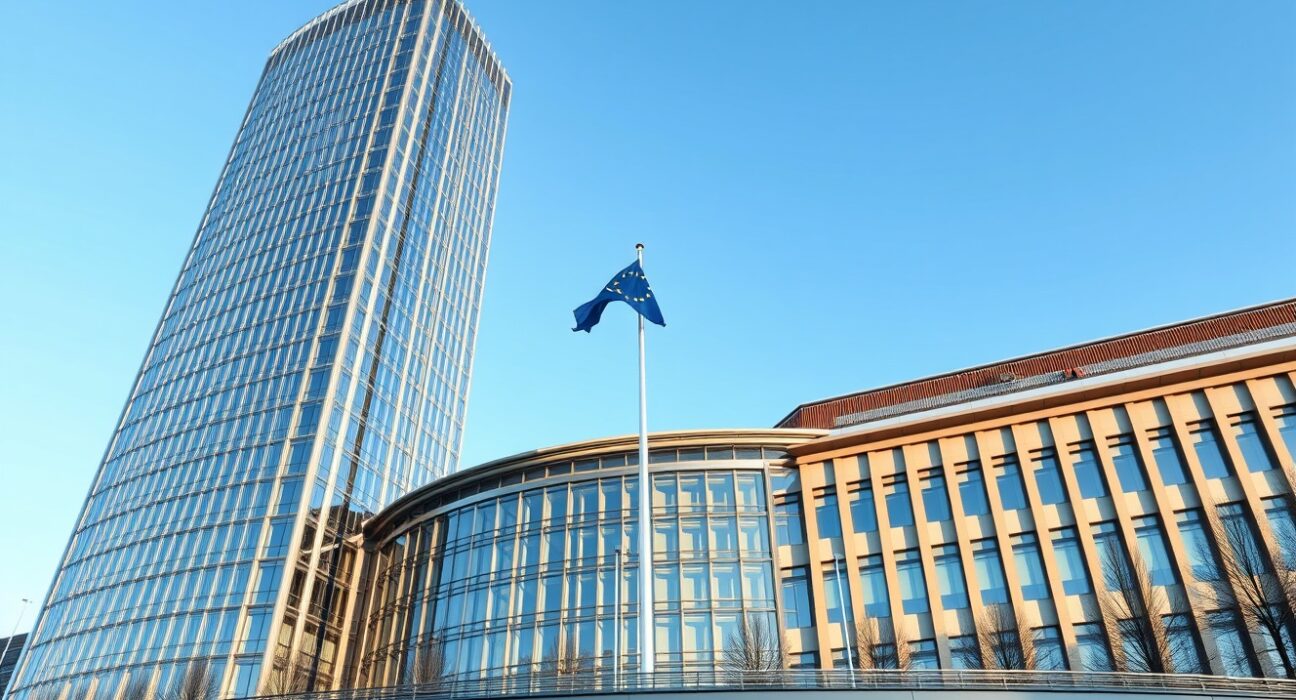
The European Central Bank has decided to keep its interest rate unchanged at its latest meeting, a move widely anticipated by markets. This decision comes amid escalating uncertainty from the ongoing Middle East war. The ECB’s Governing Council held the main refinancing rate at 4.50%. The deposit facility rate remains at 4.00%. The marginal lending facility stays at 4.75%. This marks the third consecutive meeting with no rate change.
ECB Interest Rate Decision in Context
The decision to keep the European Central Bank interest rate unchanged reflects a delicate balancing act. On one hand, inflation in the eurozone has eased from its peak of 10.6% in October 2022 to 2.4% in March 2025. On the other hand, core inflation remains sticky at 2.9%. The Middle East war adds a new layer of complexity. Energy prices have become volatile again. Supply chains face potential disruptions. These factors complicate the ECB’s path toward its 2% inflation target.
ECB President Christine Lagarde emphasized data dependency. She stated that future decisions will depend on incoming economic data. The central bank needs more evidence that inflation is sustainably returning to target. Wage growth remains a concern. Services inflation is still elevated. The ECB cannot afford to declare victory too early.
Impact of Middle East War on ECB Monetary Policy
The Middle East war economic impact is a primary driver of the ECB’s cautious stance. The conflict has disrupted shipping routes through the Red Sea. This has increased transportation costs. It has also delayed deliveries for European manufacturers. Energy prices have risen by 12% since the conflict escalated. This threatens to reignite inflationary pressures.
The ECB’s own staff projections now incorporate higher uncertainty. The baseline scenario assumes no further escalation. However, the central bank has prepared contingency plans. A wider conflict could trigger a severe energy price shock. This would force the ECB to maintain restrictive policy for longer. Conversely, a rapid de-escalation could allow earlier rate cuts.
Geopolitical Risk Premium
Financial markets are pricing in a geopolitical risk premium. This premium affects bond yields and the euro exchange rate. A stronger euro helps contain imported inflation. However, it also hurts eurozone exports. The ECB must weigh these competing forces carefully. The central bank’s primary mandate is price stability. But financial stability risks are also rising.
Eurozone Economic Outlook Amid Uncertainty
The eurozone economy is stagnating. GDP growth was just 0.1% in the fourth quarter of 2024. Germany, the bloc’s largest economy, contracted by 0.3%. The ECB inflation outlook remains uncertain. The labor market is still tight. Unemployment is at a record low of 6.4%. But wage growth is slowing. This suggests that domestic demand is weakening.
Business confidence surveys have declined. The PMI index fell to 49.2 in March, below the 50 threshold that separates growth from contraction. Services activity is barely expanding. Manufacturing output is declining for the seventh consecutive month. The Middle East war adds to these headwinds. Companies are delaying investment decisions. Consumers are saving more and spending less.
Market Reaction to ECB Decision
Financial markets reacted calmly to the interest rate decision analysis. The euro remained stable against the dollar. European stock indices edged slightly higher. Bond yields in Germany and France fell marginally. Investors now focus on the ECB’s forward guidance. The central bank removed its previous reference to keeping rates at current levels for a sufficiently long duration. This subtle change suggests a potential shift toward easing later this year.
Money markets are pricing in two rate cuts by December 2025. The first cut is expected in June. However, this depends heavily on the Middle East situation. Any escalation would delay these expectations. The ECB’s Lagarde stressed that the council is not pre-committing to a specific rate path. Every meeting is live.
Comparison with Other Major Central Banks
The ECB’s decision aligns with the Federal Reserve. The Fed also kept rates unchanged at its March meeting. The Bank of England followed a similar path. All three major central banks face the same dilemma: sticky inflation and geopolitical risks. However, the ECB faces unique challenges. The eurozone is more exposed to energy price shocks. It is also more dependent on trade through the Red Sea.
The following table summarizes the current policy rates of major central banks:
| Central Bank | Key Policy Rate | Last Change |
|---|---|---|
| European Central Bank | 4.50% | September 2024 |
| Federal Reserve | 5.50% | July 2024 |
| Bank of England | 5.25% | August 2024 |
| Bank of Japan | 0.25% | March 2025 |
Inflation Trends and Wage Dynamics
Inflation has declined significantly from its peak. But the last mile toward 2% is proving difficult. Services inflation remains above 4%. This is driven by strong wage growth. Workers are demanding higher pay to compensate for past inflation. The ECB expects wage growth to moderate in the second half of 2025. However, this forecast carries significant uncertainty.
Unit labor costs are rising faster than productivity. This puts pressure on corporate margins. Companies may pass these costs to consumers. This would keep inflation elevated. The ECB is monitoring profit margins closely. It wants to see companies absorbing some of the cost increases. This would help bring inflation down without causing a recession.
Expert Perspectives on ECB Decision
Economists broadly support the ECB’s cautious approach. Carsten Brzeski, global head of macro at ING, stated: “The ECB is right to wait. The Middle East war creates too much uncertainty. Premature easing would be a policy mistake.” Similarly, analysts at Goldman Sachs expect the first rate cut in June. They cite improving inflation data as the main reason.
However, some experts warn of overtightening. The eurozone economy is weak. Keeping rates high for too long could cause unnecessary damage. The ECB must balance these risks carefully. Its credibility depends on getting this balance right.
Conclusion
The European Central Bank has kept its interest rate unchanged for the third consecutive meeting. This decision reflects the high uncertainty from the Middle East war. The ECB is prioritizing caution over action. It wants to ensure that inflation is truly under control. The path ahead depends on geopolitical developments. If the conflict de-escalates, rate cuts could begin in mid-2025. If it worsens, rates will stay higher for longer. The central bank remains data-dependent. It will not hesitate to act if conditions change. For now, patience is the ECB’s guiding principle.
FAQs
Q1: Why did the European Central Bank keep interest rates unchanged?
The ECB kept rates unchanged due to persistent inflation and high uncertainty from the Middle East war. The central bank needs more evidence that inflation is sustainably returning to its 2% target before cutting rates.
Q2: How does the Middle East war affect ECB monetary policy?
The war disrupts energy supplies and shipping routes, increasing costs and uncertainty. This makes the ECB more cautious about easing policy, as higher energy prices could reignite inflation.
Q3: When will the ECB start cutting interest rates?
Markets expect the first rate cut in June 2025, but this depends on inflation data and geopolitical developments. The ECB has not committed to a specific timeline.
Q4: What is the current ECB interest rate?
The main refinancing rate is 4.50%. The deposit facility rate is 4.00%. The marginal lending facility is 4.75%.
Q5: How does the ECB’s decision compare to other central banks?
The ECB’s stance aligns with the Federal Reserve and Bank of England, which also kept rates unchanged. All three central banks face similar challenges from sticky inflation and geopolitical risks.
Disclaimer: The information provided is not trading advice, Bitcoinworld.co.in holds no liability for any investments made based on the information provided on this page. We strongly recommend independent research and/or consultation with a qualified professional before making any investment decisions.
