

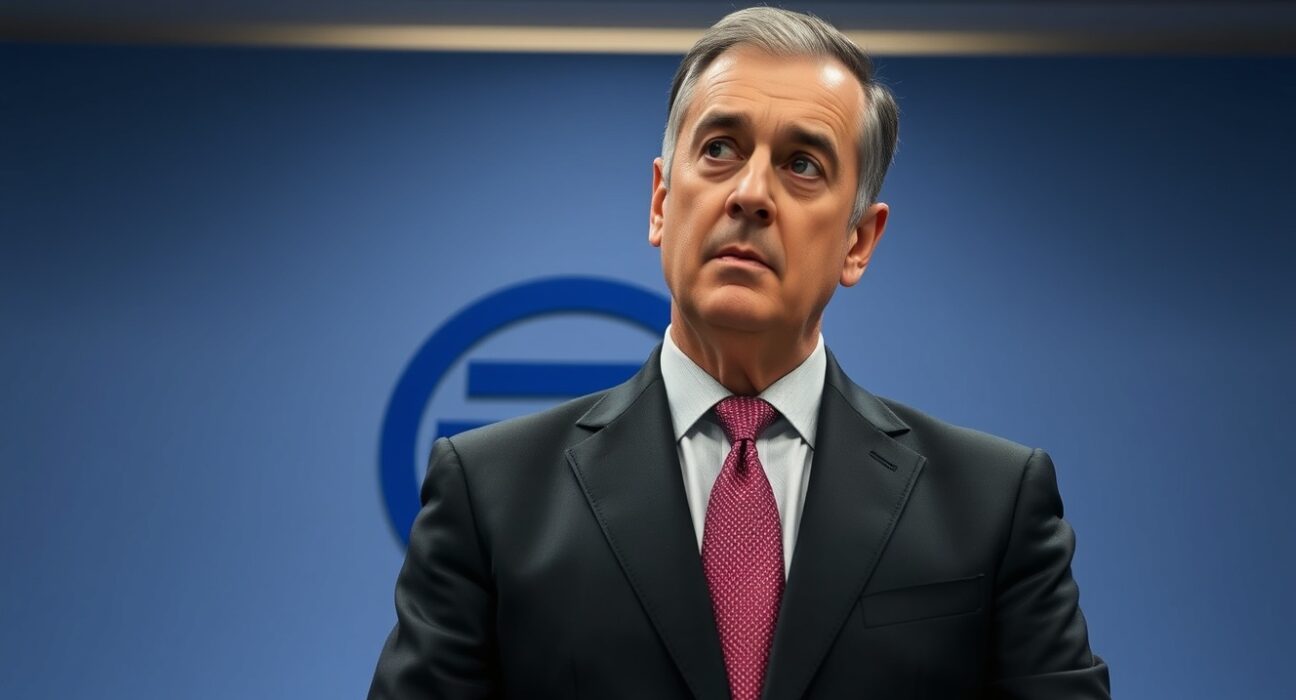
The European Central Bank (ECB) faces a new layer of complexity as board member Gabriel Makhlouf expresses deep concern over a potential higher-for-longer energy price scenario. This warning arrives during a period of fragile economic recovery across the eurozone. Makhlouf’s statement signals that persistent energy costs could derail progress on inflation and force a reassessment of monetary policy. The ECB must now navigate a landscape where energy prices remain elevated, testing the resilience of households and businesses.
ECB’s Makhlouf Highlights Risks of Higher-for-Longer Energy Prices
Gabriel Makhlouf, a key voice on the ECB’s Governing Council, explicitly voiced his unease. He stated that the higher-for-longer energy price scenario is a primary concern. This scenario suggests that energy costs, driven by geopolitical tensions and supply constraints, will not revert to pre-crisis levels quickly. Instead, they will stay high for an extended period. This directly impacts the ECB’s inflation outlook. Core inflation, which strips out volatile energy and food, remains sticky. However, energy prices act as a persistent tailwind, preventing headline inflation from falling sustainably to the 2% target.
Makhlouf’s comments come at a critical juncture. The eurozone economy shows signs of stagnation. Manufacturing output declines, and services sector growth slows. In this context, higher-for-longer energy prices act as a tax on consumers and corporations. They reduce disposable income and increase production costs. This creates a stagflationary risk, where inflation stays high while economic growth weakens. The ECB must balance the need to curb inflation against the risk of deepening the economic slowdown.
Understanding the Energy Price Scenario
The energy price scenario Makhlouf references is not a single event but a persistent condition. It includes elevated natural gas prices, high electricity costs, and expensive crude oil. These factors stem from several sources:
- Geopolitical instability: Conflicts in key energy-producing regions disrupt supply chains.
- Decarbonization costs: Transitioning to green energy involves upfront investments that raise prices.
- Infrastructure bottlenecks: Limited capacity for renewable energy storage and transmission keeps fossil fuels dominant.
- OPEC+ production cuts: Coordinated supply reductions by major oil producers maintain high crude prices.
This combination creates a structural shift. Energy is no longer a temporary shock but a permanent cost increase. The ECB must incorporate this into its models. A higher-for-longer energy price scenario means inflation expectations may become de-anchored. Consumers and businesses start to expect high prices, leading to wage-price spirals.
Implications for Eurozone Inflation and Monetary Policy
Makhlouf’s warning directly connects to the ECB’s policy trajectory. If higher-for-longer energy prices become reality, the ECB may need to keep interest rates elevated for longer than currently anticipated. Markets currently price in rate cuts in mid-2025. However, persistent energy inflation could delay these cuts. The central bank’s primary mandate is price stability. It will prioritize bringing inflation down, even at the cost of economic growth.
The impact varies across the eurozone. Countries like Germany, heavily reliant on industrial manufacturing, suffer more from high energy costs. Southern European nations, with larger service sectors, may feel less immediate pain but still face higher import bills. The ECB’s policy must be uniform, but its effects are asymmetric. This creates internal tensions within the Governing Council. Hawkish members, like Makhlouf, advocate for caution. Dovish members push for rate cuts to support growth.
Data-Backed Reasoning on Energy and Inflation
Recent data supports Makhlouf’s concern. Eurozone inflation ticked up in early 2025, driven largely by energy base effects and higher fuel costs. The ECB’s own staff projections show energy prices remaining above historical averages through 2026. This energy price scenario is not a short-term blip. It reflects a structural change in global energy markets. The ECB’s models must adapt to this new reality. Traditional inflation forecasting, based on mean reversion, may no longer hold.
Expert analysis from leading economic institutes reinforces this view. The Kiel Institute for the World Economy notes that energy prices are the single biggest upside risk to inflation. The IMF’s World Economic Outlook also highlights energy costs as a key variable. Makhlouf’s statements align with this broader expert consensus. He is not an outlier but a voice of caution backed by data.
Real-World Context and Impact on Households
The higher-for-longer energy price scenario has tangible effects on everyday life. European households face higher heating bills, expensive petrol, and increased costs for goods. Energy-intensive industries, such as chemicals, steel, and glass, struggle to remain competitive. Some factories reduce output or relocate to regions with cheaper energy, like the United States or the Middle East. This deindustrialization trend threatens long-term economic vitality.
For consumers, the impact is immediate. Disposable income shrinks. Savings rates, which rose during the pandemic, are now declining. Consumer confidence remains fragile. Spending on non-essential items drops. This weakens domestic demand, which further slows economic growth. The ECB faces a difficult trade-off. Raising rates to fight inflation hurts demand. Keeping rates low allows inflation to persist. Makhlouf’s stance suggests he prioritizes inflation control over growth support.
Timeline of Events and ECB Responses
To understand the current situation, a timeline of key events is useful:
| Date | Event | Impact |
|---|---|---|
| 2022 | Russia-Ukraine conflict begins | Energy prices spike dramatically |
| 2023 | ECB hikes rates aggressively | Inflation peaks but remains elevated |
| 2024 | Energy prices stabilize but stay high | Core inflation proves sticky |
| 2025 | Makhlouf warns of higher-for-longer | Markets reassess rate cut expectations |
This timeline shows the persistence of the problem. The initial shock has passed, but the aftereffects remain. The ECB’s response has evolved from emergency rate hikes to a more measured, data-dependent approach. Makhlouf’s warning is part of this ongoing calibration.
Expert Perspectives and Authoritative Analysis
Makhlouf’s position carries weight. As a member of the ECB’s Governing Council, he participates directly in rate decisions. His public statements often signal the direction of internal debates. When he expresses concern about higher-for-longer energy prices, it reflects a serious discussion within the central bank. Other council members, like Isabel Schnabel and Klaas Knot, have also voiced similar concerns. This indicates a hawkish tilt within the ECB.
Economic think tanks provide additional context. The Bruegel Institute, a Brussels-based policy research group, argues that the eurozone must accelerate its energy transition to break free from fossil fuel price volatility. This long-term solution, however, offers little immediate relief. In the short term, the ECB must manage the inflation-growth trade-off. Makhlouf’s comments highlight the difficulty of this task. He is not offering a solution but stating a reality: high energy prices are here to stay, and policy must adapt.
Comparing with Other Central Banks
The ECB is not alone in facing this challenge. The Federal Reserve in the US also grapples with energy-driven inflation. However, the US benefits from being a net energy exporter. Europe, a net importer, is more vulnerable. This structural difference means the ECB has less room for error. Makhlouf’s warning reflects this vulnerability. The energy price scenario for Europe is more severe than for other regions. This necessitates a more cautious approach to monetary easing.
Bank of England officials have made similar statements. They also cite energy prices as a key risk. The global nature of the problem underscores its seriousness. Central banks worldwide are coordinating their communication strategies to manage market expectations. Makhlouf’s speech is part of this broader effort. He aims to prevent markets from pricing in premature rate cuts that could reignite inflation.
Conclusion
Gabriel Makhlouf’s concern about a higher-for-longer energy price scenario is a critical signal for the eurozone economy. It highlights the persistent nature of energy inflation and its implications for monetary policy. The ECB must remain vigilant. It cannot declare victory over inflation until energy prices return to sustainable levels. For households and businesses, this means continued financial pressure. For investors, it means delayed rate cuts and prolonged tight monetary conditions. The energy price scenario is now a central pillar of the ECB’s policy framework. Makhlouf’s warning serves as a reminder that the path to price stability remains long and uncertain.
FAQs
Q1: What did ECB’s Makhlouf say about energy prices?
A: He expressed concern about a higher-for-longer energy price scenario, meaning energy costs will remain elevated for an extended period, impacting inflation and monetary policy.
Q2: How does a higher-for-longer energy price scenario affect eurozone inflation?
A: It keeps headline inflation elevated, makes core inflation stickier, and risks de-anchoring inflation expectations, forcing the ECB to maintain tight policy.
Q3: Will the ECB cut interest rates in 2025?
A: Makhlouf’s warning suggests rate cuts may be delayed if energy prices stay high. The ECB prioritizes price stability over growth, so cuts are not guaranteed.
Q4: Which countries in the eurozone are most affected by high energy prices?
A: Germany and other manufacturing-heavy economies are most vulnerable due to high industrial energy consumption. Southern European nations face less immediate impact but still suffer from higher import costs.
Q5: What can the ECB do to address the energy price scenario?
A: The ECB can only manage inflation through monetary policy. Structural solutions, like accelerating the energy transition, require government action. The ECB’s role is to communicate risks and adjust rates accordingly.
Disclaimer: The information provided is not trading advice, Bitcoinworld.co.in holds no liability for any investments made based on the information provided on this page. We strongly recommend independent research and/or consultation with a qualified professional before making any investment decisions.
