

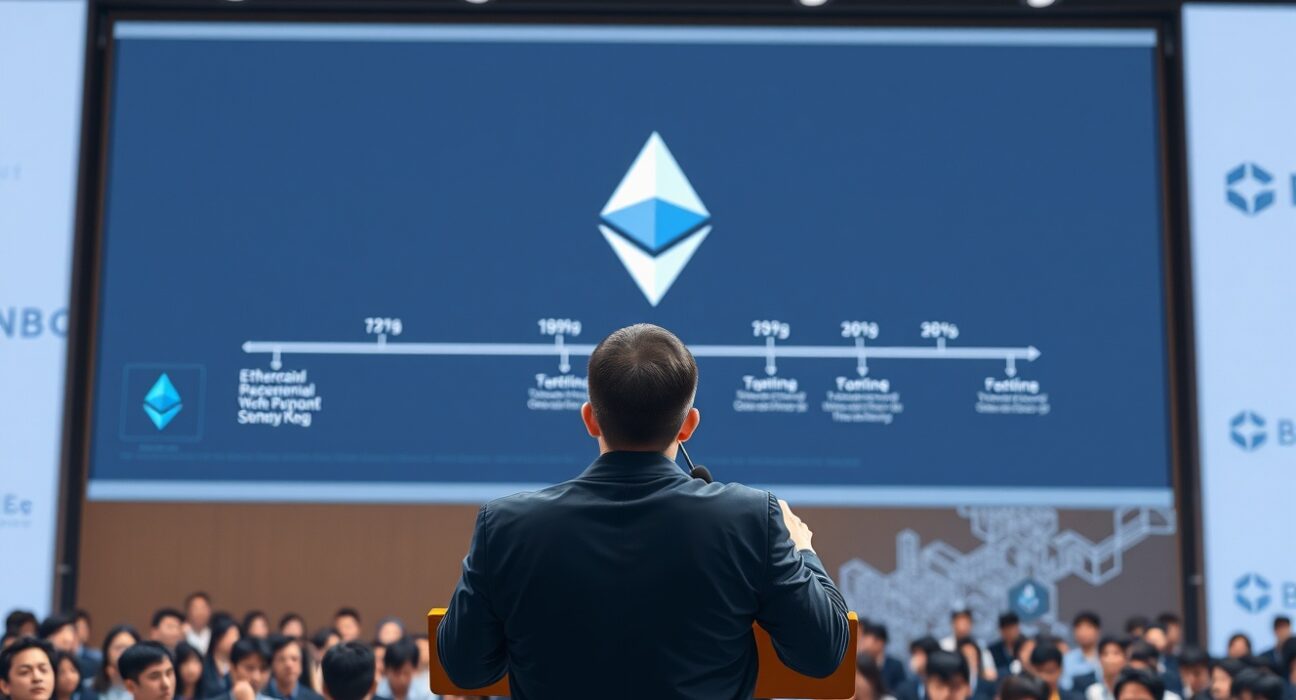
Ethereum founder Vitalik Buterin has unveiled a comprehensive four-year development blueprint that aims to fundamentally transform the world’s second-largest blockchain network. Speaking at the Hong Kong Web3 Festival on April 12, 2025, Buterin outlined ambitious targets for enhanced scalability and quantum-resistant security through 2028, marking a significant evolution in Ethereum’s technological trajectory.
Ethereum’s Strategic Evolution: The Four-Year Vision
Buterin’s presentation detailed a phased approach to Ethereum’s development, emphasizing practical implementation over theoretical concepts. The roadmap addresses critical challenges facing the network while maintaining its core principles of security and decentralization. This strategic vision comes at a pivotal moment for blockchain technology, as networks worldwide compete to solve scalability limitations while preparing for future computational threats.
Industry analysts immediately recognized the significance of this announcement. “Buterin’s roadmap represents a maturation of Ethereum’s development philosophy,” noted Dr. Sarah Chen, blockchain researcher at Stanford University. “Rather than chasing transaction speed records, Ethereum is focusing on sustainable infrastructure that can support global adoption.”
The Immediate Priorities: Gas Limits and EVM Enhancements
Short-term objectives dominate the initial phase of Ethereum’s roadmap. Buterin specifically highlighted raising the gas limit as an immediate priority for improving network scalability. This technical adjustment would increase transaction throughput without compromising network security, addressing one of Ethereum’s most persistent challenges since its transition to proof-of-stake.
Concurrently, developers will extend the Ethereum Virtual Machine (EVM) with Zero-Knowledge proofs through CKEVM implementation. This enhancement represents a crucial step toward making complex computations more efficient and private. Furthermore, the roadmap prioritizes support for smart contract wallets and quantum-resistant signatures via account abstraction, laying foundational security improvements.
Quantum Security: Preparing for Future Threats
Buterin’s emphasis on quantum-resistant signatures marks a forward-looking approach to blockchain security. Quantum computing represents a potential existential threat to current cryptographic systems, with researchers estimating that practical quantum computers could emerge within the next decade. Ethereum’s proactive stance contrasts with many blockchain networks that have yet to address this looming challenge.
The quantum security initiative involves implementing post-quantum cryptography standards that can withstand attacks from quantum computers. This preparation demonstrates Ethereum’s commitment to long-term viability. “Quantum resistance isn’t just a technical feature—it’s a necessity for any system claiming to be future-proof,” explained Michael Rodriguez, cryptography expert at MIT’s Digital Currency Initiative.
| Timeframe | Primary Objectives | Expected Impact |
|---|---|---|
| 2025-2026 | Gas limit increase, CKEVM implementation, account abstraction support | Improved transaction throughput, enhanced privacy features |
| 2026-2027 | Quantum-resistant signature deployment, smart contract wallet optimization | Future-proof security, improved user experience |
| 2027-2028 | Transaction finality reduction to 10-20 seconds, zkVM technology implementation | Faster confirmations, broader device compatibility |
zkVM Technology: Democratizing Chain Verification
Perhaps the most ambitious technical goal in Buterin’s roadmap involves zkVM technology implementation by 2028. This innovation would enable even low-specification devices to verify the Ethereum chain directly, dramatically expanding participation possibilities. The technology leverages zero-knowledge proofs to create efficient verification mechanisms that don’t require powerful hardware.
This development could fundamentally change how users interact with Ethereum. Currently, full node operation requires significant computational resources, creating barriers to network participation. zkVM technology would democratize verification, potentially increasing decentralization while improving network resilience. “Enabling verification on mobile devices represents a paradigm shift,” observed blockchain architect David Park. “It aligns with Ethereum’s original vision of accessible, decentralized computing.”
Transaction Finality: Balancing Speed and Security
Buterin’s roadmap targets reducing transaction finality time to between 10 and 20 seconds by 2028. This improvement represents a significant acceleration from current confirmation times while maintaining Ethereum’s security standards. The founder explicitly contrasted this approach with networks prioritizing extreme speed, emphasizing that Ethereum’s fundamental goal remains becoming “the world’s most secure and decentralized blockchain.”
This philosophical distinction highlights Ethereum’s different priorities compared to high-frequency trading platforms or networks optimized for maximum transactions per second. The balanced approach acknowledges that different blockchain applications require different technical characteristics. “Not every application needs millisecond finality,” Buterin noted during his presentation. “But every application needs absolute security and reliable decentralization.”
The Broader Context: Ethereum’s Competitive Position
Buterin’s announcement comes during a period of intense competition among blockchain networks. Several layer-1 and layer-2 solutions have emerged claiming superior scalability or specialized features. Ethereum’s roadmap represents a strategic response that leverages its established network effects while addressing technical limitations.
The four-year timeline allows for methodical development rather than rushed implementations. This measured approach reflects lessons from Ethereum’s previous upgrades, including the carefully executed transition to proof-of-stake. Industry observers note that Ethereum’s development philosophy increasingly emphasizes stability and security over rapid feature deployment.
Key technical components of the roadmap include:
- Gas Limit Optimization: Balancing throughput increases with network stability
- CKEVM Implementation: Enhancing privacy and computational efficiency
- Account Abstraction: Improving user experience and security simultaneously
- Quantum-Resistant Cryptography: Implementing lattice-based or hash-based signatures
- zkVM Architecture: Creating lightweight verification protocols
Conclusion
Vitalik Buterin’s comprehensive Ethereum roadmap establishes clear development priorities through 2028, focusing on scalability enhancements and quantum security preparedness. The four-year vision balances immediate technical improvements with long-term strategic positioning, reinforcing Ethereum’s commitment to security and decentralization over pure transaction speed. As blockchain technology continues evolving, Ethereum’s methodical approach to infrastructure development may prove decisive in maintaining its position as a foundational layer for decentralized applications worldwide. The roadmap’s successful implementation would represent a significant milestone in blockchain maturation, potentially setting new standards for network security and accessibility.
FAQs
Q1: What is the most immediate change coming to Ethereum according to the roadmap?
The most immediate priority involves raising the gas limit to improve transaction throughput. This change represents a straightforward scalability enhancement that developers can implement relatively quickly while maintaining network security.
Q2: Why is quantum security important for blockchain networks?
Quantum computers, when they become practical, could break current cryptographic systems that protect blockchain networks. Quantum-resistant cryptography ensures that Ethereum remains secure against future computational threats, protecting user assets and network integrity.
Q3: How will zkVM technology change Ethereum usage?
zkVM technology will enable devices with limited computational power, including smartphones and tablets, to verify the Ethereum chain directly. This democratizes network participation and could significantly increase decentralization by lowering hardware requirements.
Q4: What does transaction finality mean, and why is reducing it important?
Transaction finality refers to the point when a transaction becomes irreversible on the blockchain. Reducing this time from minutes to 10-20 seconds improves user experience for applications requiring quick confirmations while maintaining Ethereum’s security standards.
Q5: How does Ethereum’s approach differ from other blockchain networks?
Ethereum prioritizes security and decentralization over maximum transaction speed. While some networks optimize for high-frequency trading scenarios, Ethereum focuses on creating a secure, reliable foundation for diverse decentralized applications, including those where absolute security matters more than millisecond transaction times.
Disclaimer: The information provided is not trading advice, Bitcoinworld.co.in holds no liability for any investments made based on the information provided on this page. We strongly recommend independent research and/or consultation with a qualified professional before making any investment decisions.
