
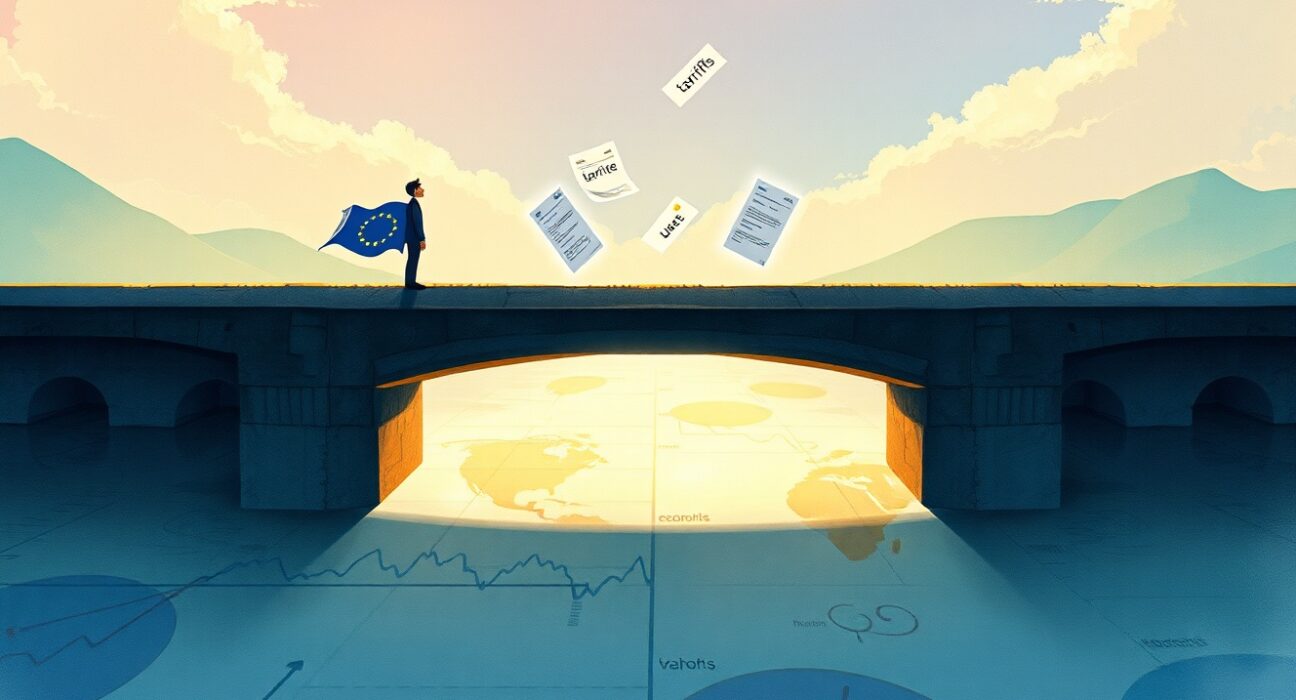
BRUSSELS, January 2025 – The specter of tariff uncertainty has returned to haunt European markets following the announcement of new US trade measures, creating fresh volatility in international economic relations and prompting immediate analysis from leading financial institutions including Commerzbank. This development marks a significant shift in transatlantic trade dynamics, potentially unraveling years of diplomatic progress and threatening the stability of global supply chains that had only recently recovered from previous disruptions.
EU Tariff Uncertainty: Historical Context and Immediate Triggers
The European Union now faces renewed trade tensions as the United States implements fresh economic measures targeting key industrial sectors. Commerzbank analysts immediately flagged this development as particularly concerning given the fragile state of post-pandemic recovery. Historically, tariff disputes between these economic powers have triggered significant market volatility. For instance, the 2018-2020 trade war resulted in approximately $100 billion in reciprocal tariffs. Consequently, European policymakers express deep concern about potential escalation patterns.
These new US measures specifically target technology transfers and green energy subsidies. They represent a strategic shift in American trade policy orientation. European Commission officials confirm they are analyzing the measures’ full implications. Meanwhile, financial markets demonstrate immediate sensitivity to the announcements. The euro experienced notable fluctuations against the dollar following the news. Additionally, European automotive and aerospace stocks showed particular vulnerability during initial trading sessions.
Commerzbank’s Analytical Framework
Commerzbank economists employ sophisticated modeling to assess potential impacts. Their analysis considers multiple escalation scenarios. The bank’s research department emphasizes several critical factors. First, supply chain integration between the EU and US remains extensive. Second, inflationary pressures already challenge both economies. Third, geopolitical tensions create additional complexity. Their models suggest even limited tariffs could reduce EU GDP growth by 0.3-0.7 percentage points annually. Furthermore, specific sectors face disproportionate risks according to their assessment.
Comparative Analysis: Previous vs. Current Trade Tensions
The current situation differs significantly from earlier trade disputes in several important respects. Market conditions have evolved substantially since 2020. Global inflation remains elevated above central bank targets. Additionally, interest rates continue at restrictive levels across major economies. Supply chains, while more resilient, still operate with reduced buffers. The geopolitical landscape has also shifted dramatically with multiple ongoing conflicts.
| Aspect | 2018-2020 Period | 2025 Situation |
|---|---|---|
| Primary Sectors Targeted | Steel, Aluminum, Automotive | Technology, Green Energy, Semiconductors |
| Average Tariff Levels | 25% on selected goods | Measures still being quantified |
| EU Response Timeframe | 2-3 months for countermeasures | Expected faster response capability |
| Global Economic Context | Pre-pandemic expansion | Post-pandemic restructuring |
| Inflation Environment | Below 2% targets | Persistently above targets |
Several key differences emerge from this comparison. The current dispute involves more technologically advanced sectors. These sectors typically feature more complex supply chains. Consequently, disruption effects could propagate more widely through the global economy. The inflation context also creates different policy constraints. Central banks now balance growth concerns against persistent price pressures. This dual challenge complicates traditional policy responses to trade shocks.
Sector-Specific Impacts and Market Reactions
Financial markets responded immediately to the renewed tariff uncertainty. European stock indices experienced sector-specific volatility. The STOXX Europe 600 index showed particular weakness in industrial and technology components. Currency markets reflected heightened risk perceptions. The euro-dollar exchange rate demonstrated increased volatility. Bond markets also adjusted expectations for interest rate paths.
Specific industries face distinct challenges according to preliminary assessments:
- Automotive Sector: European manufacturers maintain significant US market exposure. Potential tariffs could affect approximately 15% of EU auto exports. This sector already contends with transition to electric vehicles.
- Technology and Semiconductors: The EU’s digital sovereignty initiatives face new complications. Cross-border research collaborations might encounter additional barriers. Semiconductor supply chains require particularly careful management.
- Green Energy Transition: Climate-related technologies represent a growing trade category. Disruptions could delay renewable energy deployment timelines. This affects both European and American climate goals.
- Agricultural Products: While not initially targeted, agricultural markets often experience secondary effects. Export-oriented European farmers monitor developments closely.
Expert Perspectives on Resolution Pathways
Trade policy experts identify several potential resolution mechanisms. The World Trade Organization’s dispute settlement system offers one avenue. However, its effectiveness has diminished in recent years. Bilateral negotiations between the EU and US provide another pathway. These negotiations could utilize existing frameworks like the Trade and Technology Council. Sector-specific agreements might offer targeted solutions. Such agreements could address particular concerns while avoiding broader escalation.
Historical precedent suggests certain patterns in trade dispute resolution. Early technical consultations often precede formal negotiations. Confidence-building measures sometimes create space for compromise. Third-party mediation occasionally facilitates breakthroughs. The current situation’s complexity might require innovative approaches. Some analysts suggest digital trade agreements could provide templates. Others emphasize the importance of multilateral coordination.
Broader Economic Implications and Policy Considerations
The return of tariff uncertainty occurs during a delicate economic period. Global growth projections for 2025 already reflect multiple headwinds. The International Monetary Fund recently revised its forecasts downward. Trade tensions represent an additional negative factor. European policymakers must balance several competing priorities. Maintaining economic stability remains paramount. Preserving strategic autonomy presents another key objective. Supporting the green transition requires continued investment.
Monetary policy faces additional complications from trade developments. The European Central Bank monitors exchange rate effects on inflation. Trade restrictions typically create upward price pressure. This complicates the timing of potential interest rate adjustments. Fiscal authorities also confront difficult choices. Support measures for affected industries might become necessary. However, budget constraints limit response options. Coordinated European action could enhance effectiveness.
Long-Term Strategic Implications
Beyond immediate economic effects, these developments carry strategic significance. European trade policy has increasingly emphasized diversification. Recent agreements with Asian and Latin American partners reflect this orientation. The current tensions might accelerate diversification efforts. Supply chain resilience initiatives could receive additional impetus. Strategic stockpiling of critical components might expand. Research and development investments could shift emphasis.
The geopolitical dimension adds further complexity. Transatlantic relations form a cornerstone of European foreign policy. Trade disputes inevitably affect broader diplomatic relations. Security cooperation sometimes intertwines with economic discussions. Navigating these interconnected domains requires careful statecraft. European leaders emphasize the importance of dialogue. They also acknowledge the need to protect legitimate interests. Finding appropriate balance remains challenging.
Conclusion
The resurgence of EU tariff uncertainty following new US measures represents a significant economic development with far-reaching implications. Commerzbank’s analysis highlights both immediate market impacts and longer-term strategic consequences. While historical precedents provide useful reference points, the current situation features unique characteristics including technological focus and inflationary context. Resolution will require careful diplomacy and possibly innovative approaches to trade conflict management. The coming months will prove crucial for determining whether this episode represents a temporary disruption or signals more fundamental shifts in transatlantic economic relations. Ultimately, managing this EU tariff uncertainty effectively will test the resilience of international economic governance systems and the adaptability of both European and American policymaking frameworks.
FAQs
Q1: What specific US measures triggered the renewed EU tariff uncertainty?
The United States announced new trade restrictions targeting technology transfers and green energy subsidies. These measures particularly affect sectors where European companies maintain significant competitive advantages. The exact implementation details and timelines continue to emerge through official publications.
Q2: How does Commerzbank assess the potential economic impact?
Commerzbank analysts estimate that even limited tariffs could reduce EU GDP growth by 0.3-0.7 percentage points annually. Their models consider multiple escalation scenarios and account for sector-specific vulnerabilities. The bank emphasizes that effects would vary significantly across different industries and member states.
Q3: Which European sectors face the greatest risks from these developments?
Automotive, technology, semiconductors, and green energy sectors appear most exposed according to initial assessments. These industries feature extensive transatlantic supply chains and significant export dependencies. Agricultural sectors might experience secondary effects despite not being primary targets.
Q4: How does the current situation differ from previous EU-US trade disputes?
The current tensions involve more technologically advanced sectors, occur in a higher inflation environment, and follow substantial pandemic-related economic disruption. Additionally, geopolitical tensions create different background conditions compared to earlier periods of trade conflict.
Q5: What resolution mechanisms might address this EU tariff uncertainty?
Potential pathways include WTO dispute settlement procedures, bilateral negotiations through existing frameworks like the Trade and Technology Council, sector-specific agreements, and possibly innovative digital trade arrangements. Historical precedent suggests technical consultations typically precede formal negotiations.
Disclaimer: The information provided is not trading advice, Bitcoinworld.co.in holds no liability for any investments made based on the information provided on this page. We strongly recommend independent research and/or consultation with a qualified professional before making any investment decisions.