
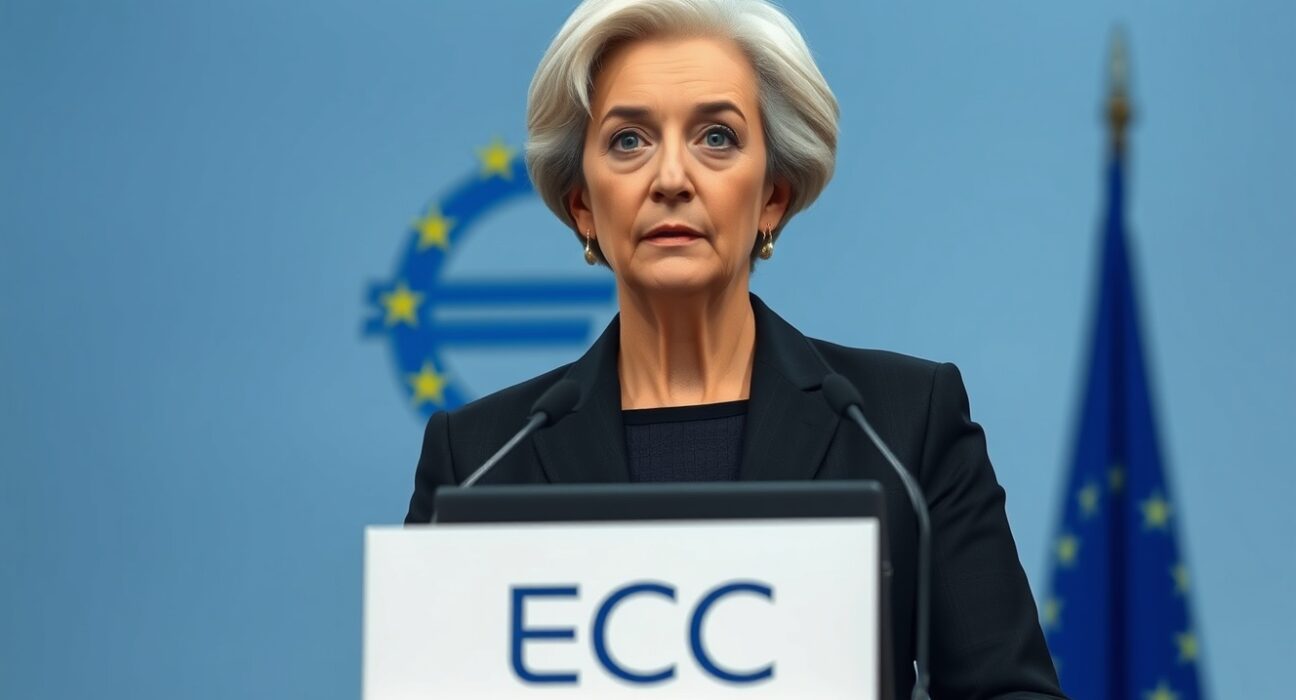
FRANKFURT, March 2025 – European Central Bank President Christine Lagarde’s recent avoidance of forward guidance has sparked significant analysis from financial institutions, particularly highlighting potential dovish risks for the Euro currency. Consequently, ING economists have published detailed research examining the implications of this strategic communication shift. This development comes amid ongoing debates about the ECB’s monetary policy trajectory and its effects on currency markets.
EUR Dovish Risks in Current Monetary Environment
The Euro faces mounting dovish pressures as the European Central Bank navigates complex economic conditions. Specifically, Christine Lagarde’s recent communications have deliberately avoided concrete forward guidance about future policy moves. This strategic ambiguity creates uncertainty in financial markets. Therefore, analysts must carefully interpret subtle signals from ECB statements and economic data releases.
ING’s research team, led by global head of macro Carsten Brzeski, identifies several key factors contributing to this dovish outlook. First, Eurozone inflation has shown persistent moderation toward the ECB’s 2% target. Second, economic growth indicators remain subdued across major European economies. Third, global trade tensions continue to create external headwinds. Fourth, labor market conditions show early signs of softening in certain sectors.
Monetary policy divergence between major central banks represents another crucial consideration. While the Federal Reserve maintains a relatively hawkish stance, the ECB appears increasingly cautious about further tightening. This policy gap could widen if economic conditions continue to diverge between regions. Market participants consequently adjust their Euro positioning based on these evolving expectations.
Lagarde’s Communication Strategy Evolution
Christine Lagarde has gradually refined her communication approach since assuming the ECB presidency in November 2019. Initially, she emphasized forward guidance as a primary policy tool. However, recent statements demonstrate a clear shift toward data-dependent flexibility. This evolution reflects lessons from previous forecasting challenges and changing economic realities.
The ECB president’s latest press conference on March 6, 2025, exemplified this new approach. Lagarde repeatedly emphasized that future decisions would depend on incoming economic data. She avoided specific timelines for policy changes. She also declined to pre-commit to particular interest rate paths. This represents a significant departure from earlier communication patterns under both her leadership and her predecessor Mario Draghi.
Expert Analysis from ING Economists
ING’s currency strategists provide detailed technical analysis of the Euro’s position. Their models incorporate multiple variables including interest rate differentials, economic growth projections, and political risk factors. The research indicates that the Euro could face sustained pressure if dovish expectations become more entrenched in market pricing.
The analysis highlights particular vulnerability in EUR/USD currency pairs. This currency pair remains sensitive to relative monetary policy expectations between the ECB and Federal Reserve. Current positioning data shows that institutional investors have reduced their Euro exposure significantly. Hedge funds have similarly adjusted their strategies to account for increased policy uncertainty.
| Indicator | Current Value | Trend | Policy Implication |
|---|---|---|---|
| Eurozone Inflation | 2.1% | Declining | Dovish |
| Core Inflation | 2.3% | Moderating | Neutral to Dovish |
| GDP Growth | 0.3% (QoQ) | Stagnant | Dovish |
| Unemployment Rate | 6.5% | Stable | Neutral |
| Manufacturing PMI | 48.7 | Contracting | Dovish |
Historical Context of ECB Forward Guidance
The European Central Bank has utilized forward guidance as a policy tool since the global financial crisis. Former President Mario Draghi famously introduced explicit guidance in July 2013. He committed to keeping interest rates at present or lower levels for an extended period. This approach helped anchor market expectations during turbulent times.
Forward guidance evolved through several distinct phases under different economic conditions:
- 2013-2017: Qualitative guidance emphasizing extended low rates
- 2018-2019: State-contingent guidance linked to inflation outlook
- 2020-2022: Pandemic-era guidance with enhanced flexibility
- 2023-present: Data-dependent approach with reduced pre-commitment
This historical perspective helps explain Lagarde’s current communication strategy. The ECB has learned that overly specific forward guidance can become counterproductive when economic conditions change unexpectedly. The pandemic period particularly demonstrated the limitations of rigid policy commitments.
Market Implications and Currency Dynamics
Financial markets have responded to the ECB’s communication shift with increased volatility in Euro-denominated assets. Currency traders report wider bid-ask spreads for Euro pairs. Option markets show rising premiums for protection against Euro depreciation. These developments reflect genuine uncertainty about the ECB’s future policy direction.
The Euro’s trade-weighted index has declined approximately 3.5% since the beginning of 2025. This movement correlates with changing expectations about monetary policy divergence. Technical analysis suggests several key support levels that could be tested if dovish sentiment intensifies. Market participants closely monitor ECB Governing Council member speeches for additional clues about policy thinking.
Interest rate futures currently price in approximately 40 basis points of ECB easing by year-end 2025. This contrasts with pricing from just three months ago, which anticipated potential additional tightening. The rapid shift in expectations demonstrates how sensitive markets remain to central bank communication. ING economists believe current pricing may still underestimate the potential for policy accommodation.
Comparative Central Bank Analysis
The ECB’s communication approach differs notably from other major central banks. The Federal Reserve continues to provide relatively explicit forward guidance through its dot plot projections. The Bank of England maintains conditional guidance linked to specific economic thresholds. The Bank of Japan has its own unique framework centered on yield curve control.
These differences create complex dynamics in global currency markets. Traders must analyze not just individual central bank policies but also their interactions. The relative hawkishness or dovishness of different institutions creates flows between currencies. Currently, the ECB appears positioned toward the dovish end of the spectrum among developed market central banks.
Economic Fundamentals Supporting Dovish Outlook
Several structural economic factors support the case for ECB caution. Eurozone productivity growth remains below historical averages. Demographic trends present long-term challenges for economic expansion. Energy transition costs continue to create inflationary pressures while simultaneously constraining growth.
The European Commission’s latest economic forecast projects modest growth of 1.2% for 2025. This represents a downward revision from previous estimates. The forecast acknowledges persistent challenges including geopolitical tensions and trade fragmentation. These factors naturally incline the ECB toward a more accommodative policy stance than might otherwise be warranted by inflation data alone.
Regional disparities within the Eurozone further complicate policy decisions. Southern European economies face different cyclical positions than their northern counterparts. Germany’s industrial sector shows particular weakness due to global demand shifts. France contends with fiscal consolidation requirements. Italy manages high public debt levels. The ECB must formulate policy that addresses this heterogeneous economic landscape.
Conclusion
The analysis of EUR dovish risks reveals significant implications for currency markets and monetary policy. Christine Lagarde’s deliberate avoidance of forward guidance reflects both strategic calculation and genuine uncertainty about economic developments. ING’s research provides valuable perspective on how this communication approach affects market pricing and expectations. Ultimately, the Euro’s trajectory will depend on actual economic outcomes rather than central bank promises. Market participants should prepare for continued volatility as the ECB navigates this complex policy environment with reduced forward guidance.
FAQs
Q1: What are dovish risks for the Euro?
Dovish risks refer to potential downward pressure on the Euro currency resulting from expectations of European Central Bank monetary policy accommodation, including potential interest rate cuts or other stimulative measures.
Q2: Why is Lagarde avoiding forward guidance?
The ECB president appears to be adopting a more data-dependent approach after previous experiences showed that specific forward guidance can become problematic when economic conditions change unexpectedly, particularly during events like the pandemic.
Q3: How does ING analyze these currency risks?
ING economists employ comprehensive models incorporating interest rate differentials, economic growth projections, inflation trends, and political risk factors to assess potential currency movements and policy implications.
Q4: What economic indicators most influence ECB policy?
The ECB primarily monitors inflation metrics (both headline and core), GDP growth, labor market conditions, and survey-based indicators like PMIs when making monetary policy decisions.
Q5: How are financial markets responding to this communication shift?
Markets have shown increased volatility in Euro-denominated assets, with currency traders reporting wider spreads and option markets pricing higher premiums for Euro depreciation protection amid the policy uncertainty.
Disclaimer: The information provided is not trading advice, Bitcoinworld.co.in holds no liability for any investments made based on the information provided on this page. We strongly recommend independent research and/or consultation with a qualified professional before making any investment decisions.