
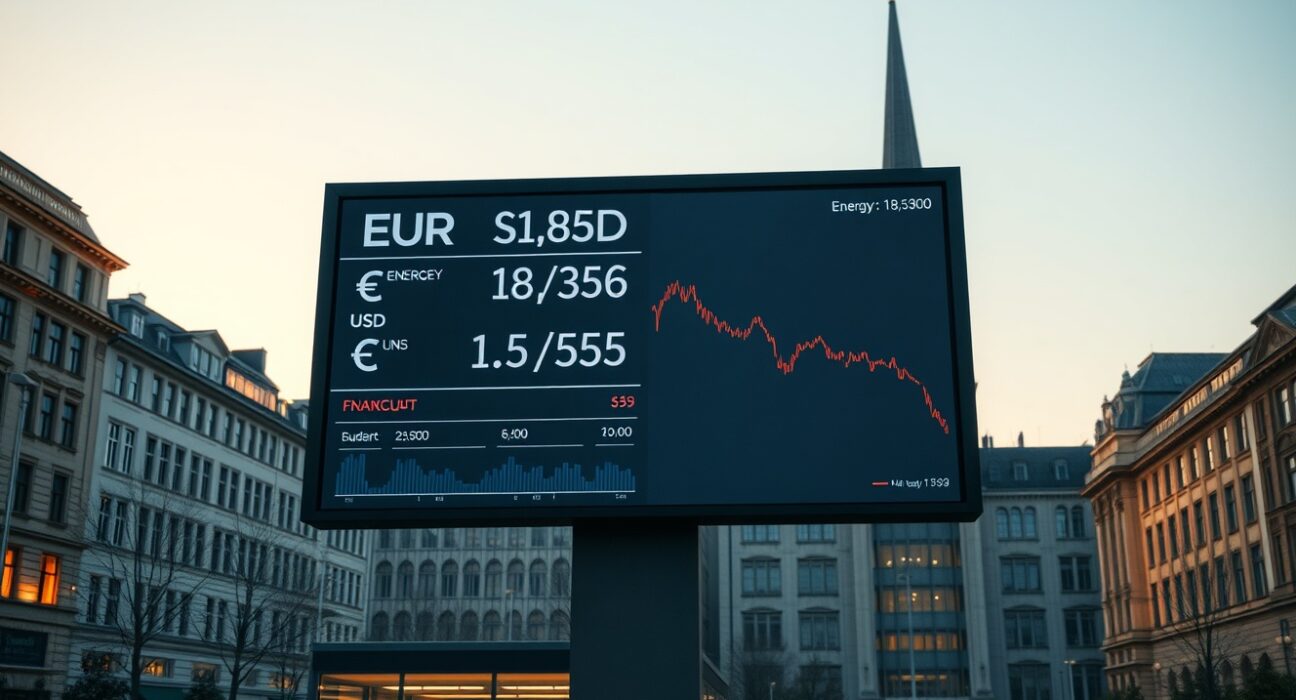
LONDON, March 2025 – The Euro’s traditional role as a global funding currency faces unprecedented pressure from Europe’s persistent energy crisis, according to recent analysis from BNY Mellon. Market participants now scrutinize how structural energy vulnerabilities continue to undermine the currency’s fundamental appeal in international finance.
EUR Funding Currency Faces Structural Headwinds
Historically, the Euro has served as a primary funding currency in carry trades and international financing. Investors typically borrow in low-interest-rate currencies to invest in higher-yielding assets elsewhere. However, Europe’s energy shock fundamentally alters this dynamic. The continent’s reliance on imported energy creates persistent trade deficits that weaken the Euro’s foundational strength.
BNY Mellon’s research highlights several critical factors. First, elevated energy import costs directly pressure the Eurozone’s current account. Second, these costs contribute to higher inflation differentials compared to other major economies. Third, the resulting monetary policy constraints limit the European Central Bank’s flexibility. Consequently, the Euro’s attractiveness as a cheap borrowing currency diminishes significantly.
Energy Price Volatility and Currency Stability
Energy markets demonstrate extraordinary volatility throughout 2024 and into 2025. European natural gas prices remain approximately 200% above pre-crisis averages despite some stabilization. This sustained elevation creates multiple transmission channels to currency markets:
- Trade Balance Deterioration: Energy imports constitute a massive outflow of Euros
- Industrial Competitiveness: High energy costs reduce European export appeal
- Investment Flows: Capital seeks regions with more stable energy supplies
- Risk Premium: Markets price additional uncertainty into Euro assets
These factors collectively increase the Euro’s volatility. Funding currencies typically require stability and predictability. Elevated volatility directly contradicts this requirement, prompting institutional investors to reconsider their Euro-based financing strategies.
BNY Mellon’s Analytical Framework
BNY Mellon’s foreign exchange strategists employ a multi-factor model to assess funding currency viability. Their analysis incorporates energy intensity metrics, current account sustainability, and relative interest rate paths. The research indicates that energy shocks affect currencies through three primary mechanisms:
| Transmission Channel | Impact on EUR | Time Horizon |
|---|---|---|
| Terms of Trade Deterioration | Direct weakening pressure | Immediate to 6 months |
| Monetary Policy Constraint | Reduced interest rate differentials | 6-18 months |
| Structural Competitiveness Loss | Persistent underperformance | 18+ months |
This framework reveals that energy impacts operate across different time horizons. Short-term trade effects combine with medium-term policy constraints and long-term structural shifts. The cumulative effect substantially alters the Euro’s profile in global markets.
Comparative Analysis with Other Funding Currencies
The Japanese Yen and Swiss Franc traditionally compete with the Euro as funding currencies. Recent developments highlight important contrasts. Japan maintains relatively stable energy import relationships despite global volatility. Switzerland benefits from diverse energy sources and substantial hydropower capacity.
These comparative advantages become increasingly significant. As European energy uncertainty persists, currency traders gradually reallocate funding activities toward alternatives. Data from the Bank for International Settlements indicates a measurable shift in currency borrowing patterns throughout 2024. The Euro’s share in global carry trade financing declined approximately 15% from pre-crisis levels.
Real-World Implications for Global Finance
The changing dynamics affect multiple market segments. Corporate treasurers managing multinational operations face increased hedging costs. International banks adjust their currency lending portfolios. Sovereign wealth funds reconsider their Euro-denominated financing arrangements.
Several emerging market economies historically relied on Euro-denominated debt. These nations now encounter refinancing challenges as Euro borrowing costs increase relative to alternatives. The shift potentially accelerates dedollarization trends while creating new currency alignments in global finance.
Policy Responses and Market Adaptation
European policymakers recognize these challenges. The European Commission’s energy diversification initiatives aim to reduce import dependency. Simultaneously, the European Central Bank navigates the delicate balance between inflation control and growth preservation.
Market participants adapt through several strategies. Some institutions increase currency hedging ratios for Euro exposures. Others develop more sophisticated energy-currency correlation models. A growing segment explores renewable energy investments as both economic and currency stabilization measures.
The adaptation process reveals broader truths about modern currency markets. Traditional fundamentals now incorporate energy security metrics. Geopolitical risk assessments include supply chain resilience factors. Currency analysis increasingly requires interdisciplinary approaches combining energy economics with monetary policy.
Conclusion
The Euro’s position as a global funding currency faces sustained pressure from Europe’s energy shock. BNY Mellon’s analysis highlights the multidimensional nature of this challenge, affecting trade balances, monetary policy, and long-term competitiveness. While the Euro remains a major reserve currency, its funding currency characteristics undergo significant transformation. Market participants must adjust their frameworks to account for energy-driven volatility in this new financial landscape. The evolving dynamics will likely influence global capital flows and currency relationships throughout 2025 and beyond.
FAQs
Q1: What exactly is a “funding currency” in foreign exchange markets?
A funding currency is a low-interest-rate currency that investors borrow to finance investments in higher-yielding assets elsewhere. These currencies typically feature stability, liquidity, and predictable monetary policy.
Q2: How does an energy shock specifically weaken a currency’s funding appeal?
Energy shocks increase import costs, worsen trade balances, elevate inflation, and constrain central bank policy. These factors reduce currency stability and increase borrowing costs, making the currency less attractive for funding purposes.
Q3: Which currencies might benefit if the Euro becomes less attractive for funding?
The Japanese Yen and Swiss Franc represent traditional alternatives. Some analysts also monitor potential shifts toward currencies of nations with stable energy exports or diversified energy portfolios.
Q4: How long might these energy-related pressures on the Euro persist?
Structural energy dependencies require years to resolve through infrastructure investment and supply diversification. Market impacts likely persist throughout 2025 and potentially beyond, depending on geopolitical developments and energy transition progress.
Q5: What should investors monitor regarding the EUR funding currency status?
Key indicators include Eurozone energy import volumes and costs, current account balances, inflation differentials with other major economies, and European Central Bank policy statements regarding energy-price passthrough effects.
Disclaimer: The information provided is not trading advice, Bitcoinworld.co.in holds no liability for any investments made based on the information provided on this page. We strongly recommend independent research and/or consultation with a qualified professional before making any investment decisions.