

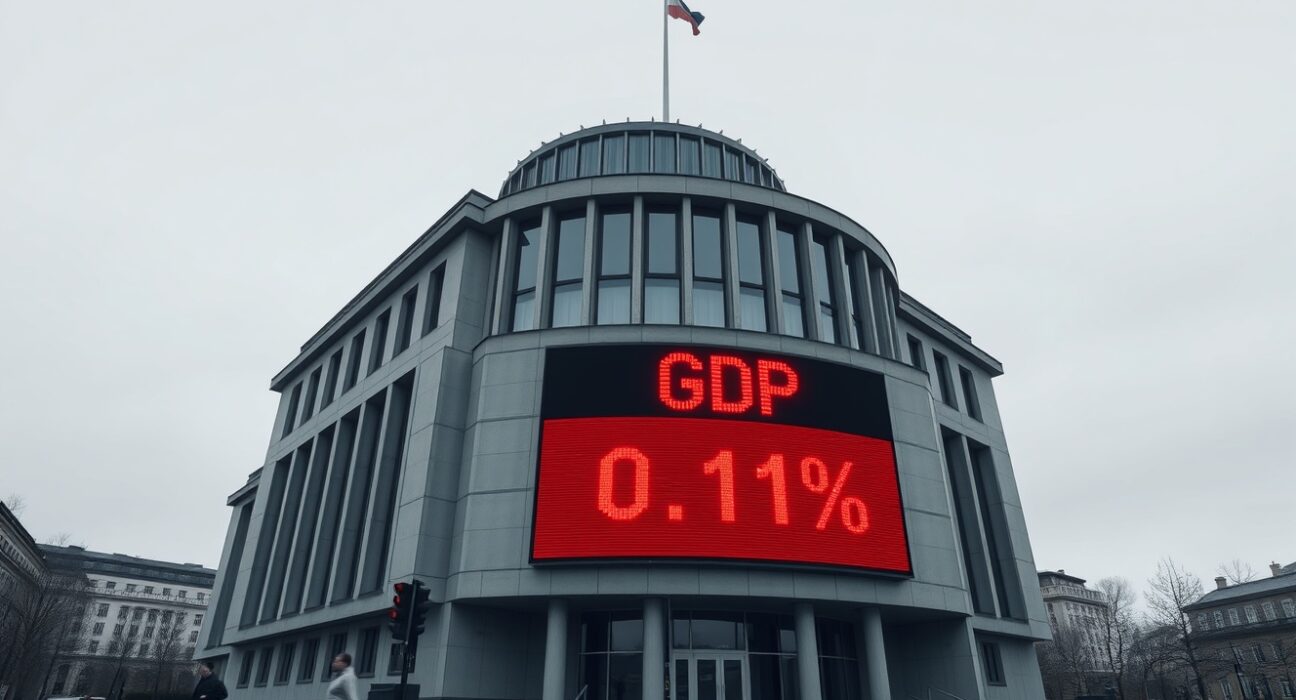
The Eurozone flash Q1 GDP growth rate arrived at a disappointing 0.1%, missing the 0.2% estimates set by economists. This figure represents a significant slowdown from the previous quarter’s 0.3% expansion. The data, released today by Eurostat, signals a fragile recovery for the 20-nation currency bloc. Markets reacted with immediate caution. The euro fell against the US dollar. Bond yields in Germany and France edged lower. Investors now question the European Central Bank’s (ECB) next policy move.
Eurozone Flash Q1 GDP: A Closer Look at the Numbers
The 0.1% growth rate marks the weakest quarterly performance since the stagnation seen in late 2023. Analysts had forecast a 0.2% increase. This miss raises concerns about the bloc’s economic resilience. The largest economies, Germany and France, reported mixed results. Germany’s GDP contracted by 0.1%, defying expectations of a 0.1% expansion. France managed a 0.2% growth, matching forecasts. Italy posted a flat 0.0% reading. Spain outperformed with a 0.4% gain, but this was not enough to offset the broader weakness.
| Country | Q1 GDP Growth | Q4 2024 GDP | Estimate |
|---|---|---|---|
| Germany | -0.1% | 0.0% | 0.1% |
| France | 0.2% | 0.1% | 0.2% |
| Italy | 0.0% | 0.2% | 0.1% |
| Spain | 0.4% | 0.3% | 0.3% |
| Eurozone Total | 0.1% | 0.3% | 0.2% |
These figures highlight a clear divergence. Northern and core economies struggle. Southern economies show relative strength. This uneven performance complicates ECB policy.
Why Did the Eurozone Q1 GDP Miss Estimates?
Several factors drove the miss. Industrial production in Germany fell sharply. Energy costs remain high. Global demand for manufactured goods weakens. The automotive sector faces structural challenges. French consumer spending stalled. Italian business investment dropped. Additionally, lingering effects of tight monetary policy weigh on credit growth. The ECB’s cumulative 450 basis points of rate hikes since mid-2022 continue to filter through. Services activity provided some support. However, it could not fully compensate for manufacturing weakness.
External headwinds also played a role. Weak demand from China hit exports. Trade tensions with the US persist. Geopolitical uncertainty from conflicts in Ukraine and the Middle East dampens confidence. The bloc’s labor market remains tight. Unemployment stays at a record low of 6.5%. Yet wage growth has not kept pace with inflation. Real household incomes remain under pressure.
Market Reaction to the Eurozone GDP Data
Financial markets reacted swiftly. The euro dropped 0.3% against the dollar, trading near $1.07. German 10-year Bund yields fell 5 basis points to 2.45%. French yields declined similarly. European stock indices opened lower. The STOXX 600 fell 0.4%. Bank stocks led the decline. Investors now price in a higher probability of an ECB rate cut in June. Money markets now see a 70% chance of a 25-basis-point cut. This is up from 60% before the release.
- EUR/USD: Fell to 1.0720, down 0.3%.
- German Bund yield: Dropped to 2.45%.
- STOXX 600: Declined 0.4%.
- Rate cut probability: June cut odds rise to 70%.
The market’s response reflects a shift in sentiment. Traders now expect the ECB to prioritize growth over inflation.
ECB Policy Implications After the GDP Miss
The ECB faces a difficult decision. Inflation remains above the 2% target. Core inflation stands at 2.9%. Services inflation is sticky at 4.0%. Yet growth is faltering. The ECB’s April meeting minutes indicated a cautious approach. Some members argued for a rate cut in June. Others warned against premature easing. The GDP miss strengthens the dovish camp. President Christine Lagarde has stressed data dependence. This release provides clear data.
Economists at major banks have revised their forecasts. Goldman Sachs now expects a first cut in June. Barclays also moved its forecast forward. The ECB’s own staff projections, due in June, will be critical. If they downgrade growth forecasts significantly, a June cut becomes almost certain. However, the ECB must balance this against wage growth and services inflation. The risk of stagflation – low growth with high inflation – looms.
Expert Perspectives on the GDP Data
Dr. Anna Schmidt, chief European economist at a leading research firm, stated: “The 0.1% GDP print is a clear warning. The Eurozone is not recovering as expected. The German contraction is particularly worrying. It signals structural issues beyond cyclical factors.” She added that the ECB should prepare for a June cut. “Waiting too long risks a deeper downturn.”
Other analysts point to the services sector’s resilience. “The economy is not collapsing,” said Mark Johnson, a macro strategist. “But the momentum is clearly slowing. The ECB will need to act.” The divergence between manufacturing and services is stark. The composite PMI fell to 51.4 in April, still in expansion but losing steam.
Historical Context of Eurozone GDP Growth
This is not the first time the Eurozone has faced a growth scare. In 2023, the bloc narrowly avoided a recession. GDP contracted in Q4 2023 and Q1 2024 before a modest recovery. The current slowdown mirrors that pattern. However, the underlying conditions differ. Inflation is lower now than in 2023. But interest rates are higher. The labor market is tighter. Fiscal support from governments is fading. The EU’s new fiscal rules require deficit reduction. This limits the ability of governments to stimulate growth.
The ECB’s quantitative tightening also continues. The central bank is reducing its bond holdings. This drains liquidity from the financial system. It adds another layer of tightening. The combination of tight monetary and fiscal policy creates a challenging environment.
Impact on Different Sectors and Countries
The GDP miss affects sectors unevenly. Manufacturing is the main drag. The industrial sector has been in contraction for over a year. Energy-intensive industries, like chemicals and metals, suffer. The automotive sector faces disruption from the EV transition and Chinese competition. Construction is weak due to high borrowing costs. Services, particularly tourism and hospitality, remain strong. Southern European countries benefit from a robust travel season.
Country-level impacts vary. Germany’s contraction raises fears of a prolonged downturn. The German government’s own forecast for 2025 growth is just 0.3%. France faces political uncertainty after the recent elections. Italy’s high public debt limits its fiscal space. Spain’s growth, driven by services and tourism, stands out. The Netherlands and Belgium also reported below-consensus figures.
What This Means for Investors and Businesses
For investors, the weak GDP data reinforces a defensive stance. Bond markets rally on rate cut expectations. Equity markets favor interest-rate-sensitive sectors. Utilities and real estate benefit. Cyclical sectors like industrials and autos underperform. The euro remains under pressure. A weaker euro helps exporters but raises import costs. Businesses face continued uncertainty. Investment decisions get delayed. Hiring plans slow. The outlook for corporate earnings weakens.
Small and medium enterprises (SMEs) feel the pinch most. They have less pricing power and higher borrowing costs. Bank lending surveys show tightening credit standards. Loan demand from businesses is falling. This creates a negative feedback loop. Weak growth leads to lower investment. Lower investment leads to weaker growth.
Conclusion
The Eurozone flash Q1 GDP growth of 0.1% clearly misses the 0.2% estimate. This signals a fragile and uneven recovery. Germany’s contraction is a major concern. The ECB now faces pressure to cut rates in June. Market expectations have shifted accordingly. However, persistent inflation limits the ECB’s room for maneuver. The bloc must navigate a narrow path between stagnation and price stability. Investors and businesses should prepare for continued volatility. The data underscores the need for structural reforms and coordinated policy action. The coming months will be crucial for the Eurozone’s economic trajectory.
FAQs
Q1: What is the Eurozone flash Q1 GDP figure?
The Eurozone flash Q1 GDP growth rate is 0.1%, missing the 0.2% estimate from economists.
Q2: Why did the Eurozone GDP miss estimates?
Key reasons include German industrial contraction, weak French consumer spending, high energy costs, and the lingering impact of tight ECB monetary policy.
Q3: How did markets react to the GDP miss?
The euro fell, bond yields declined, and stock markets opened lower. Rate cut expectations for June increased to 70%.
Q4: Will the ECB cut rates in June?
The GDP miss increases the probability of a June rate cut. However, the ECB must balance this against persistent inflation above the 2% target.
Q5: Which Eurozone countries performed worst in Q1?
Germany contracted by 0.1%. Italy posted zero growth. France met expectations at 0.2%. Spain outperformed with 0.4% growth.
Disclaimer: The information provided is not trading advice, Bitcoinworld.co.in holds no liability for any investments made based on the information provided on this page. We strongly recommend independent research and/or consultation with a qualified professional before making any investment decisions.
