

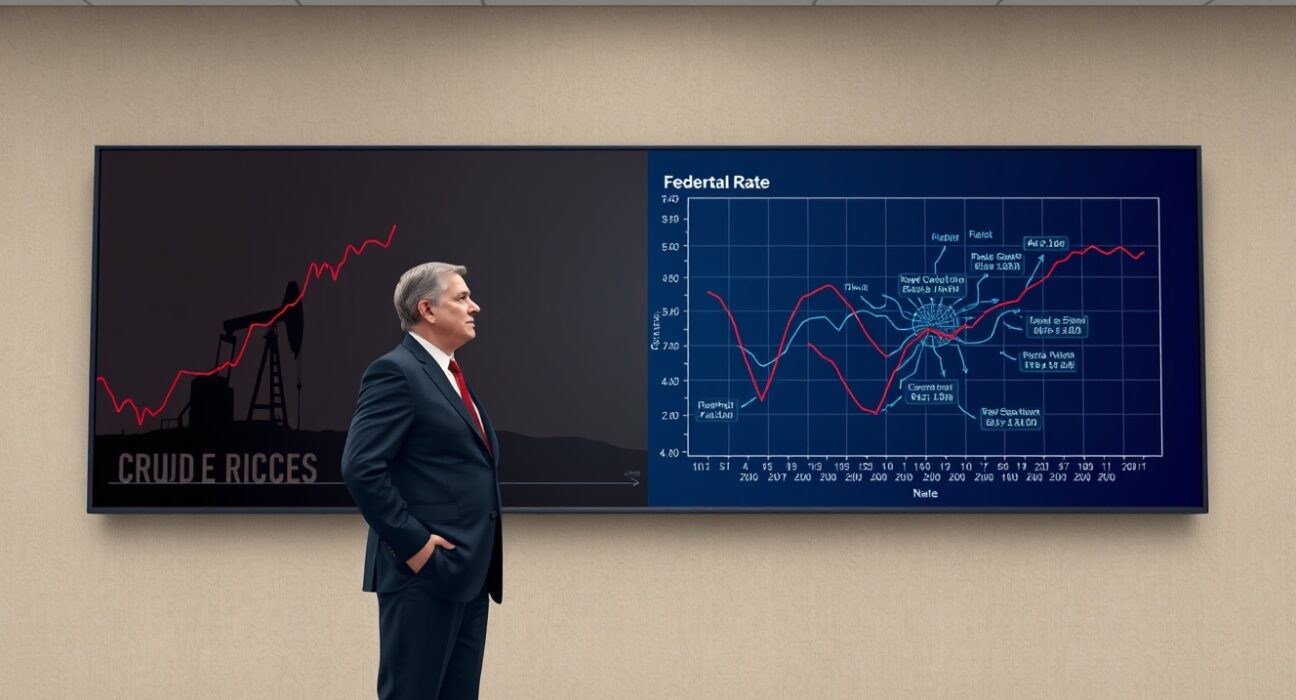
WASHINGTON, D.C. – March 15, 2025 – A significant oil price shock is creating substantial complications for the Federal Reserve’s carefully planned interest rate trajectory, according to a detailed analysis from TD Securities. This development introduces fresh uncertainty into monetary policy deliberations as central bankers navigate persistent inflationary pressures against growing economic headwinds. Consequently, market participants now face a more complex forecasting environment for the remainder of 2025.
Federal Reserve Confronts Dual Mandate Dilemma
The Federal Reserve’s dual mandate requires balancing maximum employment with stable prices. However, a sharp rise in oil prices directly challenges this equilibrium. Rising energy costs act as a tax on consumers and businesses, potentially slowing economic growth. Simultaneously, they feed directly into broader inflation measures, complicating the disinflationary process. TD Securities analysts highlight this precise tension in their latest research note. They argue the current situation creates a policy trade-off with no clear optimal path.
Historically, oil shocks have preceded economic slowdowns. For instance, the 1973 embargo and the 1990 price spike both triggered recessions. The 2008 price surge also contributed to the global financial crisis. The Federal Reserve must now decide whether to prioritize fighting inflation, which could weaken the economy further, or support growth, which might let inflation become entrenched. This decision carries significant weight for global financial stability.
Anatomy of the 2025 Oil Price Shock
Several interconnected factors are driving the current oil market volatility. Geopolitical tensions in key producing regions have disrupted supply chains. Additionally, underinvestment in traditional energy infrastructure during the transition period has reduced spare production capacity. OPEC+ production discipline remains tight, limiting market responsiveness. Meanwhile, global demand, particularly from emerging economies, has proven more resilient than many analysts projected.
The price impact is already visible across the economy. Transportation costs are rising for goods movement. Manufacturing energy inputs are becoming more expensive. Households are facing higher costs for gasoline and heating. These increases create second-round effects as businesses pass costs to consumers. The Federal Reserve monitors these pass-through effects closely because they influence core inflation expectations.
TD Securities’ Analytical Framework
TD Securities employs a multi-factor model to assess monetary policy impacts. Their analysis incorporates real-time commodity data, inflation expectations surveys, and labor market indicators. The firm’s economists compare current conditions to historical episodes like the 2011-2014 period. During that time, elevated oil prices coexisted with modest economic growth and stable core inflation. However, today’s starting point features higher underlying inflation, making the Federal Reserve’s task more difficult.
The research suggests the Federal Reserve may adopt a “wait-and-see” posture. Policymakers could delay planned rate cuts while assessing the shock’s persistence. Alternatively, they might proceed with cautious easing if labor market data shows meaningful softening. The path forward depends heavily on whether the oil shock proves temporary or sustained. Market pricing currently reflects heightened uncertainty, with futures indicating a wider range of potential outcomes.
Comparative Policy Responses to Commodity Shocks
Central banks globally face similar challenges, though their responses may differ. The European Central Bank must consider energy-intensive European industries. The Bank of England deals with imported inflation via a weaker pound. The Federal Reserve, however, benefits from greater domestic energy production. This relative insulation provides some policy flexibility. Nevertheless, global financial conditions remain tightly linked, limiting any central bank’s independence.
The table below summarizes potential Federal Reserve policy stances under different oil price scenarios:
| Oil Price Scenario | Likely Fed Stance | Primary Risk |
|---|---|---|
| Short-term spike (1-2 quarters) | Pause, then resume planned path | Overreacting to transient data |
| Sustained elevation | Extended pause, higher-for-longer | Triggering economic slowdown |
| Rapid normalization | Accelerated easing cycle | Reigniting inflation expectations |
Market Implications and Investor Positioning
Financial markets are recalibrating expectations based on this new uncertainty. Treasury yield curves have flattened as investors price in a more cautious Federal Reserve. Equity sectors are experiencing divergent performance. Energy companies are benefiting from higher prices. Conversely, consumer discretionary and industrial sectors face margin pressures. The U.S. dollar has strengthened as higher rates attract capital flows, creating challenges for emerging markets.
Investors should monitor several key indicators. First, watch core PCE inflation excluding energy. Second, track consumer inflation expectations from the University of Michigan survey. Third, observe jobless claims for early labor market signals. Finally, follow Federal Reserve communications for any shift in tone regarding the oil shock’s impact. TD Securities recommends a defensive tilt in portfolios, emphasizing quality factors and real assets.
The Inflation Expectations Channel
A critical risk involves inflation expectations becoming unanchored. If consumers and businesses expect persistently higher prices, they may change behavior. Workers could demand larger wage increases. Companies might raise prices preemptively. The Federal Reserve views well-anchored expectations as essential for price stability. Recent surveys show a slight uptick in long-term expectations, warranting close monitoring. Central bank credibility in managing this channel remains paramount.
Broader Economic Consequences
The oil shock’s effects extend beyond monetary policy. Consumer spending patterns are shifting away from discretionary items. Business investment decisions may be delayed due to uncertainty. Government budgets face pressure from higher energy subsidies and transportation costs. The global trade system experiences renewed stress as transport costs rise. These interconnected effects create a complex feedback loop for policymakers.
Potential mitigation strategies exist. Strategic petroleum reserve releases could temporarily dampen prices. Diplomatic efforts might stabilize producing regions. Accelerated permitting for energy projects could boost medium-term supply. However, each option carries political and economic trade-offs. The Federal Reserve must operate within this constrained environment, focusing on variables within its direct control.
Conclusion
The Federal Reserve’s interest rate path faces significant complications from the ongoing oil price shock, precisely as TD Securities analysis warns. Navigating this challenge requires balancing inflation risks against growth concerns. Policymakers must distinguish between temporary price spikes and sustained inflationary impulses. Market participants should prepare for heightened volatility and a data-dependent Federal Reserve. Ultimately, the central bank’s credibility and communication will be tested as it manages this complex economic crosscurrent in 2025.
FAQs
Q1: What is an oil price shock and how does it affect the economy?
An oil price shock is a rapid, significant increase in the price of crude oil. It affects the economy by raising costs for transportation, manufacturing, and heating. This acts like a tax, reducing consumer disposable income and business profit margins, while simultaneously pushing up measured inflation.
Q2: Why does an oil shock complicate the Federal Reserve’s interest rate decisions?
It creates a policy dilemma. Higher oil prices boost inflation, suggesting the Fed should maintain higher rates. However, they also slow economic growth by reducing spending, which might argue for lower rates. The Fed must judge whether the inflation effect is temporary or will become embedded in expectations.
Q3: How is the 2025 oil shock different from previous ones?
The current shock occurs in an environment of already elevated core inflation, reducing the Fed’s policy flexibility. Additionally, the energy transition has changed investment patterns, potentially affecting supply responsiveness. Geopolitical factors are also more multipolar than during previous shocks.
Q4: What indicators should I watch to gauge the Fed’s likely response?
Monitor core inflation measures (like Core PCE), consumer inflation expectation surveys, labor market data (especially wage growth), and Fed officials’ speeches. The persistence of high oil prices, not just the initial spike, will be a key determinant.
Q5: What does TD Securities recommend for investors during this period?
TD Securities suggests a cautious, defensive investment stance. They recommend focusing on quality companies with strong balance sheets, considering allocations to real assets that can hedge inflation, and being prepared for continued volatility in both bond and equity markets as the policy path remains uncertain.
Disclaimer: The information provided is not trading advice, Bitcoinworld.co.in holds no liability for any investments made based on the information provided on this page. We strongly recommend independent research and/or consultation with a qualified professional before making any investment decisions.