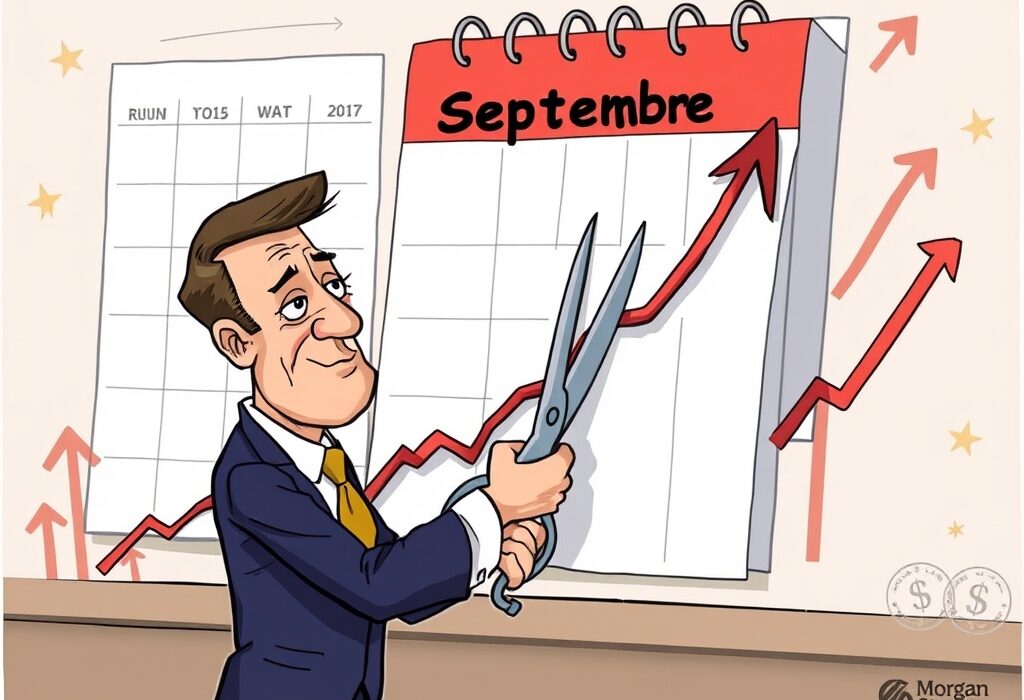
The financial world is buzzing with a significant prediction from investment giant Morgan Stanley. They anticipate the U.S. Federal Reserve will begin implementing Fed rate cuts as early as September. This forecast suggests a shift in monetary policy that could have profound implications for markets, businesses, and everyday consumers. Understanding these potential changes is crucial for anyone navigating the current economic landscape.
Morgan Stanley’s Bold Forecast for Fed Rate Cuts
According to a report by Walter Bloomberg, Morgan Stanley’s economists project a clear timeline for the upcoming Fed rate cuts. The firm expects an initial reduction of 25 basis points in September. Following this, they foresee another cut in December.
This isn’t just a short-term outlook. Morgan Stanley extends its forecast, projecting quarterly reductions of 25 basis points through the end of 2026. This consistent approach would ultimately bring the federal funds target rate to a range between 2.75% and 3.0%.
- Initial Cut: A 25 basis point reduction is expected in September.
- Second Cut: Another 25 basis point reduction is projected for December.
- Long-Term Plan: Quarterly 25 basis point cuts are anticipated until Q4 2026.
- Projected Target Rate: The target rate is forecast to reach 2.75% to 3.0% by the end of 2026.
Why Are Fed Rate Cuts So Important for the Economy?
You might wonder, why do these anticipated Fed rate cuts matter so much? Interest rate adjustments by the Federal Reserve are powerful tools that influence the entire economy. When the Fed lowers rates, it generally makes borrowing cheaper for banks, which then translates to lower interest rates for consumers and businesses.
Cheaper loans can stimulate economic activity. For instance, mortgage rates might drop, encouraging home buying. Businesses could find it less expensive to invest in expansion, potentially leading to job creation. However, the timing and magnitude of these Fed rate cuts are always closely watched, as they also reflect the Fed’s assessment of inflation and economic growth.
Navigating the Market Ahead of Potential Fed Rate Cuts
The prospect of significant Fed rate cuts presents both opportunities and challenges. Investors often react to these predictions, leading to market volatility. Understanding the potential impact can help individuals and businesses prepare.
Potential Benefits:
- Lower Borrowing Costs: Mortgages, car loans, and credit card interest rates could decrease.
- Stimulated Spending: Consumers might feel more confident to spend and invest.
- Business Growth: Companies can access capital more cheaply, fostering expansion.
- Equity Market Boost: Lower rates often make stocks more attractive compared to bonds.
Potential Challenges:
- Reduced Savings Returns: Interest earned on savings accounts and Certificates of Deposit (CDs) might fall.
- Inflation Concerns: Aggressive cuts could, in some scenarios, reignite inflation if not managed carefully.
- Market Volatility: Uncertainty surrounding the Fed’s decisions can lead to short-term market swings.
What Could Influence Future Federal Reserve Rate Cuts?
The Federal Reserve’s decisions are not set in stone. They are highly dependent on incoming economic data and evolving conditions. Key factors that will influence the actual implementation and pace of these Fed rate cuts include:
- Inflation Data: The Fed’s primary goal is price stability. If inflation remains stubbornly high, rate cuts could be delayed.
- Employment Figures: A strong job market might give the Fed more leeway, while a weakening one could accelerate cuts.
- GDP Growth: Economic growth indicators provide insight into the overall health of the economy.
- Global Economic Trends: International events and economic performance can also play a role in the Fed’s considerations.
Morgan Stanley’s forecast offers a detailed roadmap, but the Federal Reserve will ultimately make its decisions based on its dual mandate: maximizing employment and maintaining price stability. Therefore, keeping an eye on these economic indicators is vital.
In conclusion, Morgan Stanley’s prediction of consistent Fed rate cuts starting in September signals a potential shift towards a more accommodative monetary policy. While this could bring relief to borrowers and stimulate economic growth, it also requires careful consideration for savers and investors. Staying informed about the Federal Reserve’s actions and the broader economic landscape remains paramount for making sound financial decisions in the months and years ahead.
Frequently Asked Questions (FAQs)
What are Fed rate cuts?
Fed rate cuts refer to decisions by the U.S. Federal Reserve to lower the target range for the federal funds rate. This action typically makes borrowing cheaper across the economy, aiming to stimulate economic growth.
When does Morgan Stanley expect the first Fed rate cut?
Morgan Stanley anticipates the first Fed rate cut of 25 basis points to occur in September, followed by another in December.
How will Fed rate cuts affect consumers?
For consumers, Fed rate cuts could lead to lower interest rates on mortgages, car loans, and credit cards, making borrowing more affordable. However, returns on savings accounts and CDs might also decrease.
What is a basis point?
A basis point (bp) is a common unit of measure in finance, equal to one-hundredth of a percentage point. So, a 25 basis point cut means a 0.25% reduction in interest rates.
What is the projected target rate by 2026?
Morgan Stanley projects that through quarterly Fed rate cuts, the federal funds target rate will reach a range between 2.75% and 3.0% by the end of 2026.
Did you find Morgan Stanley’s prediction insightful? Share this article with your network on social media to keep others informed about the potential impact of future Fed rate cuts!
To learn more about the latest economic trends and their impact on digital assets, explore our article on key developments shaping the crypto market’s price action amidst global economic shifts.
Disclaimer: The information provided is not trading advice, Bitcoinworld.co.in holds no liability for any investments made based on the information provided on this page. We strongly recommend independent research and/or consultation with a qualified professional before making any investment decisions.