

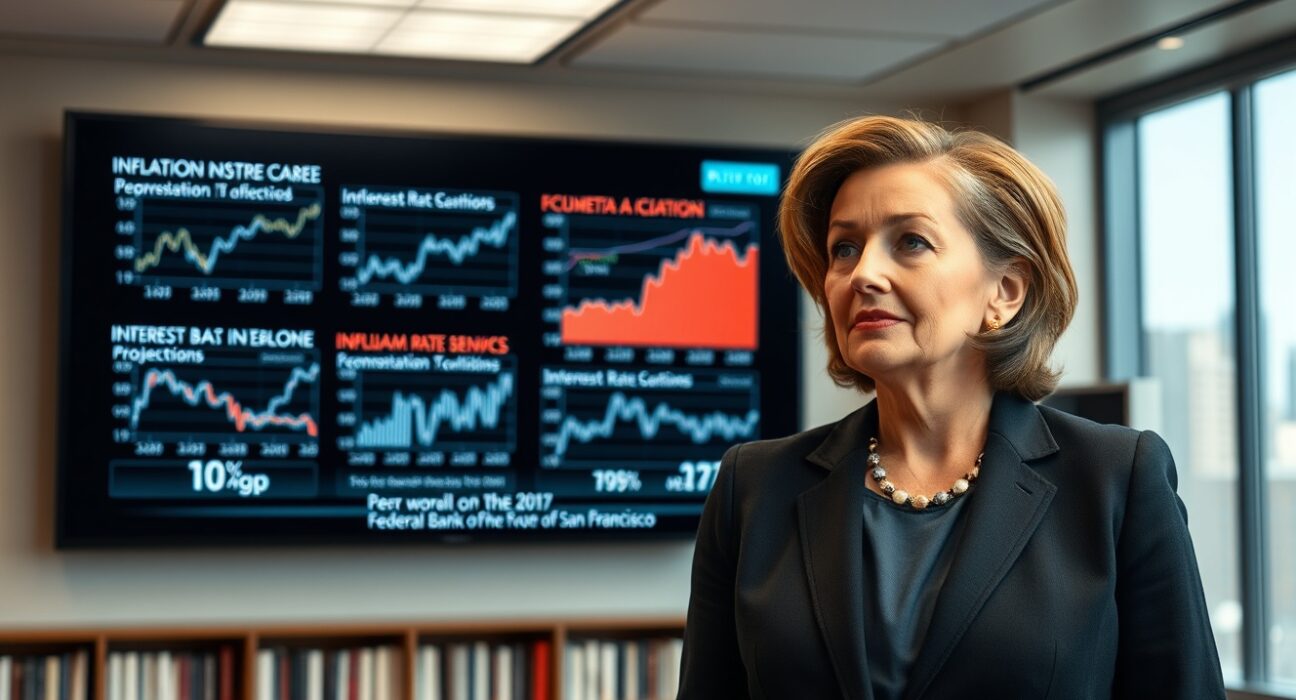
Federal Reserve Bank of San Francisco President Mary Daly delivered significant remarks today, suggesting the central bank could maintain current interest rates as economic charts reveal complex signals about inflation and growth trajectories for 2025.
Federal Reserve’s Monetary Policy at a Critical Juncture
Mary Daly’s comments emerged during a policy discussion at Stanford University on March 15, 2025. The Federal Reserve official emphasized data-dependent decision-making while analyzing recent economic indicators. Consequently, financial markets immediately processed her cautious stance on potential rate adjustments. Moreover, her analysis referenced specific economic charts showing inflation moderation alongside persistent service-sector pressures.
The Federal Open Market Committee faces complex decisions in coming months. Recent data reveals conflicting signals across different economic sectors. For instance, consumer spending shows resilience while manufacturing indicators suggest softening. Therefore, policymakers must balance multiple objectives simultaneously.
Analyzing the Economic Charts Driving Policy Decisions
Federal Reserve economists rely on several key data visualizations. These charts provide crucial insights into economic health. Specifically, inflation metrics receive particular attention from policymakers.
- Core PCE Inflation Charts: Show year-over-year price changes excluding food and energy
- Labor Market Indicators: Display unemployment rates and wage growth patterns
- Consumer Spending Data: Illustrate retail sales and service consumption trends
- Business Investment Metrics: Track capital expenditure and equipment purchases
- Financial Conditions Index: Measures credit availability and market volatility
Current charts reveal inflation has moderated from peak levels. However, services inflation remains elevated above pre-pandemic averages. Meanwhile, employment indicators show gradual cooling without significant deterioration. Consequently, this mixed picture supports a patient approach to policy adjustments.
Historical Context of Federal Reserve Rate Decisions
The Federal Reserve began its current tightening cycle in March 2022. Initially, policymakers responded aggressively to surging inflation. Subsequently, they implemented eleven rate increases over twenty months. Therefore, the current federal funds rate stands at its highest level in twenty-three years.
Recent months have witnessed a notable shift in policy approach. Specifically, the Federal Reserve has moved from rapid tightening to extended observation. This transition reflects improving inflation metrics and emerging economic uncertainties. Meanwhile, global central banks exhibit divergent policy paths, creating additional complexity.
| Date | Policy Action | Federal Funds Rate |
|---|---|---|
| March 2022 | First increase | 0.25%-0.50% |
| June 2022 | Largest single increase | 1.50%-1.75% |
| December 2023 | Cycle peak | 5.25%-5.50% |
| September 2024 | First pause | 5.25%-5.50% |
| March 2025 | Current stance | 5.25%-5.50% |
Expert Analysis of Current Economic Conditions
Former Federal Reserve economists provide valuable perspective on current conditions. Dr. Claudia Sahm, creator of the Sahm Rule recession indicator, emphasizes labor market stability. “Current employment charts show remarkable resilience,” she notes. “However, we must monitor leading indicators for early warning signals.”
Similarly, Harvard economist Jason Furman analyzes inflation persistence. “Service sector inflation demonstrates notable stickiness,” Furman observes. “This characteristic justifies the Federal Reserve’s cautious approach to potential rate cuts.”
Market participants generally anticipate limited policy changes in coming months. Futures pricing suggests only modest adjustments through mid-2025. Therefore, Mary Daly’s comments align with prevailing market expectations.
Potential Impacts on Financial Markets and Economy
Extended higher rates influence multiple economic sectors significantly. First, housing markets face continued affordability challenges. Second, business investment decisions incorporate higher financing costs. Third, government debt servicing requires substantial budgetary resources.
Financial markets exhibit specific reactions to Federal Reserve communications. Typically, Treasury yields respond immediately to policy signals. Meanwhile, equity markets process implications for corporate earnings. Additionally, currency markets adjust to relative interest rate differentials.
Recent trading sessions show particular sensitivity to Federal Reserve commentary. For instance, two-year Treasury notes demonstrate heightened volatility. Similarly, rate-sensitive technology stocks exhibit amplified price movements. Consequently, investors monitor policy communications with exceptional attention.
Global Central Bank Policy Coordination Challenges
International monetary policy divergence creates additional complications. Currently, the European Central Bank maintains different inflation dynamics. Meanwhile, the Bank of Japan continues unconventional policy approaches. Therefore, Federal Reserve decisions influence global capital flows substantially.
Emerging market economies face particular vulnerability to U.S. rate decisions. Historically, dollar strength creates debt servicing difficulties for these nations. Consequently, international policymakers monitor Federal Reserve communications closely.
Conclusion
Federal Reserve President Mary Daly’s analysis suggests interest rates could remain unchanged as economic charts present mixed signals. The central bank’s data-dependent approach requires careful monitoring of inflation metrics and employment indicators. Therefore, monetary policy likely maintains its current restrictive stance through mid-2025. Financial markets should prepare for extended period of policy stability with potential gradual adjustments later this year. Ultimately, Federal Reserve decisions will balance inflation control with economic growth preservation.
FAQs
Q1: What did Mary Daly specifically say about interest rates?
Mary Daly suggested the Federal Reserve could leave rates where they are, emphasizing data dependence and careful analysis of economic charts showing inflation trends.
Q2: Which economic charts are most important for Federal Reserve decisions?
The Federal Reserve primarily analyzes core PCE inflation charts, employment data, consumer spending metrics, and financial conditions indices when making monetary policy decisions.
Q3: How long has the Federal Reserve maintained current interest rate levels?
The federal funds rate has remained at 5.25%-5.50% since December 2023, representing the longest period without change in the current tightening cycle.
Q4: What are the risks of keeping rates higher for longer?
Extended higher rates risk excessive economic slowing, increased debt servicing costs, financial market volatility, and potential stress in rate-sensitive sectors like housing and commercial real estate.
Q5: When might the Federal Reserve consider cutting interest rates?
Most analysts suggest rate cuts might occur later in 2025 if inflation shows sustained movement toward the 2% target and employment indicators demonstrate meaningful softening.
Disclaimer: The information provided is not trading advice, Bitcoinworld.co.in holds no liability for any investments made based on the information provided on this page. We strongly recommend independent research and/or consultation with a qualified professional before making any investment decisions.
