
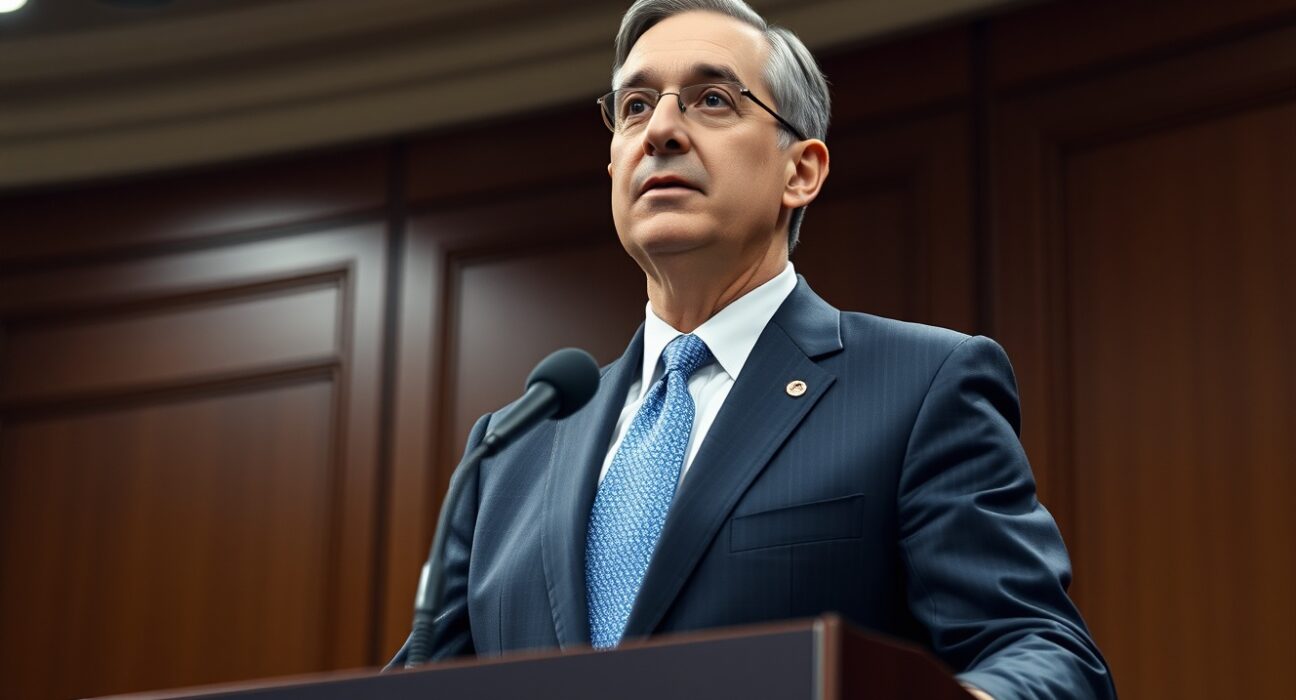
WASHINGTON, D.C., March 2025 – Federal Reserve Governor Alberto Musalem delivered a significant policy statement today, emphasizing the necessity for current monetary policy to remain unchanged for an extended period. Consequently, this position signals a cautious approach by the central bank amid ongoing economic evaluations. Furthermore, his remarks come at a critical juncture for global financial markets.
Federal Reserve Maintains Steady Monetary Policy Course
Governor Musalem articulated the Federal Reserve’s current stance during a policy symposium. Specifically, he highlighted the importance of maintaining the existing federal funds rate target range. Therefore, this approach aims to balance inflation control with economic growth support. Additionally, recent economic indicators show mixed signals about future directions.
The Federal Open Market Committee (FOMC) previously established the current rate range. Moreover, this decision followed extensive analysis of inflation data and employment figures. Subsequently, policymakers determined that premature adjustments could undermine progress. Meanwhile, global central banks monitor these developments closely.
Historical context reveals similar policy holding periods. For instance, the Fed maintained rates unchanged for eleven consecutive months during 2016-2017. Similarly, the European Central Bank recently extended its policy pause. However, current economic conditions present unique challenges.
Economic Context and Inflation Considerations
Recent Consumer Price Index (CPI) data shows gradual moderation. Specifically, the latest report indicates a 3.2% annual increase. Consequently, this remains above the Fed’s 2% target but shows improvement. Meanwhile, core inflation excluding food and energy persists at higher levels.
Employment statistics present a complex picture. The unemployment rate currently stands at 4.0%. However, wage growth continues at a moderate pace. Therefore, policymakers must consider multiple labor market indicators.
| Indicator | Current Value | Federal Reserve Target | Trend |
|---|---|---|---|
| CPI Inflation | 3.2% | 2.0% | Declining |
| Core Inflation | 3.5% | 2.0% | Stable |
| Unemployment Rate | 4.0% | 4.0% (Natural Rate) | Stable |
| GDP Growth | 2.1% | 1.8-2.2% (Potential) | Moderate |
Global economic factors also influence Fed decisions. European economic stagnation presents concerns. Similarly, Asian manufacturing slowdowns affect trade balances. Nevertheless, domestic considerations remain primary.
Expert Analysis of Policy Implications
Former Fed economist Dr. Sarah Chen explains the rationale. “Policy stability allows economic actors to plan effectively,” she notes. “Frequent changes create uncertainty that hinders investment.” Additionally, she references historical policy transitions.
Market analysts anticipate several potential outcomes. First, extended rate stability could support business expansion. Second, housing markets might experience gradual normalization. Third, consumer spending patterns may stabilize further.
Financial institutions have prepared contingency plans. Major banks stress-tested various rate scenarios. Meanwhile, investment firms adjusted portfolio allocations accordingly. Consequently, markets show measured responses.
Historical Precedents and Policy Evolution
The Federal Reserve’s current approach follows established patterns. Previous Chair Paul Volcker maintained high rates to combat 1970s inflation. Similarly, Alan Greenspan practiced gradual policy adjustments. However, each era presents distinct challenges.
Modern monetary policy incorporates several advanced tools:
- Forward Guidance: Communicating future policy intentions clearly
- Quantitative Tools: Managing balance sheet operations precisely
- Data Dependency: Basing decisions on comprehensive economic indicators
- Risk Management: Weighing potential policy errors carefully
Governor Musalem emphasized data-driven decision making. “Each economic indicator receives thorough examination,” he stated. “We consider multiple data points before determining appropriate actions.” This methodological approach ensures balanced considerations.
Market Reactions and Future Projections
Financial markets responded moderately to the announcement. Treasury yields showed minimal movement initially. However, longer-term securities experienced slight adjustments. Equity markets maintained relative stability throughout trading sessions.
Federal Reserve projections suggest gradual policy normalization. The Summary of Economic Projections indicates potential rate adjustments later. Nevertheless, timing remains data-dependent. Therefore, investors monitor indicators closely.
International coordination continues among central banks. The Bank of England maintains similar cautious stances. Meanwhile, the Bank of Japan adjusts its yield curve control. Consequently, global policy alignment emerges gradually.
Conclusion
Federal Reserve Governor Alberto Musalem’s advocacy for sustained monetary policy stability reflects careful economic stewardship. The current federal funds rate target range will likely remain unchanged through upcoming meetings. This Federal Reserve monetary policy approach prioritizes inflation control while supporting continued economic expansion. Ultimately, data-dependent decision making guides all future adjustments. Market participants should anticipate measured policy evolution rather than abrupt changes.
FAQs
Q1: How long might the Federal Reserve maintain current interest rates?
Governor Musalem suggested “some time,” which analysts interpret as multiple FOMC meetings, potentially extending through mid-2025 depending on inflation and employment data.
Q2: What economic indicators most influence Fed policy decisions?
The Federal Reserve primarily monitors inflation metrics (CPI and PCE), employment data (unemployment rate and wage growth), GDP growth, and financial market conditions when making policy determinations.
Q3: How does this policy stance affect consumers and businesses?
Stable interest rates provide predictability for borrowers and lenders, potentially supporting business investment planning and allowing consumers to make informed decisions about major purchases like homes and vehicles.
Q4: What would trigger a change in the current monetary policy?
Sustained inflation moving toward the 2% target combined with labor market stability or significant economic weakening would likely prompt policy reevaluation by the Federal Open Market Committee.
Q5: How does the Fed’s current approach compare to other central banks?
The Federal Reserve’s cautious stance aligns with similar approaches by the European Central Bank and Bank of England, reflecting coordinated global efforts to balance inflation control with economic support amid uncertain conditions.
Disclaimer: The information provided is not trading advice, Bitcoinworld.co.in holds no liability for any investments made based on the information provided on this page. We strongly recommend independent research and/or consultation with a qualified professional before making any investment decisions.