
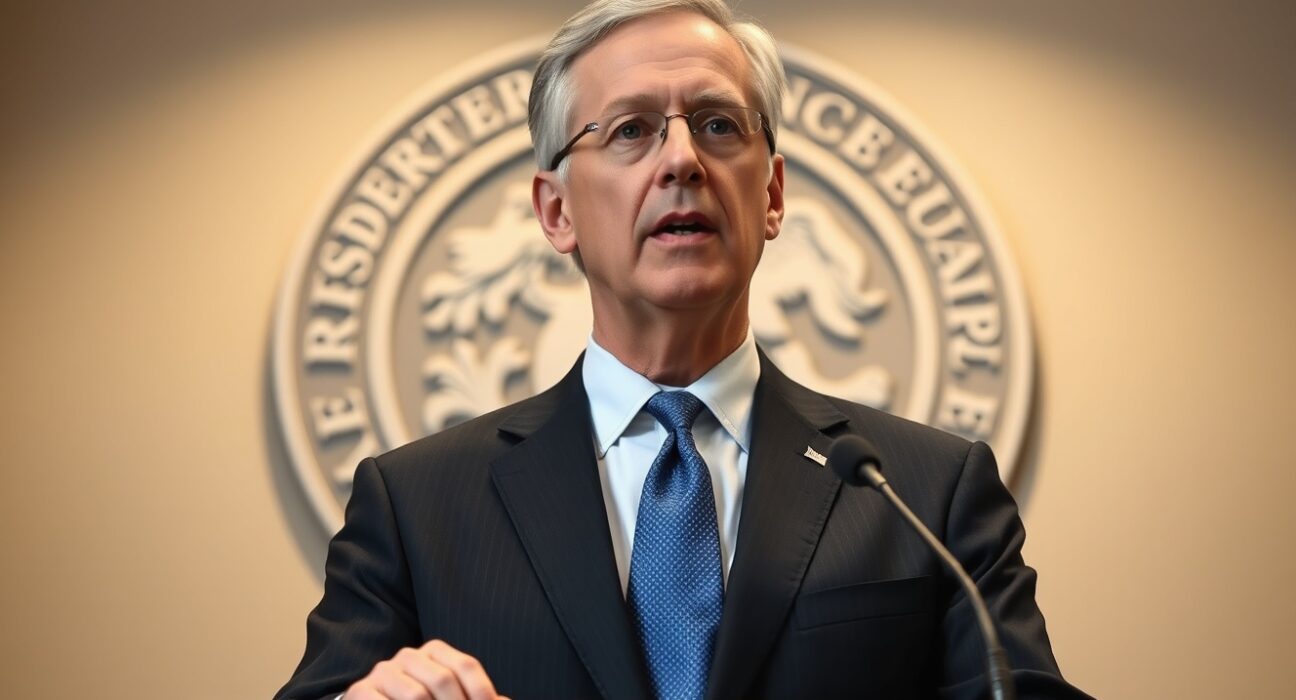
Federal Reserve Governor Christopher Waller delivered significant remarks today, clearly stating the central bank sees no immediate need to consider interest rate increases. This announcement provides crucial insight into the Federal Reserve’s monetary policy direction as economic indicators continue to evolve throughout 2025. Waller’s comments come at a pivotal moment for global financial markets, which have been closely monitoring central bank communications for signals about future policy adjustments.
Federal Reserve Maintains Steady Course on Interest Rates
Governor Christopher Waller’s recent statements reinforce the Federal Reserve’s current policy stance. During his address at the Economic Club of New York, Waller emphasized that current economic conditions do not warrant consideration of rate hikes. Consequently, this position aligns with recent Federal Open Market Committee (FOMC) meeting minutes. The central bank continues prioritizing its dual mandate of maximum employment and price stability.
Market analysts immediately reacted to Waller’s comments. Specifically, Treasury yields showed modest movement while equity markets demonstrated stability. Furthermore, the U.S. dollar index maintained its position against major global currencies. These market responses indicate investor confidence in the Federal Reserve’s communicated path.
Economic Context Behind the Policy Decision
Several key economic factors support the Federal Reserve’s current position. First, inflation metrics have shown consistent moderation throughout early 2025. The Consumer Price Index (CPI) recently registered at 2.3% year-over-year, approaching the Fed’s 2% target. Second, employment figures remain robust but sustainable, with unemployment holding steady at 3.8%.
The following table illustrates recent economic indicators:
| Indicator | Current Value | Trend |
|---|---|---|
| CPI Inflation | 2.3% | Declining |
| Core PCE Inflation | 2.1% | Stable |
| Unemployment Rate | 3.8% | Steady |
| GDP Growth (Q1 2025) | 2.1% | Moderate |
Third, consumer spending patterns demonstrate resilience without excessive pressure on prices. Fourth, business investment continues at measured levels. Finally, global economic conditions provide a relatively stable backdrop for U.S. monetary policy decisions.
Historical Perspective on Federal Reserve Policy Shifts
The Federal Reserve’s current approach represents a significant evolution from previous years. During the 2022-2024 period, the central bank implemented the most aggressive tightening cycle in decades. The federal funds rate increased from near zero to a range of 5.25%-5.50%. This historical context makes Waller’s current statements particularly noteworthy.
Several previous policy cycles offer valuable comparisons. The 2015-2018 tightening cycle proceeded more gradually than recent actions. The 2004-2006 period featured steady increases but different economic fundamentals. Understanding these historical patterns helps analysts interpret current Fed communications more accurately.
Expert Analysis of Monetary Policy Trajectory
Financial economists widely interpret Waller’s remarks as signaling an extended pause in rate adjustments. According to Dr. Sarah Chen, Chief Economist at Global Financial Insights, “Governor Waller’s comments reflect careful data analysis. The Federal Reserve appears confident that current policy settings appropriately balance growth and inflation concerns.”
Market strategists emphasize several implications. First, borrowing costs should remain stable for consumers and businesses. Second, financial conditions will likely maintain current supportive levels. Third, the yield curve may continue its recent normalization pattern. Fourth, risk assets could benefit from reduced uncertainty about near-term rate movements.
Global Central Bank Coordination and Implications
The Federal Reserve’s stance occurs alongside similar positions from other major central banks. The European Central Bank recently maintained its policy rates while signaling cautious optimism about inflation trends. The Bank of England has similarly paused its tightening cycle. The Bank of Japan continues its distinctive approach amid different economic conditions.
This global coordination carries several important implications:
- Currency stability among major economies
- Reduced volatility in international capital flows
- Consistent messaging supporting global economic stability
- Coordinated approach to monitoring inflation risks
International financial institutions have welcomed this coordinated approach. The International Monetary Fund recently noted that synchronized central bank communication reduces global financial stability risks.
Forward Guidance and Market Expectations
Governor Waller’s comments provide valuable forward guidance to financial markets. Market participants now anticipate several probable scenarios. First, the Federal Reserve will likely maintain current rates through at least the third quarter of 2025. Second, any future policy adjustments will remain data-dependent. Third, the balance sheet reduction program will continue according to established plans.
Futures markets currently price in minimal probability of rate increases before September 2025. However, they indicate approximately 35% probability of one rate cut by year-end. This pricing reflects market expectations that inflation will continue moderating toward the Fed’s target.
Conclusion
Federal Reserve Governor Christopher Waller’s clear statement regarding interest rates provides crucial policy transparency. The central bank sees no immediate need for rate hikes based on current economic conditions. This Federal Reserve position supports financial stability while allowing continued economic expansion. Market participants should monitor upcoming economic data releases for confirmation of these trends. The Federal Reserve’s data-dependent approach remains the guiding principle for all future monetary policy decisions.
FAQs
Q1: What specifically did Federal Reserve Governor Waller say about rate hikes?
Governor Waller stated clearly that he does not believe current economic conditions warrant consideration of interest rate increases, emphasizing data shows inflation progressing toward the Fed’s 2% target.
Q2: How does this affect mortgage rates and consumer borrowing costs?
The Federal Reserve’s position suggests stability in borrowing costs, with mortgage rates likely to remain near current levels absent significant economic changes, providing predictability for homebuyers and businesses.
Q3: What economic indicators is the Federal Reserve monitoring most closely?
The Fed primarily tracks core PCE inflation, employment data, wage growth, consumer spending patterns, and business investment metrics to inform its policy decisions.
Q4: How does this compare to other recent Federal Reserve communications?
Waller’s comments align with recent FOMC statements and Chair Powell’s press conferences, all emphasizing a patient, data-dependent approach to monetary policy adjustments.
Q5: What would cause the Federal Reserve to reconsider its position on rate hikes?
Significant acceleration in inflation metrics, sustained overheating in labor markets, or evidence of rising inflation expectations could prompt reconsideration of current policy stance.
Disclaimer: The information provided is not trading advice, Bitcoinworld.co.in holds no liability for any investments made based on the information provided on this page. We strongly recommend independent research and/or consultation with a qualified professional before making any investment decisions.