
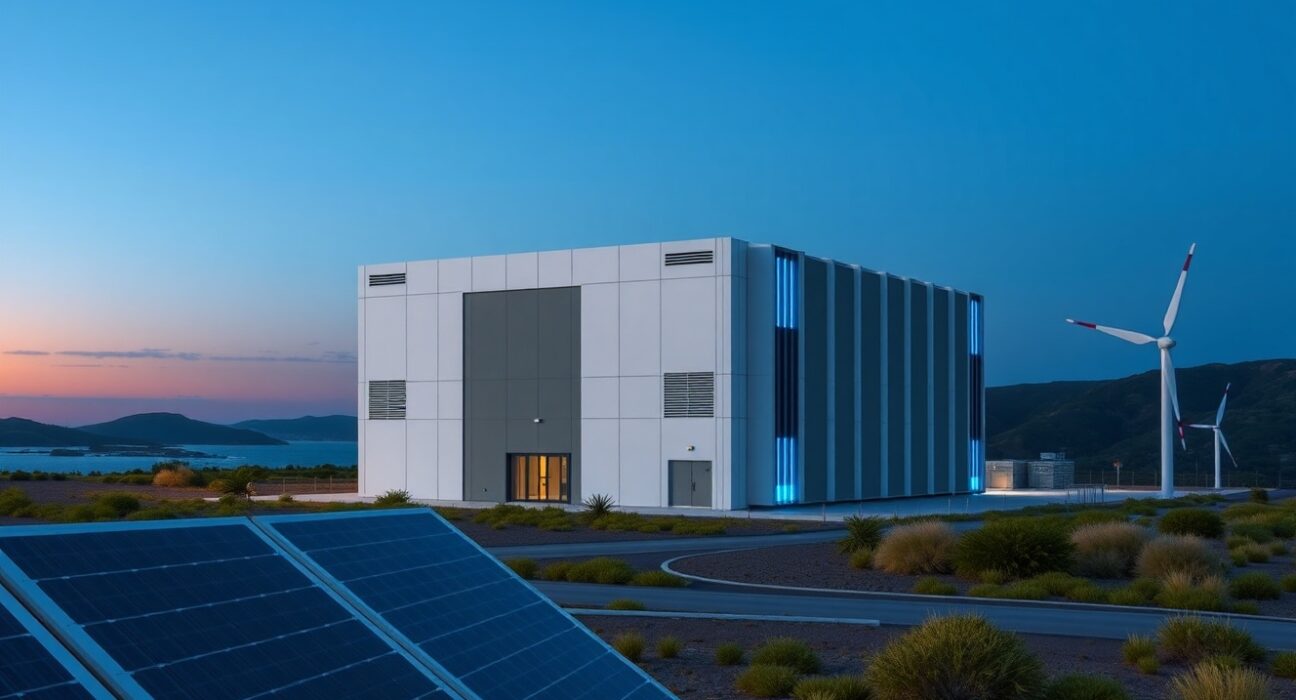
Singapore-based AI infrastructure company Firmus has catapulted to a $5.5 billion valuation following a massive $505 million funding round, positioning itself as a dominant force in building next-generation data centers for artificial intelligence workloads across the Asia-Pacific region. Announced on April 7, 2026, this landmark valuation underscores the intense investor appetite for physical AI infrastructure and validates Firmus’s ambitious ‘Project Southgate’—a network of energy-efficient ‘AI factory’ data centers leveraging Nvidia’s cutting-edge reference designs.
Firmus AI Datacenter Strategy and Project Southgate
The company’s core initiative, Project Southgate, represents a strategic pivot from its origins in Bitcoin mining cooling technologies to becoming a full-stack AI infrastructure provider. This transformation mirrors a broader industry trend where companies with expertise in compute-intensive processes are repurposing their knowledge for the generative AI boom. Firmus is specifically developing its data center network in Australia and Tasmania, regions selected for their potential renewable energy sources and geopolitical stability.
Furthermore, Firmus’s technical blueprint relies heavily on Nvidia’s reference architectures for efficient data center construction. These designs provide a standardized framework for optimizing power usage, cooling, and compute density. Consequently, the company aims to reduce the typical development timeline and operational overhead associated with custom-built AI facilities. The choice of location is also strategic, as it taps into growing demand for localized AI processing power in the Asia-Pacific market, reducing latency for regional clients.
The Nvidia Vera Rubin Platform Integration
A critical component of Firmus’s roadmap is the integration of Nvidia’s forthcoming Vera Rubin platform, the successor to the current Blackwell architecture. Scheduled to ship in the second half of 2026, the Vera Rubin system is expected to deliver significant leaps in AI computing performance and energy efficiency. By building its ‘AI factories’ with this next-generation hardware from the ground up, Firmus seeks to offer a performance advantage that retrofitted existing data centers cannot match. This forward-looking hardware strategy is a key reason for investor confidence, as it future-proofs the company’s infrastructure against rapid technological obsolescence.
Funding Trajectory and Market Validation
The latest $505 million investment, led by global investment firm Coatue, marks a stunning acceleration in Firmus’s financial growth. Notably, the company has raised $1.35 billion in just six months. This follows a previous round of approximately $215 million (AU$330 million) at a $1.2 billion valuation, which included backing from Nvidia itself. The leap from a $1.2 billion to a $5.5 billion valuation in a short period highlights the feverish market conditions for AI infrastructure assets.
This funding will primarily fuel the rapid construction and scaling of Project Southgate. The capital injection allows Firmus to secure hardware supply, acquire strategic land, and accelerate build-out schedules in a competitive market for components like advanced cooling systems and high-voltage power distribution units. The involvement of Coatue, a firm known for its technology sector investments, provides not just capital but also strategic validation and networking leverage within the tech ecosystem.
The investment thesis for firms like Coatue rests on several verifiable market facts:
- The global AI data center market is projected to exceed $200 billion by 2028, driven by demand for training and inferencing.
- Energy efficiency has become a primary cost and regulatory constraint for new data center construction.
- There is a significant shortage of readily available, purpose-built AI data center capacity worldwide.
Industry Context and Competitive Landscape
Firmus operates within a highly competitive field that includes established cloud giants (AWS, Google Cloud, Microsoft Azure), traditional data center REITs, and a wave of specialized startups. Its differentiation lies in a focused regional strategy, a first-principles design approach using Nvidia blueprints, and its heritage in thermal management from crypto mining—a skill directly transferable to cooling high-density AI server racks. The company’s evolution from a crypto-adjacent service provider to a pure-play AI infrastructure builder exemplifies a successful pivot that investors currently favor.
Moreover, the Asia-Pacific region presents a unique growth opportunity. Governments and enterprises in countries like Japan, South Korea, India, and across Southeast Asia are aggressively adopting AI but often lack sufficient local data processing infrastructure to meet data sovereignty and latency requirements. Firmus’s Australian and Tasmanian locations offer a politically neutral and geographically central hub for serving this vast market. The emphasis on energy efficiency also aligns with stringent environmental, social, and governance (ESG) criteria that are increasingly mandatory for large corporate and government contracts.
Expert Analysis on the AI Infrastructure Boom
Industry analysts observe that valuations for AI infrastructure companies reflect a long-term bet on the permanence of the AI demand cycle, unlike the more volatile crypto mining industry. The capital expenditure required for AI data centers is immense, creating high barriers to entry and favoring well-funded players like Firmus. Experts point to the company’s partnership with Nvidia as a significant moat, ensuring early access to premier hardware and engineering support. However, they also note execution risk, as building physical infrastructure at scale involves complex supply chain management, regulatory approvals, and construction logistics that are distinct from software-centric tech scaling.
Conclusion
Firmus’s ascent to a $5.5 billion valuation is a definitive signal of the massive capital flowing into the foundational layer of the AI revolution: physical compute infrastructure. Its Project Southgate, powered by Nvidia’s Vera Rubin platform and funded by top-tier investors, positions the company as a critical enabler of AI progress in the Asia-Pacific region. The success of this AI datacenter builder will depend on its execution capability in constructing and operating its planned network efficiently. Ultimately, its journey from cooling Bitcoin miners to building AI factories encapsulates the dynamic redirection of technological expertise and capital toward the era of generative artificial intelligence.
FAQs
Q1: What is Firmus and what does it do?
Firmus is a Singapore-based company that designs and builds specialized, energy-efficient data centers optimized for artificial intelligence workloads. Its flagship project is called ‘Project Southgate,’ a network of these ‘AI factory’ data centers in Australia and Tasmania.
Q2: Why is Nvidia’s involvement with Firmus significant?
Nvidia is both an investor and a technology partner. Firmus uses Nvidia’s reference designs for data center construction and plans to deploy Nvidia’s next-generation Vera Rubin AI computing platform. This partnership ensures Firmus has access to leading-edge hardware and design expertise.
Q3: How much funding has Firmus raised?
In total, Firmus has raised $1.35 billion. This includes a recent $505 million round at a $5.5 billion valuation led by Coatue, and a previous round of approximately $215 million that included investment from Nvidia.
Q4: What is Project Southgate?
Project Southgate is Firmus’s initiative to build a network of advanced, energy-efficient data centers specifically for AI processing. The project focuses on locations in Australia and Tasmania and aims to serve the growing demand for AI compute capacity in the Asia-Pacific region.
Q5: What was Firmus’s business before focusing on AI data centers?
Firmus originally provided advanced cooling technologies for Bitcoin mining operations. This expertise in managing the extreme heat generated by high-performance computing is directly applicable to cooling the dense server racks used in AI data centers.
Disclaimer: The information provided is not trading advice, Bitcoinworld.co.in holds no liability for any investments made based on the information provided on this page. We strongly recommend independent research and/or consultation with a qualified professional before making any investment decisions.