

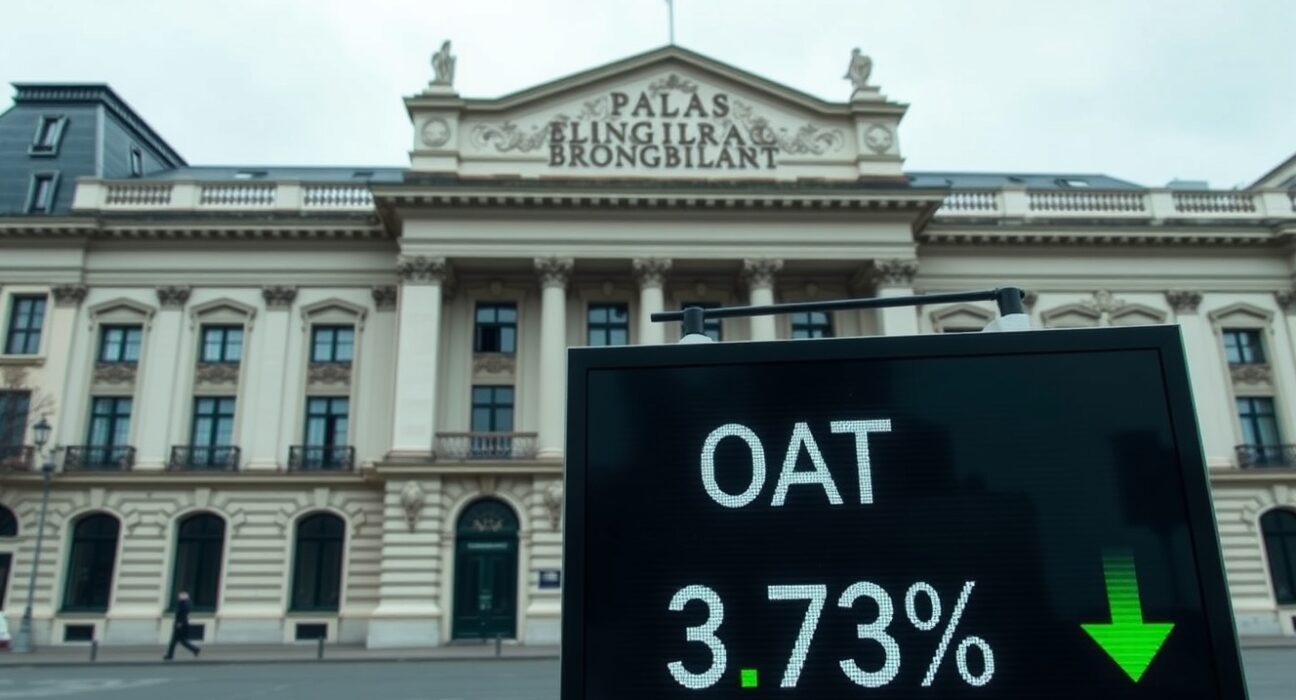
The yield on France’s 10-year government bond (OAT) edged lower at the latest auction, settling at 3.73%. This marks a decline from the previous auction’s rate of 3.8%, signaling a slight easing in borrowing costs for the French government amid a complex European interest rate environment.
Auction Details and Context
The French Treasury conducted the regular sale of 10-year OATs, with the average yield dropping by 7 basis points. While the absolute change is modest, it provides a snapshot of current investor sentiment toward French sovereign debt. The decline comes after a period of elevated yields driven by global monetary tightening and fiscal uncertainty. The auction also saw steady demand, reflecting continued investor appetite for core eurozone government bonds despite broader economic headwinds.
What’s Driving the Yield Decline?
Several factors are contributing to the lower yield. First, market expectations for further interest rate hikes by the European Central Bank have moderated, as inflation data shows signs of cooling. Second, a general flight-to-safety bid has supported core government bonds amid ongoing geopolitical tensions and uncertainty over global growth. Third, France’s own fiscal outlook, while under scrutiny, has not deteriorated sharply enough to trigger a sell-off. The yield movement also aligns with a broader trend in the eurozone, where German Bund yields have similarly eased in recent sessions.
Implications for Investors and the Economy
For investors holding French bonds, the yield decline translates into a short-term price gain. For the French government, lower borrowing costs provide some fiscal relief, particularly as it navigates a high debt-to-GDP ratio. However, the 3.73% level remains elevated compared to the sub-zero yields seen just a few years ago, indicating that the era of cheap money is firmly in the past. The yield’s direction in the coming months will depend heavily on ECB policy decisions, inflation trajectories, and France’s ability to implement credible fiscal consolidation measures.
Conclusion
The drop in France’s 10-year bond yield to 3.73% at the latest auction is a notable but incremental development. It reflects a slight improvement in market conditions for French debt, driven by shifting ECB expectations and broader risk-off sentiment. While the decline is positive for the issuer and existing bondholders, the overall yield level remains a key metric to watch as the eurozone navigates its post-inflationary monetary policy path.
FAQs
Q1: What does a lower bond yield mean for France?
A lower yield reduces the cost of borrowing for the French government, meaning it pays less interest on new debt issuance. This can ease pressure on the national budget.
Q2: Why did the yield fall from 3.8% to 3.73%?
The decline is primarily attributed to a combination of moderating ECB rate hike expectations, a global flight to safer assets, and steady demand at the auction. It is part of a broader trend of slightly lower yields across core European government bonds.
Q3: Is a 3.73% yield high or low historically?
Historically, 3.73% is moderate. It is significantly higher than the negative or near-zero yields seen between 2015 and 2021, but well below the peaks of over 5% seen during the eurozone debt crisis in 2011-2012. It reflects a return to a more normalized interest rate environment.
Disclaimer: The information provided is not trading advice, Bitcoinworld.co.in holds no liability for any investments made based on the information provided on this page. We strongly recommend independent research and/or consultation with a qualified professional before making any investment decisions.
