From DeFi to TradFi: How Crypto Exchanges Are Entering the Financial Markets
In this article
DEK: The crypto market is gradually expanding beyond its own assets, and more and more platforms are launching tokenized stock markets. In this article, we’ve tried to explain the crypto industry’s move toward traditional finance and why this is happening.
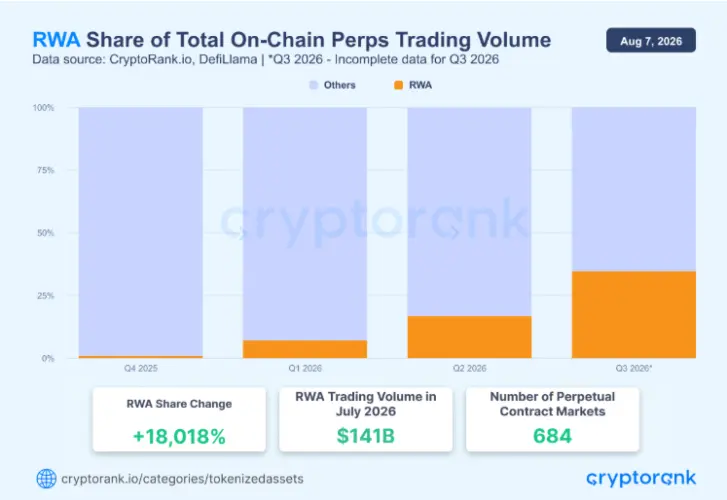
Tokenized assets now account for 29% of total crypto market volume on perpetual DEXs, increased by 18,000% since Q4 2025. Amid this, Major exchanges have increasingly introduced tokenized assets trading.
Tokenized real-world assets exist in both types: spot and perps. For spot, every exchange introduces its own type of assets, which we broke down in this article. Perps, being derivatives, are traded more actively because they offer leverage, short exposure, and greater capital efficiency without requiring traders to own the underlying asset. In practice, traders simply open a long or short position tied to the asset’s price, while funding payments help keep the perpetual contract aligned with the underlying market. Perps represent contracts tied to the asset price, with the primary difference in the pricing mechanics.
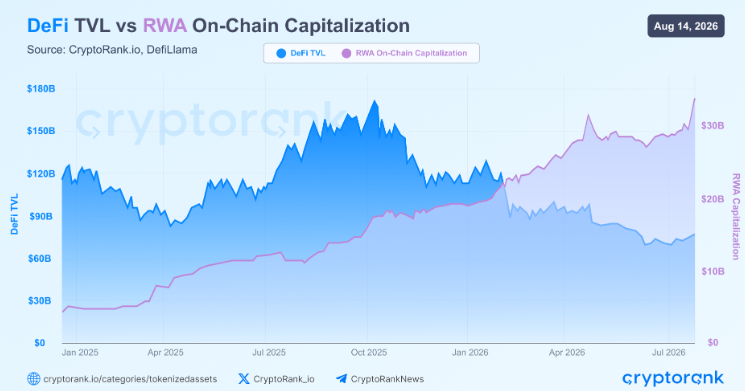
Total On-Chain RWA Market Cap grew from $4.3B at the beginning of 2025 to nearly $30B by the end of July 2026. $12B of that growth occurred in 2026 alone, despite negative market sentiment. Meanwhile, the total DeFi TVL declined by $39B (-32.5%), and total crypto market capitalization fell by $750B (-25%). This indicates that the RWA sector is growing due to structural demand rather than market sentiment. In line with market trends, CEXs have begun listing tokenized assets on a large scale on their platforms.

Why Are Exchanges Launching Tokenized Asset Markets?
Reduced volatility in the crypto market
One of the reasons for the launch of tokenized stocks was the general decline in trading volumes and reduced volatility in the cryptocurrency market. Total cryptocurrency trading volume has fallen by 52% compared to its peak in 2025.
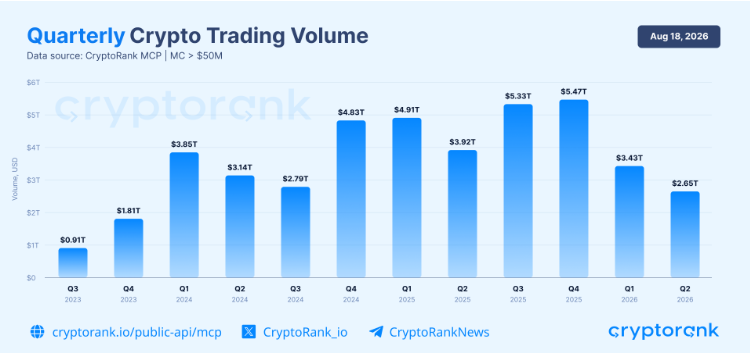
Built with CryptoRank MCP
Bitcoin is the clearest example of this structural change. Based on the non-annualized 60-day historical volatility measure used in our dataset, BTC volatility has not exceeded 4% since August 2022. Short-term data in 2026 points in the same direction. Bitcoin’s annualized 7-day realized volatility fell to 26% in May, within two percentage points of its YTD low. Even when volatility briefly surged to around 70% during June’s market stress, it quickly fell back toward 40% once conditions stabilized. In other words, volatility spikes still occur, but they are increasingly event-driven and short-lived rather than persistent regimes of high volatility.
The effect extends beyond Bitcoin, although it is not similar across the market. Kaiko’s broad Standard Crypto Index recorded 51.5% rolling one-year annualized volatility in mid-July, while its Mid Cap Index stood higher at 59%. This suggests that volatility has not disappeared from crypto, but has become more concentrated in smaller and higher-beta assets, while the largest and most liquid cryptocurrencies increasingly behave like mature financial instruments.
For exchanges, this shift has an important economic consequence. Lower volatility in BTC and other major assets reduces speculative turnover, particularly during periods when prices move sideways and traders have fewer short-term opportunities.
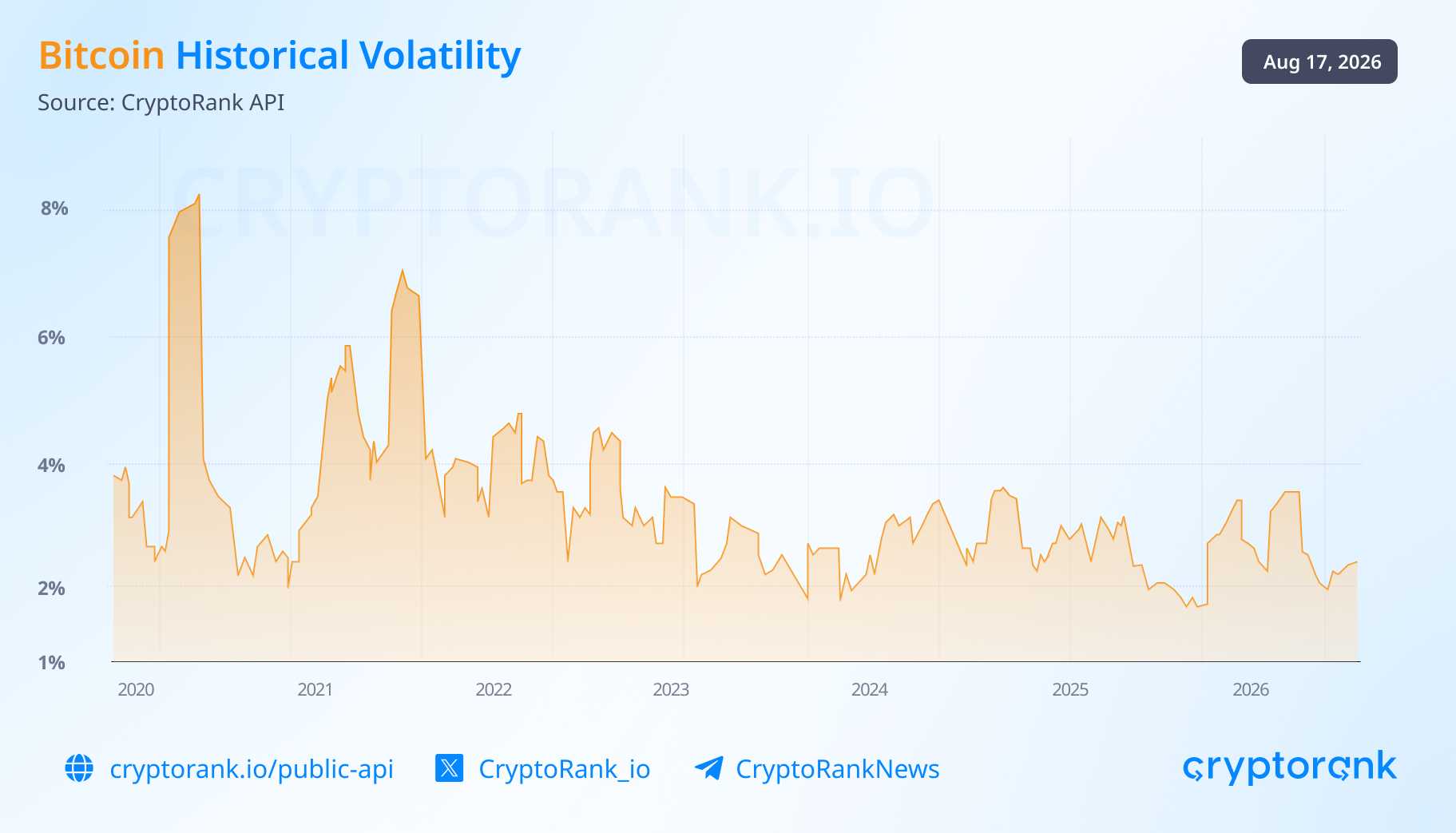
Built with CryptoRank MCP
Since their returns depend exclusively on the cryptocurrency market, they are particularly vulnerable to market cycles. Stocks and indices allow for partial diversification of this dependence. The S&P 500 has historically followed a long-term upward trend with significantly lower volatility than crypto, making it a useful hedge against periods of weakness in the crypto market.
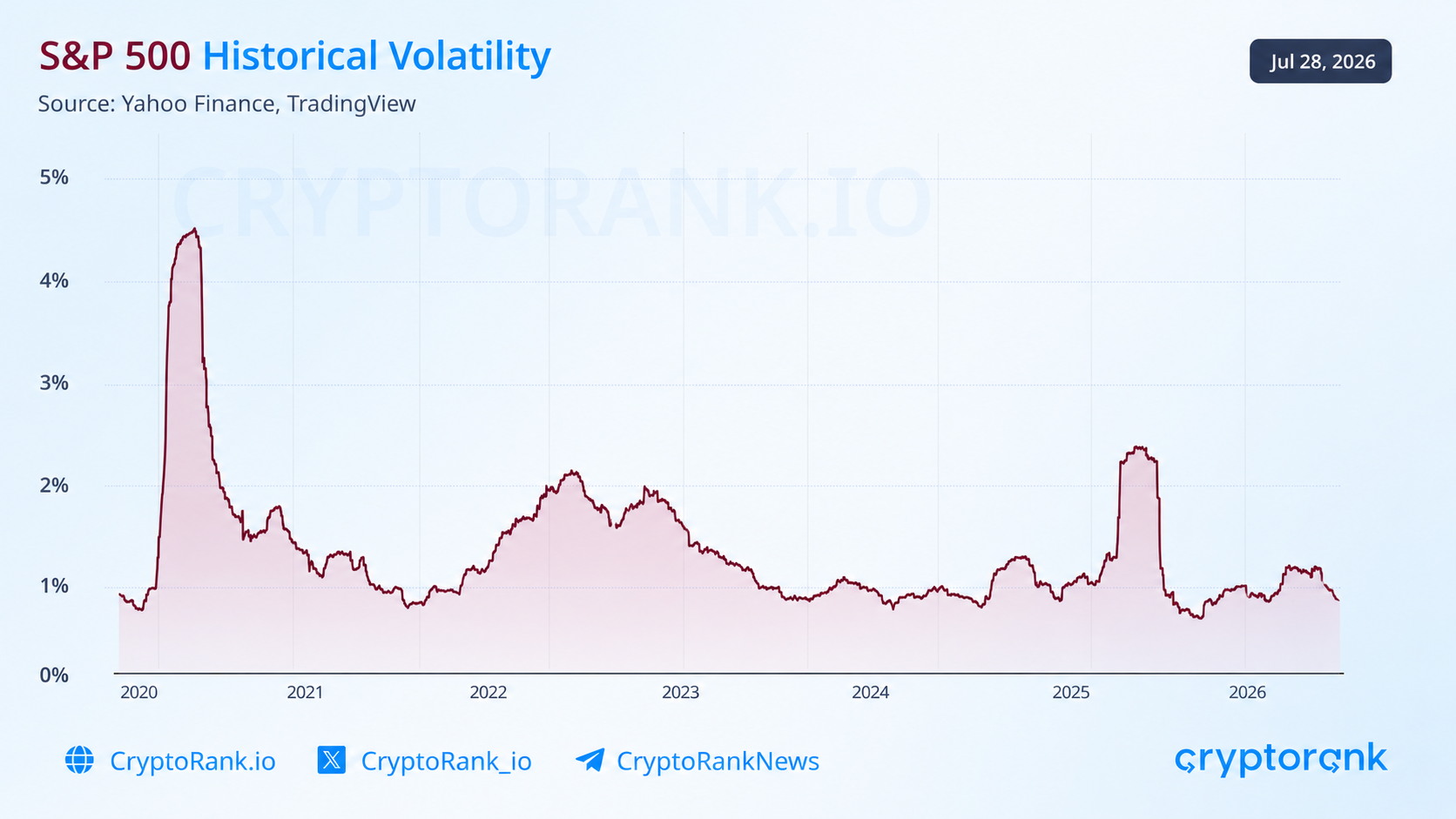
Even if the cryptocurrency market remains weak, users will still be able to trade shares of Tesla, Nvidia, Coinbase, the S&P 500 index, or other traditional financial instruments. The volatility of major tech giants creates favorable conditions for trading derivatives, which affects trading volume. For exchanges, this means a more stable flow of commission revenue and less dependence on the next cryptocurrency rally.
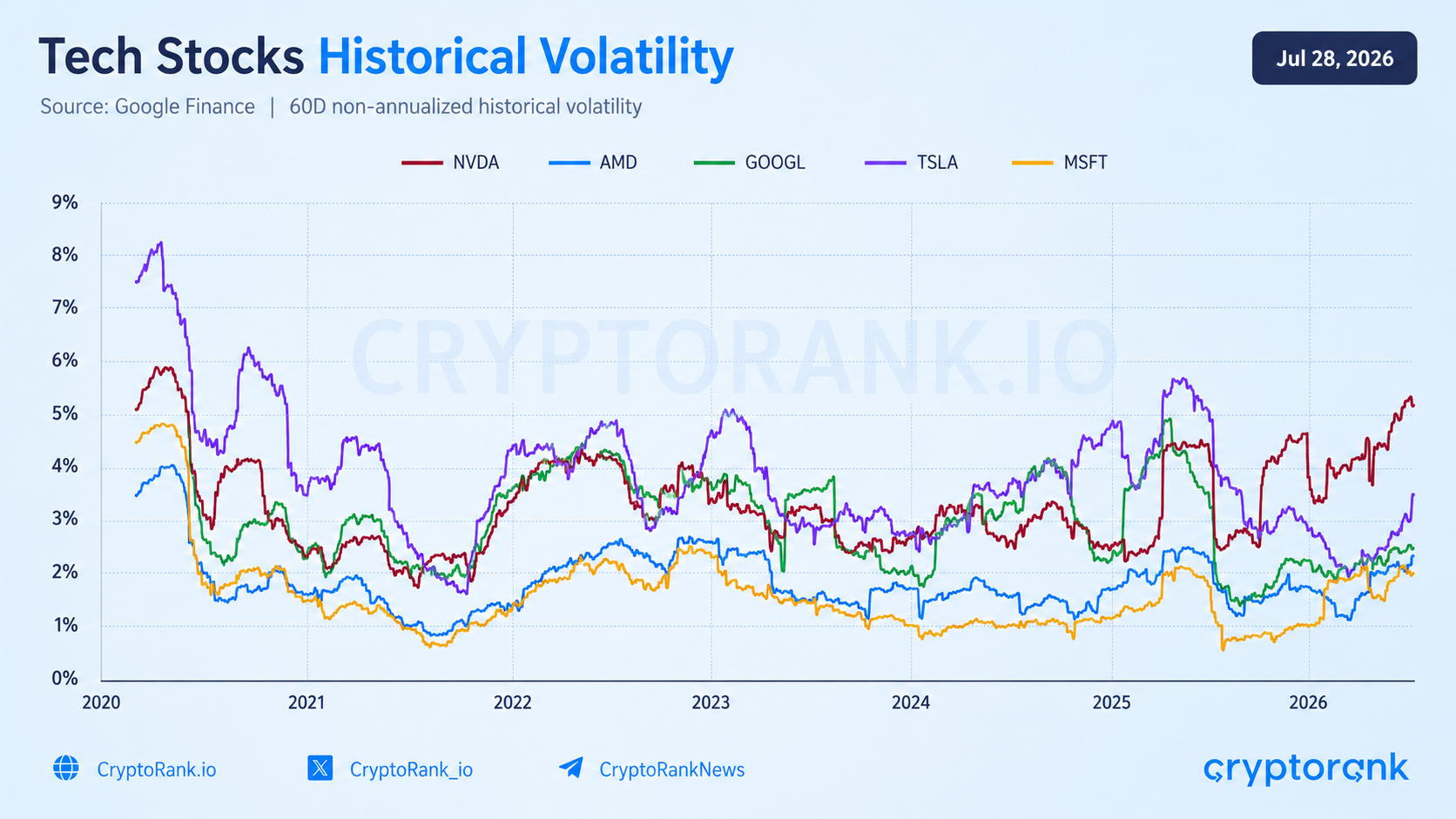
TAM Expansion
Access to TradFi assets significantly expands the total addressable market for crypto platforms. Even a small percentage of users and trading volume can become a significant source of revenue.
The most liquid and speculative instruments are particularly attractive to crypto exchanges:
- stocks of major tech companies
- stock indices
- crypto-related stocks
It is precisely these instruments that resonate most with the existing audience of crypto traders.
Exchanges Become All-In-One Platforms
From a user experience perspective, one of the criteria for an ideal exchange is the “all-in-one” feature. If a user does not have to constantly switch between platforms, but can simply use one where they can trade BTC and the S&P 500 and accumulate gold. This reduces switching costs and can make a single-platform model more attractive.Bringing multiple asset classes under one interface also lowers the barrier to entry by reducing the need to open and manage accounts across different services, while increasing user retention as more of their trading activity remains within a single ecosystem.
Growing Demand for 24/7 Markets from TradFi Traders
Demand for overnight access is already visible at the broader market level. According to DTCC data, overnight trading accounts for approximately 1% of total daily U.S. equity notional volume. Activity is also expanding rapidly: trading volume on Blue Ocean ATS, which represents around 90% of overnight ATS activity, increased from 827 million shares in Q1 2025 to 4 billion shares in Q4, which is nearly a fivefold increase within a single year.
Tokenized Stocks Models: Same But Different
Tokenized stocks are blockchain-based instruments whose value is linked to publicly traded companies and ETFs, such as Apple, Tesla, NVIDIA, Coinbase, SPY, or QQQ. In the simplest structure, an issuer acquires the underlying security through a broker, places it with a custodian, and issues a corresponding token that can be traded or transferred on-chain.
However, the token itself is usually not the registered share. Depending on the product, the holder may own a contractual claim against the token issuer, a certificate backed by securities, a secured note, or an instrument that only tracks the economic return of the underlying stock. Voting rights, direct shareholder ownership, cash dividends, redemption rights, and bankruptcy protection can therefore differ even when two tokens reference the same company.
This is why AAPLx, AAPLon, rAAPL, AAPLG, and XAAPL should not be treated as interchangeable versions of Apple stock. The underlying company may be the same, but the legal claim, dividend mechanism, issuer risk, liquidity source, and withdrawal path can all be different. The SEC similarly distinguishes issuer-sponsored tokenized securities, custodial third-party claims, structured notes, and synthetic price exposure according to the rights held by the investor. This can also result in price and performance differences.
Robinhood: Building a Native Stock-Token DeFi Ecosystem
In July 2026, Robinhood launched a new generation of Stock Tokens on its own network. The newer Stock Tokens can be traded 24/7 through decentralized venues integrated into Robinhood Wallet, including Uniswap and other DEXs. Robinhood Chain, built with the Arbitrum technology stack, provides the settlement layer, while lending, borrowing, and collateral integrations are intended to make the tokens usable beyond simple spot exposure.
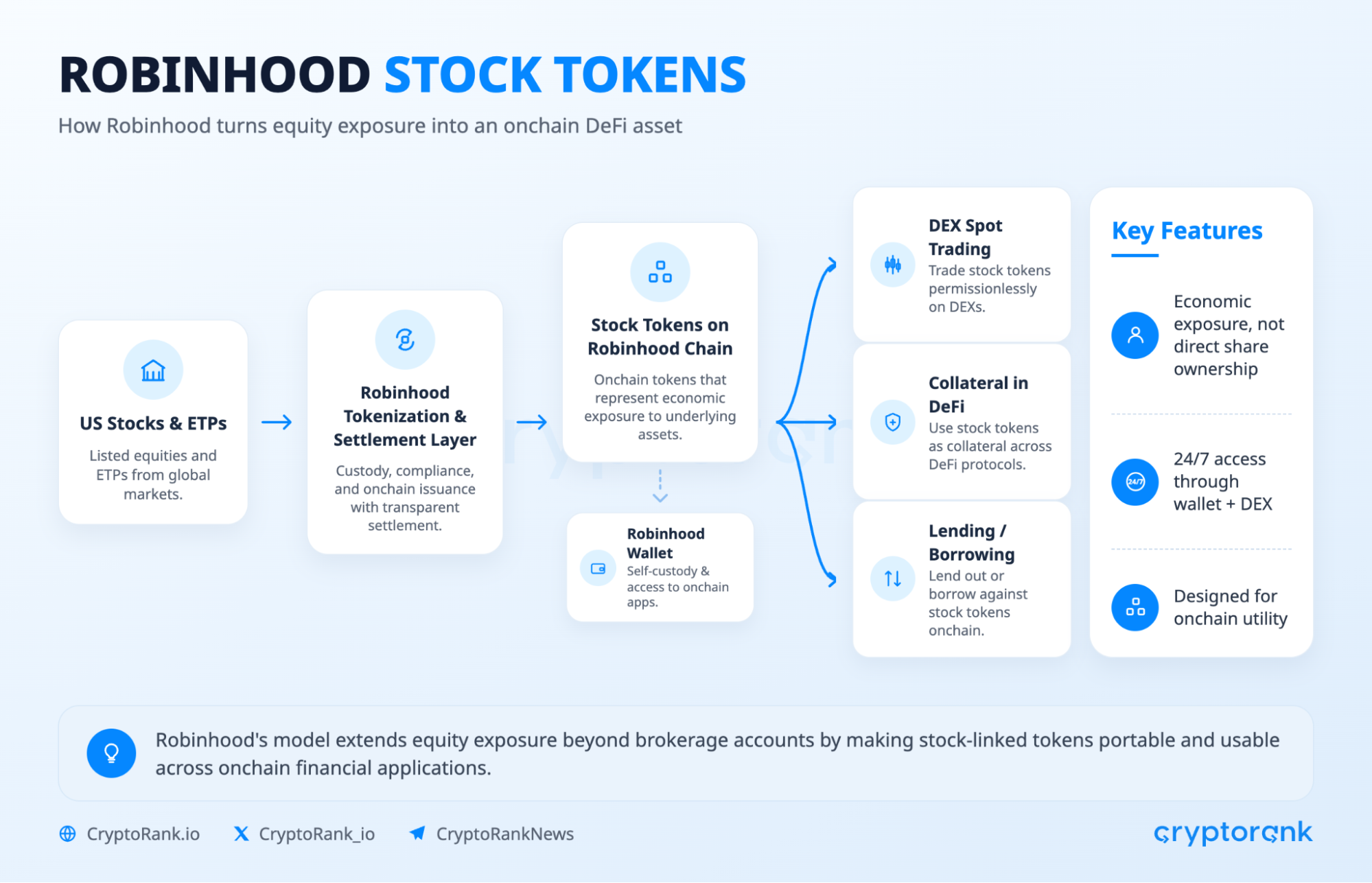
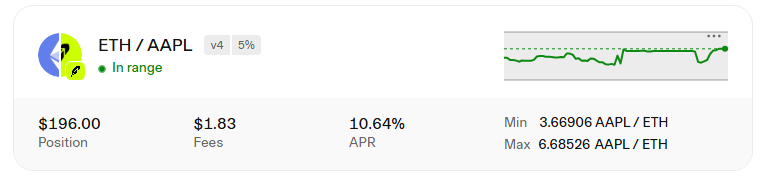
This marks a fundamental change in the role of an equity portfolio. In a traditional brokerage account, stocks are mostly passive assets: they appreciate, decline, and generate dividends. Onchain, a stock-linked token can potentially be deposited into a lending market, used as collateral for borrowing, supplied to a liquidity pool, or combined with other DeFi positions.
Binance: From Traditional Stock Access to a Full Tokenization Cycle
Binance’s stock strategy should be divided into separate layers. Broker-style access to conventional equities is not the same product as a tokenized security, while third-party instruments listed through Binance Wallet or Binance Alpha may use their own issuers and legal structures.
The most relevant native product is bStocks. These are tokenized U.S. securities issued as BEP-20 assets on BNB Chain. Each bStock is backed by an underlying security held in custody, but the token holder does not directly become the registered owner of the corresponding corporate share. bStocks are certificates issued under the Abu Dhabi Global Market framework, not direct equities.
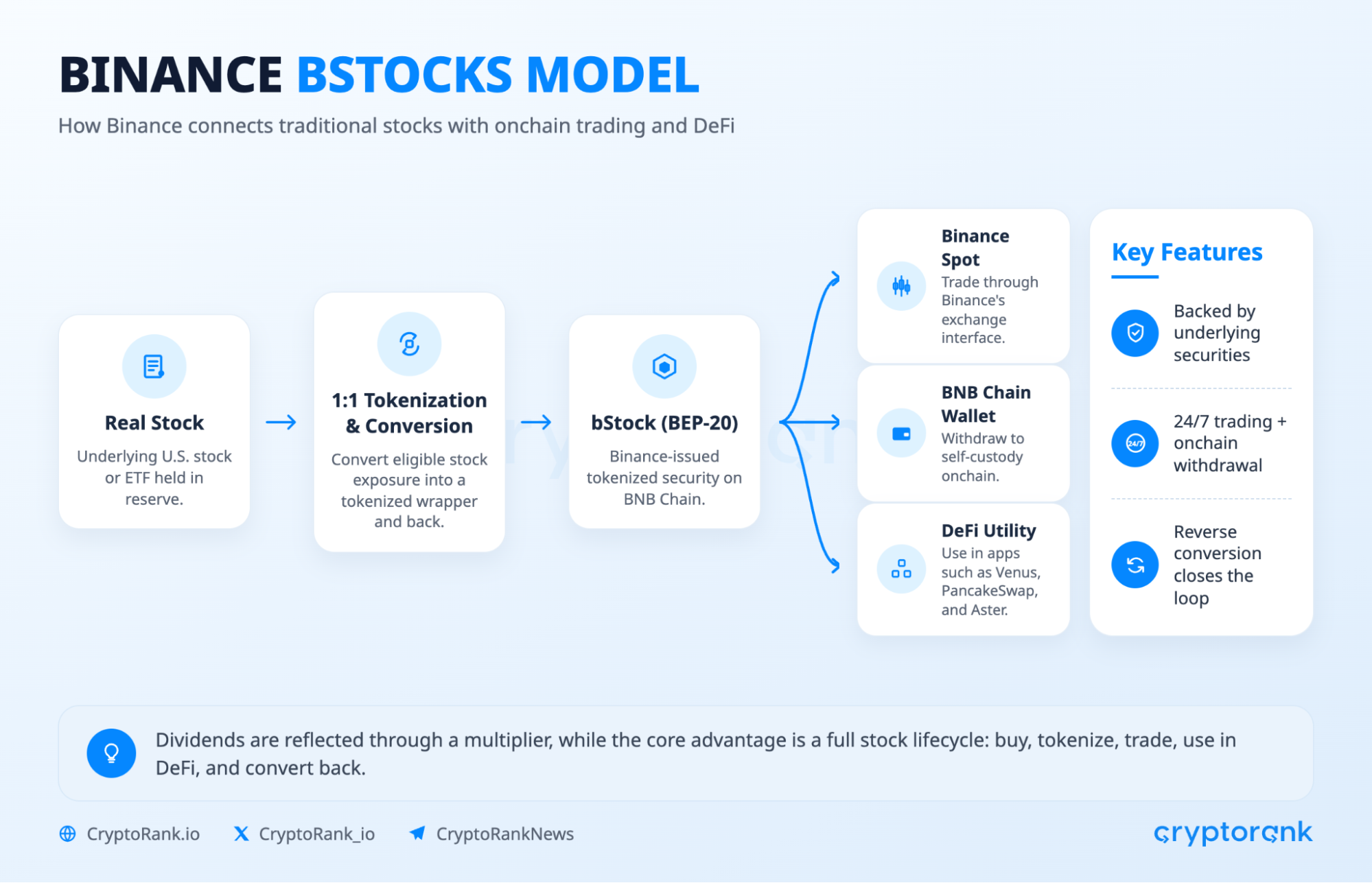
The system combines Binance’s spot order book with a conversion mechanism connecting traditional shares and their tokenized form. Eligible users can tokenize supported securities or acquire bStocks with USDT, withdraw the resulting BEP-20 tokens to a personal wallet, and use them across BNB Chain applications. Binance also publishes Proof of Collateral data, while dividends are reinvested and reflected through a multiplier rather than being paid separately as cash.
Gate: One Interface, Several Different Tokenized-Stock Models
Gate takes the broadest marketplace approach. Instead of relying on one tokenized-stock structure, the platform gives users access to several product families:
- Gate-native gStocks;
- xStocks issued through the Backed infrastructure;
- Ondo Stocks;
- stock perpetual futures;
- conventional stock access through a separate TradFi section.
These instruments may all provide exposure to the same company, but they should not be presented as equivalent. A spot token backed by securities, a total-return tracker, a perpetual contract, and a conventional brokerage position produce different rights, funding costs, dividend outcomes, and liquidation risks.
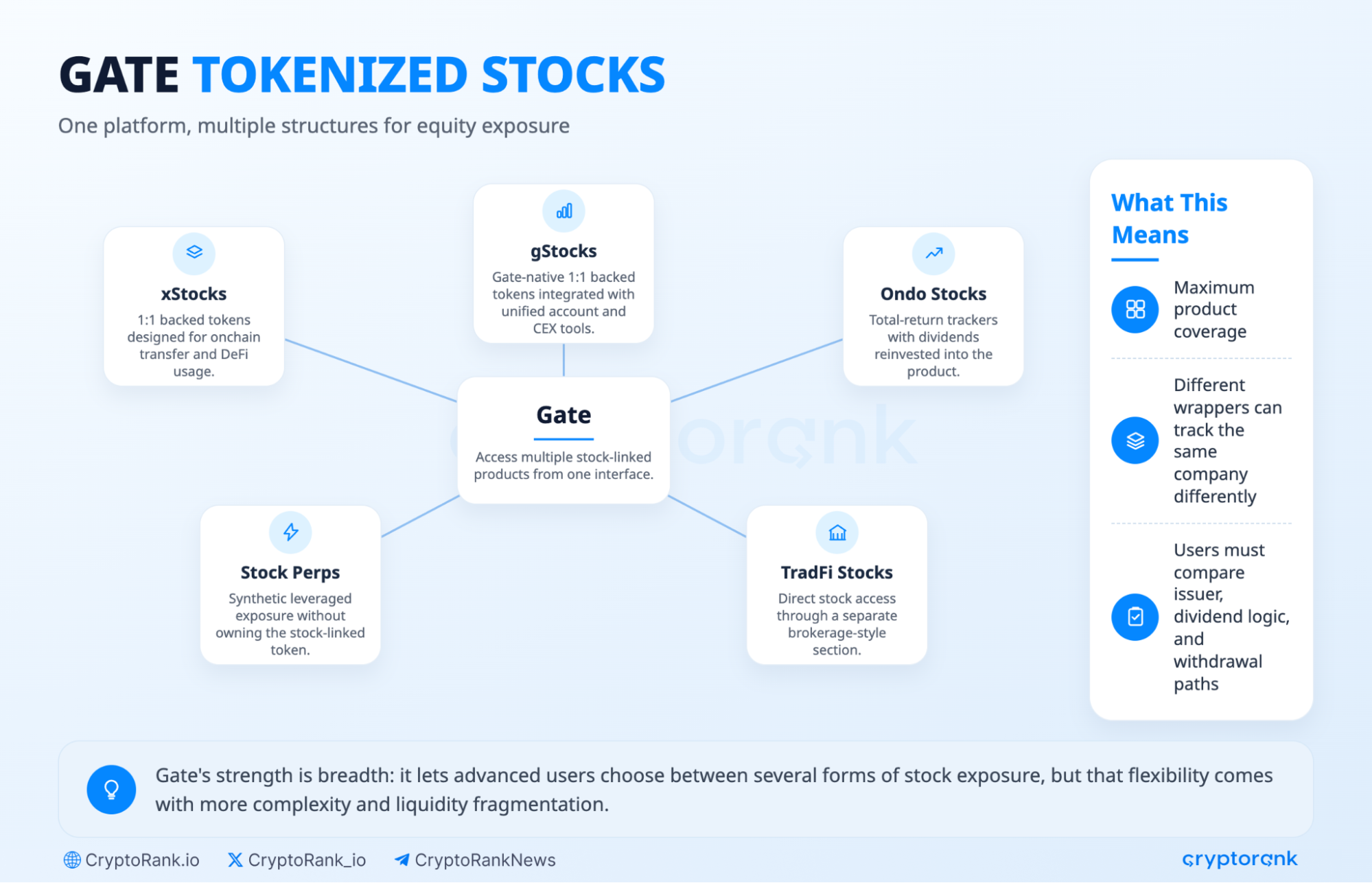
gStocks are Gate’s native tokenized-stock line. Gate states that circulating tokens are backed 1:1 by underlying securities and traded through its traditional spot order book. The products are designed to integrate with Gate’s unified account, margin products, trading bots, API infrastructure, fractional trading, and selected yield tools.
Kraken: xStocks as a Portable Onchain Standard
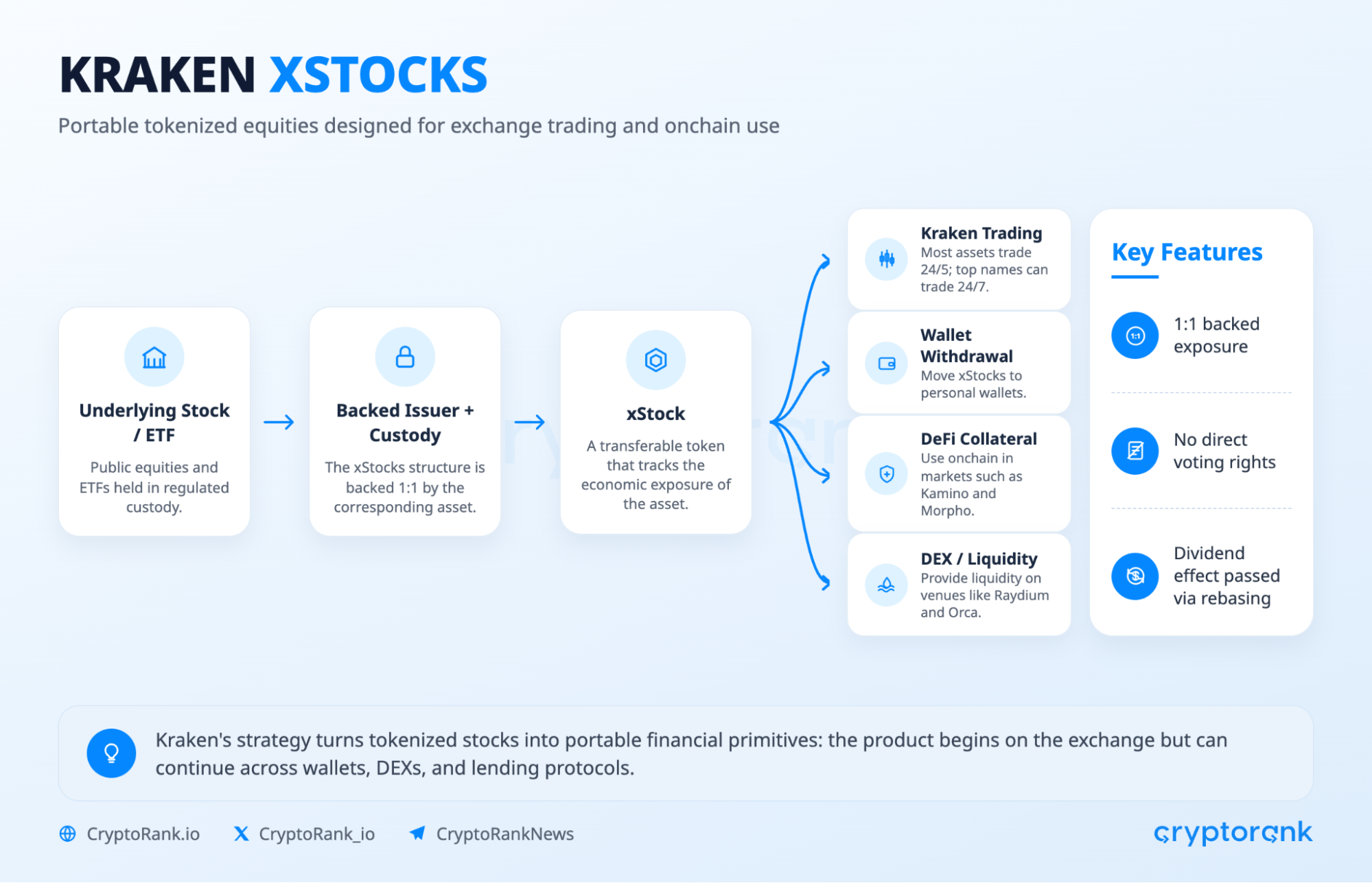
Kraken offers 131 xStocks, consisting of 100 tokenized stocks, 27 ETFs, and four specialized assets. The products are issued through the Backed infrastructure and are supported on Solana, Ethereum, TON, and Ink. Each token is backed 1:1 by the corresponding security held in regulated custody.
However, an xStock is not a registered share. Holders do not receive voting rights, a direct claim on the company, or a traditional cash dividend. The net economic value of distributions is reinvested by the issuer and passed to the user through a rebasing multiplier. For example, the number of on-chain tokens may remain unchanged while the displayed xStock balance increases. This distinction matters when comparing wallet balances, exchange quantities, and the price of the underlying share.
OKX: One Stock, One Position, One Order Book
OKX is approaching tokenized stocks primarily as a liquidity-fragmentation problem. On most platforms, Apple may trade as AAPLx, AAPLon, rAAPL, or another issuer-specific wrapper. Each version has its own token supply, order book, custody structure, and network. Even when every product tracks Apple, liquidity is divided between separate instruments.
OKX introduces a unified asset layer. Different issuer tokens referencing the same underlying security can be deposited and normalized into one exchange position measured in shares. The user trades a single XAAPL or XTSLA market rather than choosing a particular issuer’s wrapper.
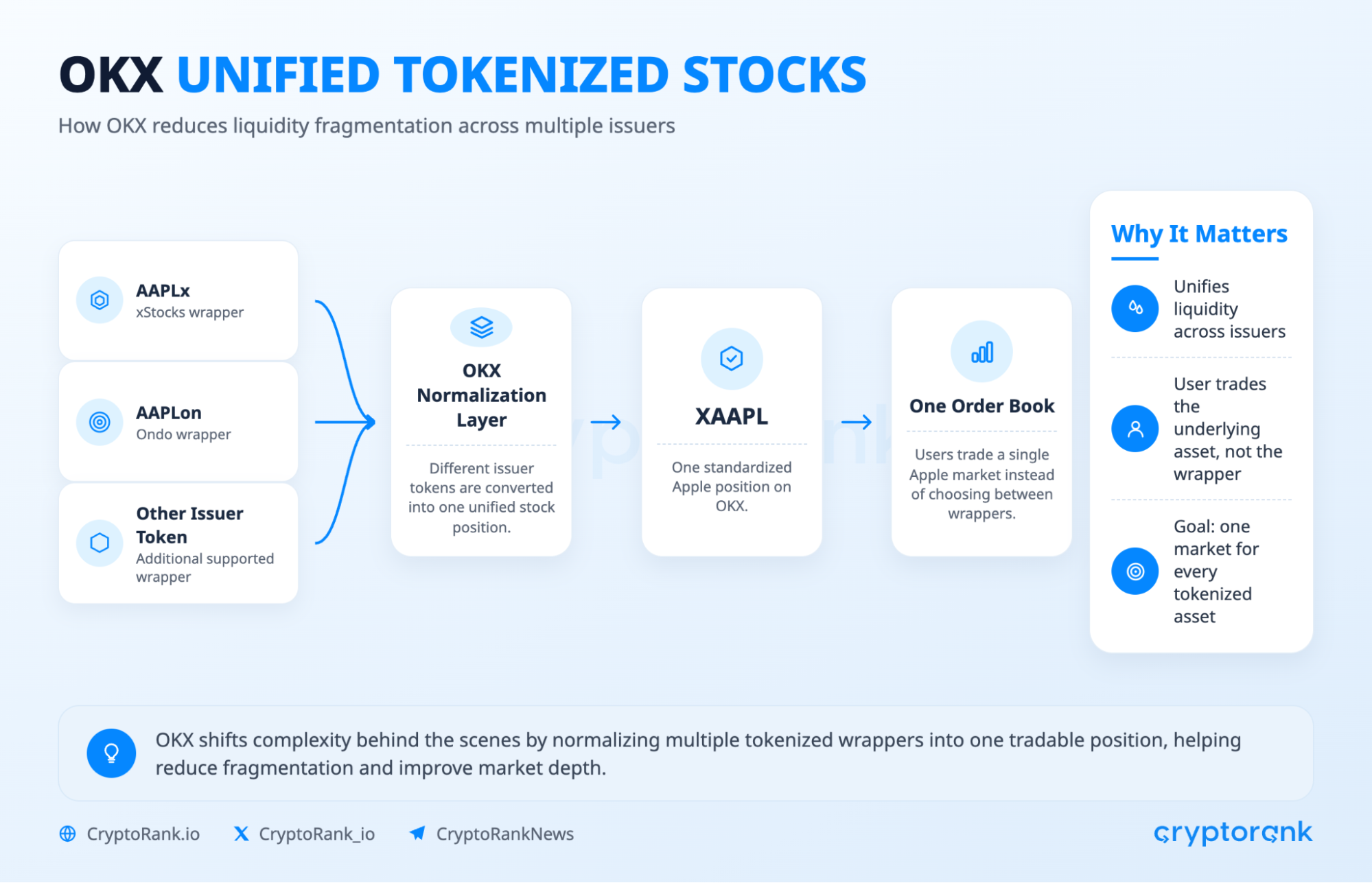
At launch, the system is powered by xStocks, but OKX intends to onboard additional issuers into the same unified markets. When a user deposits a supported token, OKX converts the issuer-specific token amount into standardized share units. Trading and valuation then occur through one order book and one set of corporate-action rules.
Bitget: Two Tokenized-Stock Models for Different Use Cases
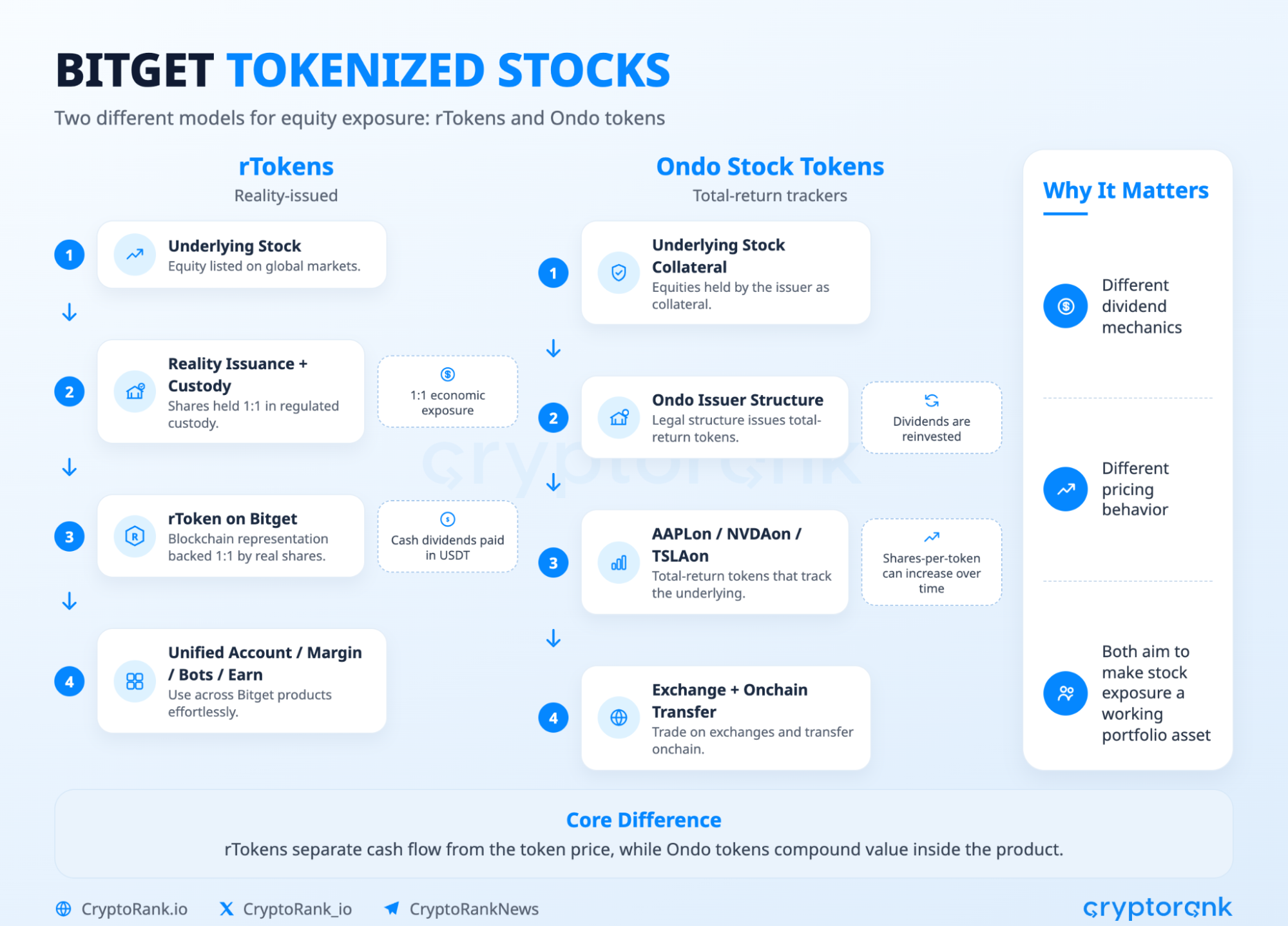
Bitget offers two structurally different tokenized-stock systems:
The distinction is important because the two products treat dividends, pricing, liquidity, and token balances differently.
Bitget rTokens
Reality-issued rTokens use an r prefix, such as rAAPL, rNVDA, rTSLA, rSPY, or rQQQ. Bitget supports more than 500 stock- and ETF-linked products through this infrastructure. Each rToken is designed to provide the economic exposure of one corresponding share, although the holder does not become the registered shareholder and generally receives no voting rights.
Reality manages issuance, reserve backing, broker connectivity, custody, settlement, and verification. Bitget provides the USDT order book, account infrastructure, execution venue, and integrations with other trading products.
The underlying shares are held through licensed brokerage and custody infrastructure. The CryptoRank research describes the reserve as being held through Alpaca and independently verified. rTokens are linked to U.S. equity liquidity through broker access, while the Bitget order book provides the secondary execution layer.
Unlike total-return trackers, rTokens use a clean-price model. Eligible cash dividends are converted into USDT and credited separately to the user. Stock dividends and supported corporate actions are reflected through additional tokens or position adjustments. This makes the token price easier to compare directly with the underlying stock price.
Ondo Stock Tokens on Bitget
Ondo tokens use an [on] suffix, such as AAPLon, NVDAon, or TSLAon. Unlike rTokens, they are designed as total-return trackers.
The issuer holds collateral linked to the underlying securities and reinvests net dividends into additional shares. Over time, a token may therefore represent the economics of more than one share, causing its unscaled price to diverge from the headline stock price.
Ondo tokens are transferable across supported networks and can be deployed in compatible DeFi protocols. Primary minting and redemption connect the token to the liquidity of the U.S. stock market, while Bitget provides a secondary exchange venue.
You can read more about the differences between each platform’s strategies in our research report: Tokenized Equities on Crypto Exchanges: How New Products Compete on Structure and Liquidity Quality
Stock Perpetuals: Who Already Offers These Markets
RWA perpetuals are developing simultaneously across centralized and decentralized exchanges, but the infrastructure behind them differs substantially. The main technical challenge is maintaining reliable pricing when the underlying TradFi market is closed. During overnight, weekend, or holiday sessions, exchanges must manage wider basis deviations, lower liquidity, and increased oracle risk.
DEX
Decentralized exchanges rely more heavily on oracle design and protocol-level safeguards. RWA perpetuals are commonly priced using external data providers that aggregate multiple TradFi venues. For example, trade[XYZ] switches from external TradFi pricing to internal price discovery when external data becomes unavailable, while limiting price movement according to the market’s maximum leverage: an AAPL market with 20× leverage has a ±5% discovery range, whereas a COIN market with 10× leverage has a ±10% range. The external reference market is closing, but XYZ continues its internal price discovery within the discovery bounds. Lighter takes a different approach: its RWA markets trade 24/7, gradually transitioning from Chainlink, Pyth, or Stork feeds to an EMA-smoothed price derived from its own order book when oracle data becomes stale. Unlike on a CEX, these fallback rules, price caps, and margin restrictions are publicly defined and automatically enforced by the protocol.
| Platform | RWA Markets | RWA Open Interest | Share of RWA OI | RWA 24H Volume | Share of RWA Volume |
| trade[XYZ] | 97 | $3.63B | 76.8% | $4.72B | 79.1% |
| Variational | 65 | $465M | 10.7% | $342M | 4.8% |
| GMTrade | 23 | $206M | 4.8% | $483M | 6.7% |
| Lighter | 72 | $78M | 1.6% | $198M | 3.3% |
| Extended | 31 | $41M | 0.8% | $99M | 1.6% |
| Aster | 108 | $24M | 0.5% | $86M | 1.4% |
| Ondo | 24 | $23M | 0.5% | $186M | 3.1% |
| edgeX | 2 | $18M | 0.4% | $7M | 0.1% |
| ApeX Omni | 35 | $3M | 0.07% | $14M | 0.2% |
Built with CryptoRank API
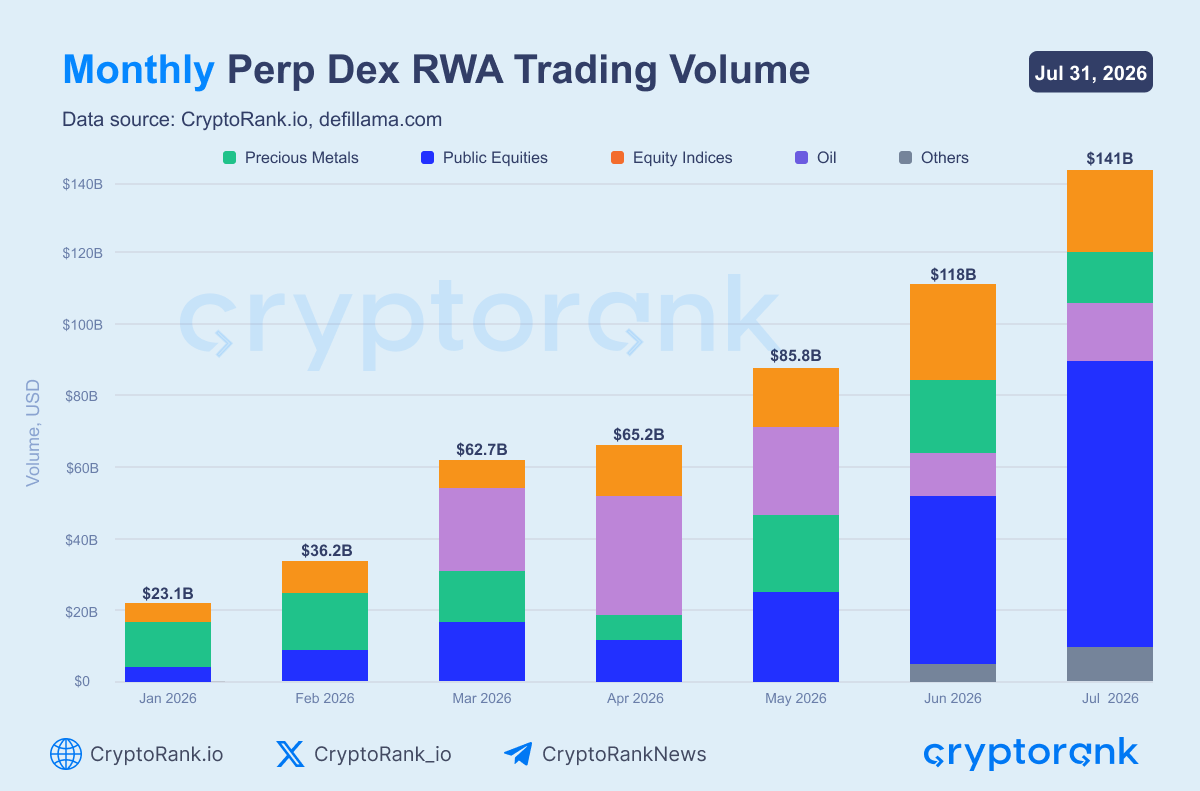
Looking at the bigger picture, the RWA sector grew steadily throughout the first half of 2026. In July, RWA trading volume on the perp dexs reached a record $141B, representing a +513% increase year-to-date. If we try to forecast the volume by December 2026, we can identify two scenarios: an optimistic one and a conservative one. If we mechanically maintain the average growth rate of +37.1%, the monthly volume by December could reach about $683B, and the total volume for 2026 would be approximately $2.53T. However, this forecast appears aggressive, as the average is heavily skewed by growth in February and March. A more conservative scenario, based on an average absolute increase of about $19.7B per month, projects a December 2026 volume of ~$239B and a full-year 2026 volume of ~$1.53T.
Built with CryptoRank MCP
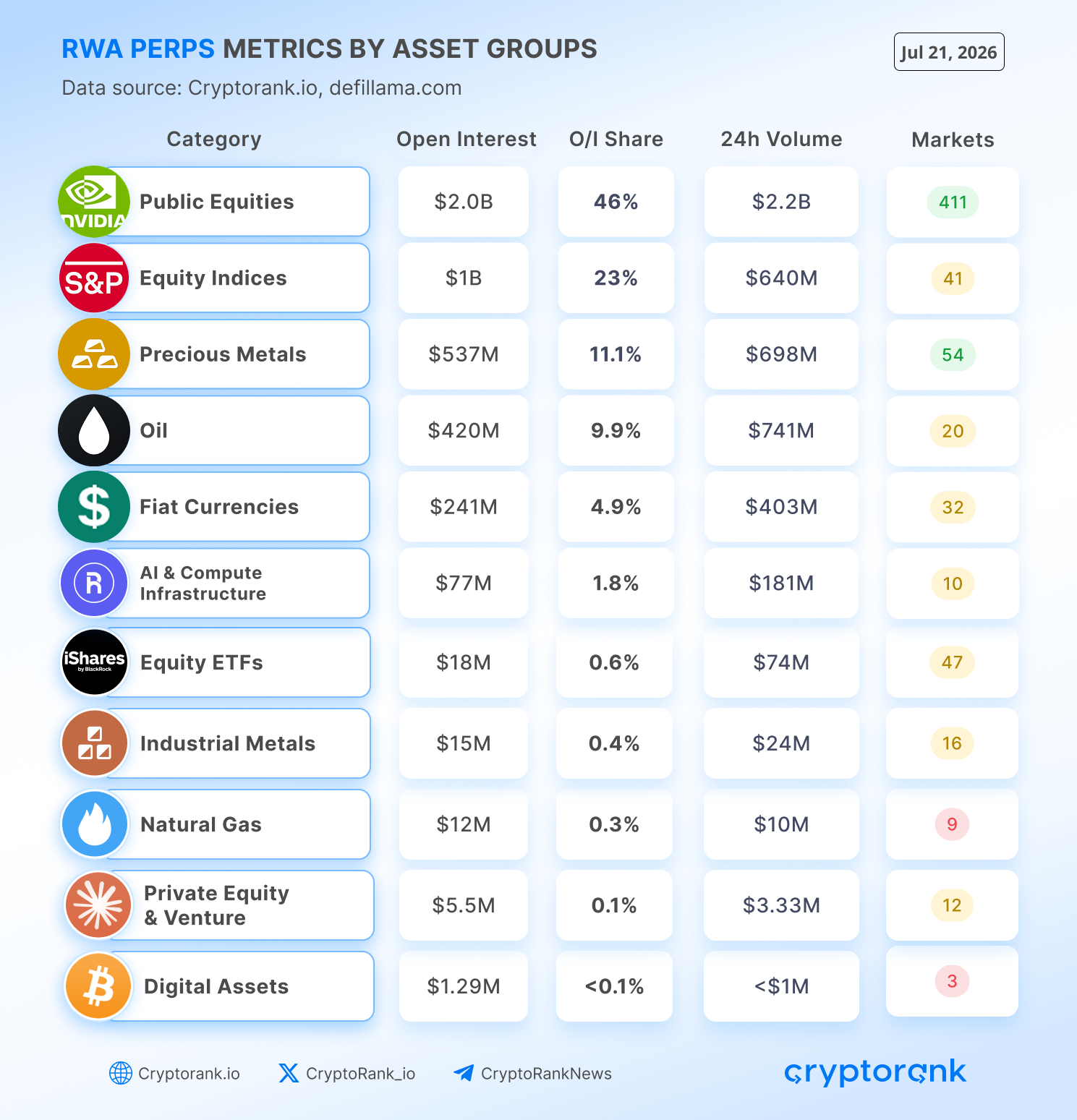
Public Equities lead in open interest, which is atypical for traditional markets. When comparing the entire traditional derivatives market by notional OI, interest rates are the clear leader. On the CME, the distribution of open interest among comparable futures categories as of July 30, 2026, was as follows:
- Interest Rates
- Energy
- Equity Indices
- FX
- Metals
Crypto-RWA: Individual stocks dominate, as these products are primarily aimed at traders who need easy, leveraged access to NVDA, TSLA, AAPL, and other popular securities. A fully-fledged market for interest rate derivatives on crypto exchanges is still virtually nonexistent.
TradFi: The main demand comes from banks, funds, insurers, and corporations hedging interest rates, currency risks, energy costs, and broad market indices.
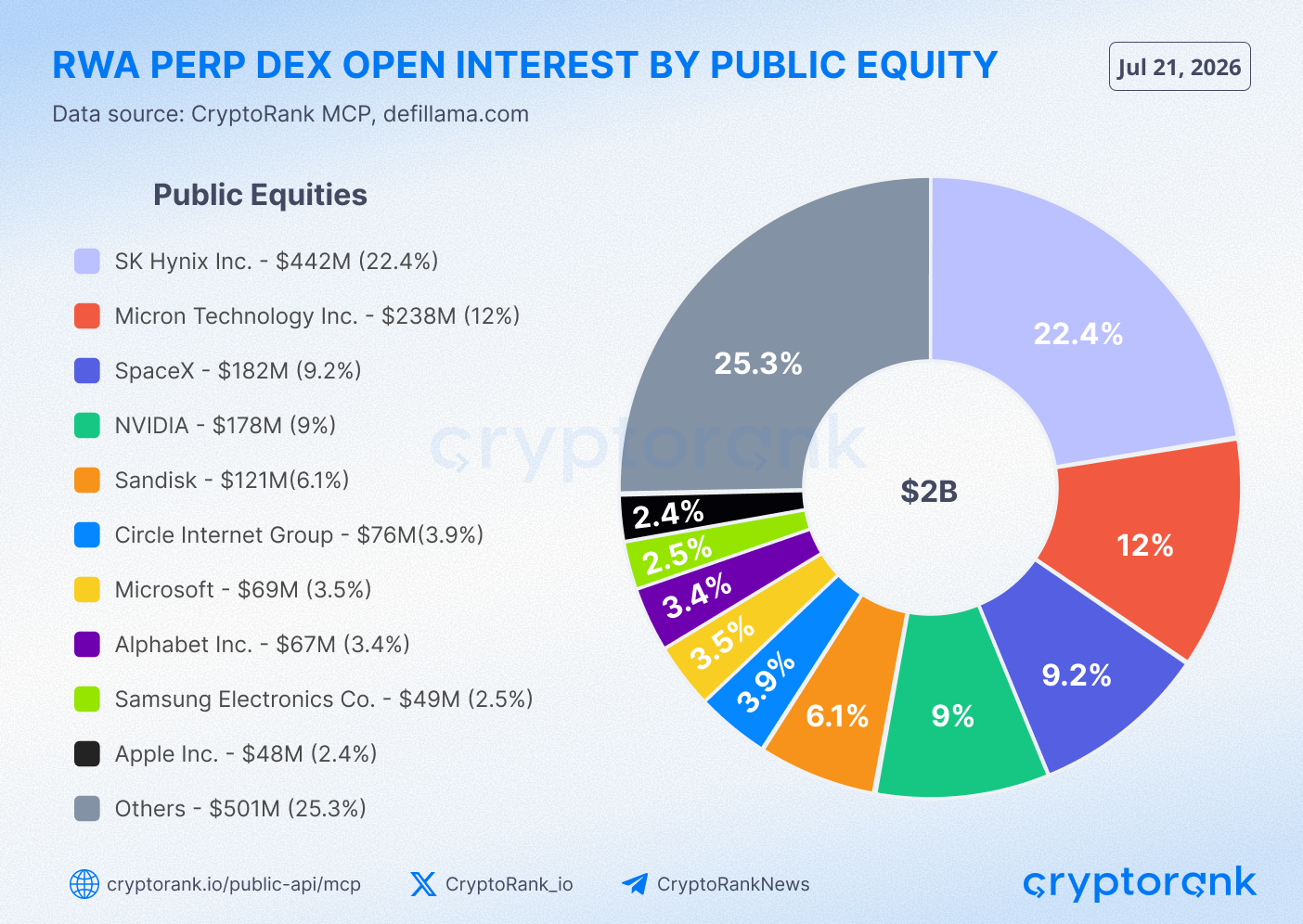
If we look even more closely, we can see that only four companies account for more than 50% of the open interest in all public equity. For example, Hynix shares have more open interest than the entire oil market, although this is not the case on TradFi platforms: Open interest in SK hynix futures is $18B, while open interest in NYMEX WTI futures is approximately $173B.
CEX
Centralized exchanges typically manage the mismatch between 24/7 crypto trading and limited TradFi market hours through proprietary reference indices, internal market makers, and tighter risk controls outside the underlying asset’s primary session. When stock markets are closed, CEXs may widen price bands, reduce maximum leverage, increase margin requirements, cap open interest, or adjust funding more aggressively to prevent the perpetual price from drifting too far from the last reliable reference price. Because order books, liquidations, and insurance funds are controlled internally, these platforms can react quickly to abnormal volatility or suspend trading around corporate actions and major price gaps.
Built with CryptoRank MCP
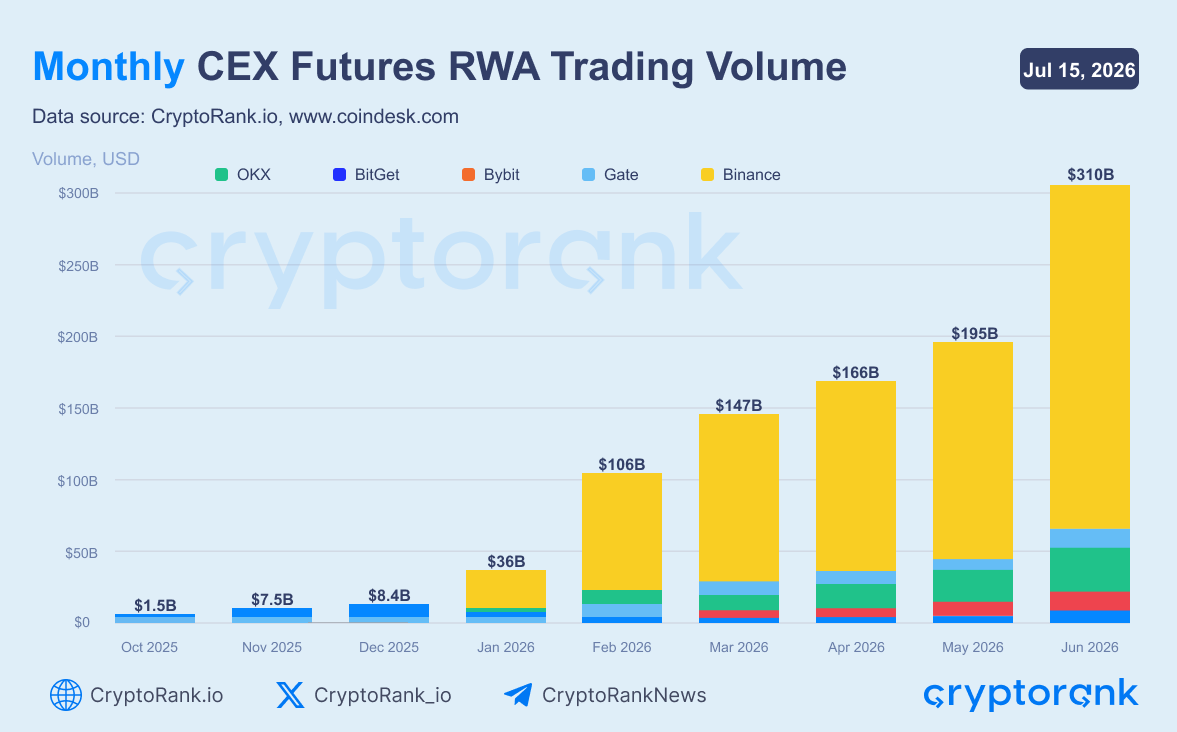
RWA perpetuals are expanding across both channels, but market scaling is still being driven primarily by CEXs, where liquidity is deeper, markets are more mature, and access to institutional capital is easier. Binance leads in trading volume and holds a market share of approximately 79%, but Gate leads in the number of listed markets.
TOP 3 Platforms By CEX Futures RWA Trading Volume in June 2026
| Platform | RWA Perp Markets Listed | June RWA Volume | CeFi Market Share |
| Binance | 68 | $245B | 78.6% |
| OKX | 65 | $33.3B | 10.7% |
| Gate | 146 | $12.1B | 3.9% |
Conclusion
The expansion into traditional financial assets is becoming more than another product category for crypto exchanges, because it represents a broader transformation of their business model. As crypto volatility and trading activity become more cyclical, tokenized stocks, indices, commodities, and other RWAs give platforms access to a much larger pool of global trading demand while reducing their dependence on crypto-native market cycles. The fact that on-chain RWA capitalization has continued to grow even as the broader crypto market and DeFi TVL contracted suggests that this trend is increasingly structural rather than purely speculative. In this environment, the long-term ambition is clear: exchanges are evolving from crypto trading venues into global, multi-asset platforms where the same capital can move between Bitcoin, NVIDIA, the S&P 500, gold, and eventually an even broader range of financial instruments.
The next stage of competition, however, will be determined by much more than the number of assets listed. As the sector matures, the strongest platforms are therefore likely to be those that can combine deep liquidity, reliable market infrastructure, transparent asset backing, efficient capital use, and seamless 24/7 access. Crypto exchanges are unlikely to replace traditional financial markets themselves; instead, they are increasingly positioning themselves as a new distribution and settlement layer through which users can access those markets.