
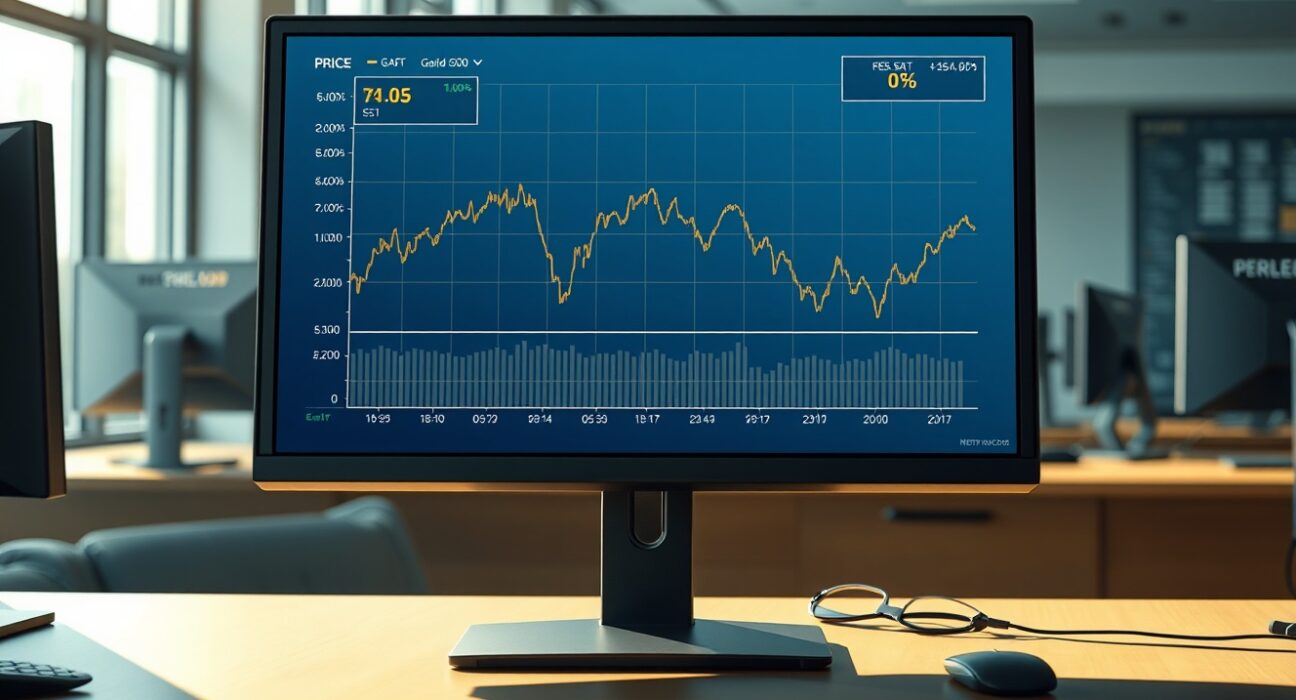
Global gold markets witnessed a significant sell-off this week, with the precious metal’s price breaking decisively below the $5,100 per ounce threshold. This sharp decline coincides directly with a sustained rally in global crude oil benchmarks, stoking renewed and critical concerns about persistent inflationary pressures. Analysts point to a complex interplay between commodity markets and central bank policy expectations as the primary driver behind this dramatic price action.
Gold Price Breakdown and Technical Analysis
The breach of the $5,100 support level marks a pivotal moment for gold traders. Consequently, this move signals a potential shift in medium-term sentiment. Historically, gold serves as a traditional hedge against currency devaluation and price inflation. However, its recent performance contradicts this established narrative. Market data reveals a clear inverse correlation emerging between gold and oil prices over the past month. For instance, West Texas Intermediate (WTI) crude has surged over 18% during the same period gold fell 7%. This dynamic pressures gold because rising energy costs can force central banks to maintain or even tighten monetary policy, increasing the opportunity cost of holding non-yielding assets like bullion.
Furthermore, trading volumes for gold futures spiked by 35% during the sell-off. This indicates strong conviction among institutional sellers. The chart pattern now shows gold testing its 200-day moving average, a key long-term trend indicator watched by fund managers globally. A sustained break below this level could trigger further automated selling.
Expert Insight on Market Mechanics
Dr. Anya Sharma, Chief Commodity Strategist at Global Markets Insight, explains the current mechanism. “The relationship is not about oil causing gold to fall in a vacuum,” she states. “Instead, rising oil prices directly feed into broader consumer price index (CPI) calculations. Higher CPI readings reduce market expectations for near-term interest rate cuts. Higher real interest rates, therefore, increase the carrying cost for gold. This makes treasury bonds or other interest-bearing assets relatively more attractive to investors.” This analysis is supported by recent Federal Reserve communications emphasizing data dependency.
The Oil Price Surge and Its Inflationary Impact
Brent crude oil futures recently topped $95 per barrel, reaching a nine-month high. Several concrete factors drive this surge. Geopolitical tensions in key production regions have disrupted supply chains. Simultaneously, OPEC+ has maintained its production cuts to support prices. On the demand side, economic resilience in major economies like the United States has kept consumption robust. The direct consequence is higher input costs for transportation, manufacturing, and energy. These costs inevitably filter through to consumer goods and services, reigniting inflation fears that many believed were subsiding.
The following table illustrates the recent price movement correlation:
| Commodity | Price 30 Days Ago | Current Price | Percentage Change |
|---|---|---|---|
| Gold (per oz) | $5,480 | $5,095 | -7.0% |
| WTI Crude (per barrel) | $78.50 | $92.80 | +18.2% |
| Brent Crude (per barrel) | $82.30 | $95.50 | +16.0% |
This price action forces a reevaluation of the “inflation hedge” thesis for gold in the short term. Market participants are now prioritizing the yield offered by cash and bonds over the long-term store of value promised by precious metals.
Broader Market Implications and Investor Sentiment
The simultaneous move in these two critical commodities sends a powerful signal to all financial markets. Rising oil prices act as a tax on growth, potentially slowing economic expansion. Meanwhile, falling gold prices suggest that traders are betting on central banks successfully containing inflation through higher rates, even at the cost of growth. This creates a challenging environment for portfolio allocation. Money has flowed out of gold exchange-traded funds (ETFs) for four consecutive weeks, according to the World Gold Council. Conversely, assets under management in energy sector ETFs have hit record highs.
Investors are now closely monitoring key economic indicators. Upcoming CPI prints and Federal Reserve meeting minutes will be critical. The market’s reaction to this data will likely determine the next major trend for both gold and oil. Additionally, the strength of the U.S. dollar remains a crucial factor. A strong dollar typically pressures dollar-denominated commodities like gold, making them more expensive for foreign buyers.
The Historical Context and Cycle Analysis
Examining past cycles provides crucial context. During the high-inflation period of the 1970s, both gold and oil prices rose dramatically. However, the current macroeconomic setup differs significantly. Today, central banks possess more established inflation-targeting mandates and tools. The current divergence suggests markets believe policymakers will prioritize fighting inflation over stimulating growth, a stance that historically weighs on gold. This period may represent a phase where traditional correlations break down before re-establishing themselves, a pattern seen during major policy transitions.
Conclusion
The gold price falling below $5,100 is a significant market event, intricately linked to the surge in oil prices and the resulting inflation concerns. This movement highlights the complex and sometimes counterintuitive relationships within global commodity markets. While gold’s long-term role as a wealth preservation asset remains intact, its short-term trajectory is now tightly coupled with central bank policy expectations, which are being directly influenced by energy-led inflationary pressures. Investors and analysts will watch the next inflation data releases with heightened attention, as they will likely dictate the next major move for both precious metals and energy markets.
FAQs
Q1: Why does the price of gold fall when oil prices rise?
Gold often falls when oil prices rise sharply because higher oil fuels broader inflation. Central banks may respond to this inflation by keeping interest rates higher for longer. Higher rates increase the opportunity cost of holding gold, which pays no interest, making bonds and cash more attractive.
Q2: Is gold still a good hedge against inflation?
Historically, gold has been a long-term store of value during inflationary periods. However, in the short term, its price can be negatively impacted if rising inflation leads to aggressively higher interest rates. Its effectiveness as a hedge can depend on the source and expected duration of the inflation.
Q3: What level is the next major support for gold?
Following the break below $5,100, technical analysts are watching the 200-day moving average, currently around $5,050, and the psychological level of $5,000 per ounce. A break below these could signal a deeper correction.
Q4: What factors could reverse the current trend in gold prices?
A reversal could be triggered by a sharp decline in oil prices, signs that inflation is decelerating faster than expected, or a clear shift in central bank communication toward imminent interest rate cuts. Geopolitical escalation could also boost safe-haven demand for gold.
Q5: How are other precious metals performing in this environment?
Silver and platinum often follow gold’s directional moves but with higher volatility. However, their industrial demand components can provide some divergence. Palladium, heavily used in automotive catalysts, can be more sensitive to industrial and automotive sector outlooks than to pure monetary policy shifts.
Disclaimer: The information provided is not trading advice, Bitcoinworld.co.in holds no liability for any investments made based on the information provided on this page. We strongly recommend independent research and/or consultation with a qualified professional before making any investment decisions.