
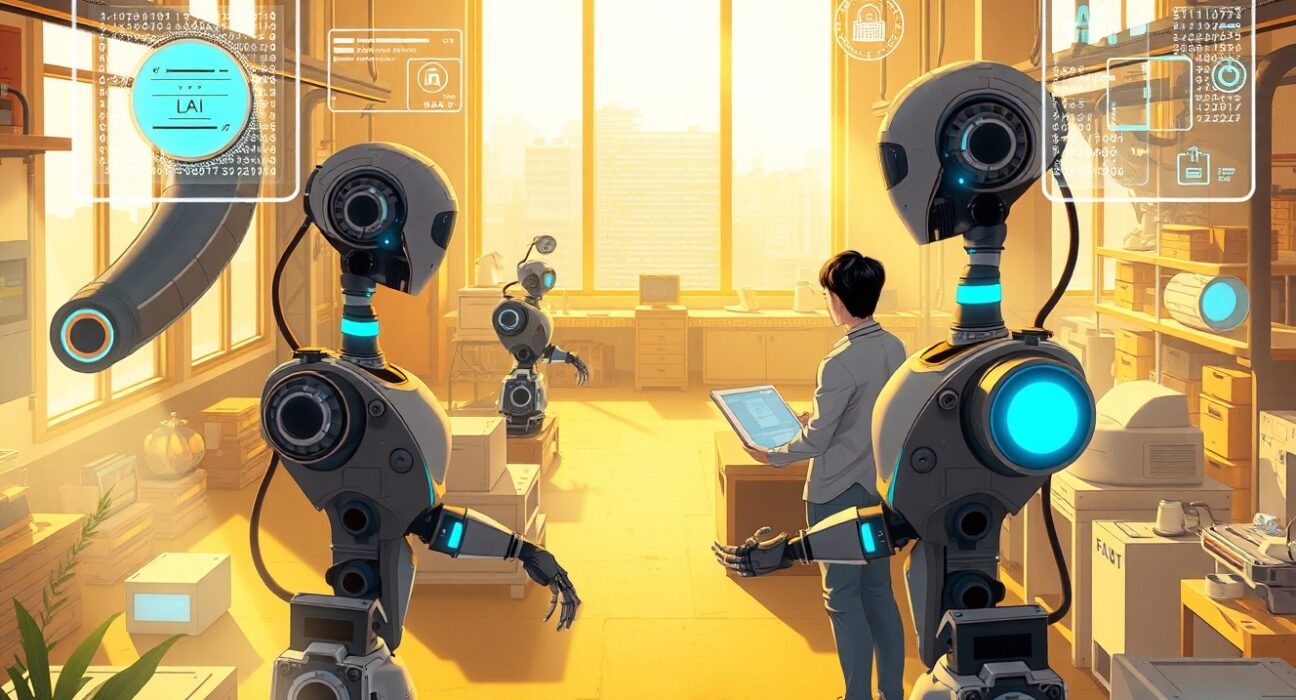
In a strategic consolidation that reshapes the future of industrial automation, Google announced on Wednesday, October 15, 2025, that it is bringing Intrinsic—the Alphabet-owned robotics software platform—directly under its corporate umbrella. This significant organizational move positions Google to accelerate its ambitious push into physical AI, a frontier where artificial intelligence directly controls and optimizes machines in the real world. The integration promises to merge Intrinsic’s specialized robotics platforms with Google’s formidable AI research from DeepMind and the computational power of its cloud infrastructure, potentially unlocking new efficiencies for global manufacturing.
Google Intrinsic Robotics Merger: A Strategic Deep Dive
Google’s decision to fold Intrinsic into its core operations represents more than a simple corporate reshuffle. It is a calculated response to the evolving AI landscape. While many AI advancements have focused on digital realms—large language models, image generation, and data analysis—industry leaders increasingly view the physical world as the next major monetization frontier. Consequently, this move aligns Google with competitors and partners investing heavily in embodied AI. Intrinsic will operate as a distinct entity within Google but will forge tight, collaborative bonds with Google DeepMind. This structure allows the robotics unit to maintain its focused mission while leveraging Google’s Gemini AI models and expansive cloud services for enhanced capability and scale.
The Intrinsic Journey: From Moonshot to Mainstream
Understanding the significance of this merger requires examining Intrinsic’s origins. The company spent five years incubating within Alphabet’s X, the celebrated “moonshot factory” responsible for groundbreaking projects like Waymo and Wing. In 2021, Intrinsic graduated to become a standalone Alphabet company under CEO Wendy Tan White. The company quickly established itself through strategic acquisitions, including the AI robotics firm Vicarious in April 2022 and key divisions of Open Robotics. These moves built a comprehensive software stack designed to simplify robotics programming. However, the path included a workforce reduction of 20% in early 2023, a common recalibration phase for ambitious tech ventures focusing on product-market fit.
Physical AI: The Next Industrial Revolution
The core thesis behind the Google-Intrinsic merger centers on physical AI. This concept refers to AI systems that perceive, learn from, and act upon the physical environment through robots and other automated systems. For manufacturers, the potential impact is profound. Imagine a factory where AI-driven robots can adapt to new assembly tasks overnight, optimize production flows in real-time based on supply chain data, or perform delicate quality inspections with superhuman consistency. This is the future Intrinsic and Google are building toward. Notably, industry visionaries like Nvidia’s Jensen Huang have publicly championed physical AI as the inevitable next step, arguing that the true value of AI will be realized when it can manipulate the physical economy.
| Year | Milestone | Strategic Significance |
|---|---|---|
| 2016-2021 | Development within Alphabet’s X | Moonshot-phase research on accessible robotics software. |
| 2021 | Spins out as independent Alphabet company | Shift to operational focus under CEO Wendy Tan White. |
| 2022 | Acquires Vicarious and Open Robotics assets | Builds intellectual property and talent in AI-first robotics. |
| 2023 | Launches Flowstate platform | Delivers first product: no-code/low-code tool for robotics workflows. |
| Late 2025 | Releases Intrinsic Vision AI model; partners with Foxconn | Demonstrates advanced perception AI and secures major manufacturing partner. |
| Oct 2025 | Announces integration into Google | Gains direct access to Gemini AI and Google Cloud for scaled deployment. |
Flowstate and Foxconn: The Path to Market
Intrinsic is not merely a research project. The company’s flagship product, Flowstate, is a practical software platform already influencing the market. Designed for developers without deep robotics expertise, Flowstate lowers the barrier to creating complex robotic workflows. Essentially, it allows engineers to program robots using higher-level logic and simulations rather than intricate, device-specific code. Furthermore, Intrinsic’s recently announced joint venture with electronics manufacturing titan Foxconn provides a critical real-world testing ground. The partnership aims to develop general-purpose intelligent robots to automate electronics manufacturing, targeting full factory automation. This collaboration offers Google a direct pipeline into one of the world’s largest manufacturing ecosystems, providing invaluable data and use cases to refine its AI models.
- Flowstate Platform: Enables visual, logic-based programming for industrial robots, reducing reliance on specialized coding skills.
- Simulation Environment: Allows for safe, cost-effective testing and training of robotic AI in digital twins before physical deployment.
- Intrinsic Vision AI: A perception model released in late 2025 that helps robots understand and interact with unstructured physical environments.
Expert Analysis: Why This Merger Makes Strategic Sense
From a business perspective, integrating Intrinsic into Google creates powerful synergies. First, it streamlines Alphabet’s sometimes complex corporate structure, bringing a strategic asset closer to core AI and infrastructure teams. Second, it provides Intrinsic with virtually unlimited access to Google’s computational resources and cutting-edge AI research, particularly from the Gemini project. This access could dramatically accelerate the training of robotics-specific AI models. Finally, Google Cloud gains a powerful, industry-specific solution to offer manufacturing clients, helping it compete with other cloud providers in the lucrative industrial sector. As Wendy Tan White stated in the announcement blog post, combining with Google’s AI will “fundamentally shift production, from its economics to operations.”
The Competitive Landscape of Industrial AI
Google is not entering a vacuum. The race to automate physical work attracts massive investment and competition. Key players include:
- Nvidia: Provides the foundational GPU hardware and Isaac robotics platform used by many companies, including Intrinsic.
- Amazon: Integrates robotics in its fulfillment centers through acquired companies like Kiva Systems and develops AWS services for industrial IoT.
- Startups: Numerous venture-backed firms are tackling niche problems in robotic vision, manipulation, and mobility.
- Traditional Automators: Companies like Siemens and Rockwell Automation are embedding AI into their industrial control systems.
Google’s unique advantage lies in its vertical integration of AI research (DeepMind), cloud infrastructure, and now, applied robotics software (Intrinsic). This end-to-end control could allow for more seamless and optimized solutions than partnerships between separate entities can achieve.
Conclusion
The integration of Intrinsic into Google marks a pivotal moment in the commercialization of physical AI. This move transitions advanced robotics from a specialized moonshot project into a core component of Google’s enterprise and AI strategy. By combining Intrinsic’s accessible robotics platforms with Google’s generative AI prowess and cloud scale, the partnership is poised to democratize advanced automation for a broader range of manufacturers. The upcoming collaboration with Foxconn will serve as a crucial proving ground. Ultimately, this merger signals that the next phase of AI’s impact will be measured not just in text or images generated, but in tangible goods produced, supply chains optimized, and entirely new manufacturing paradigms enabled. The factory of the future is being coded today, and Google Intrinsic robotics intends to write a significant portion of its operating system.
FAQs
Q1: What is Intrinsic, and what does it do?
Intrinsic is a robotics software company that develops AI models and platforms, like its Flowstate software, designed to make programming and deploying industrial robots easier and more accessible, especially for users without deep robotics expertise.
Q2: Why did Google bring Intrinsic under its direct control?
Google is strategically expanding into “physical AI,” where AI interacts with the real world. Integrating Intrinsic allows tighter collaboration with Google DeepMind and provides Intrinsic with direct access to Gemini AI models and Google Cloud resources to accelerate development and scaling.
Q3: What is “physical AI,” and why is it important?
Physical AI refers to artificial intelligence systems that can perceive, learn from, and act upon the physical environment through robots and automated machinery. It’s considered the next frontier because it allows AI to directly optimize real-world processes like manufacturing, logistics, and infrastructure.
Q4: What is the Flowstate platform?
Flowstate is Intrinsic’s primary product—a software platform that uses visual, logic-based programming to enable developers to create and simulate robotics workflows without writing complex, low-level code. It aims to democratize robotics programming.
Q5: How does the Foxconn joint venture fit into this strategy?
The October 2025 joint venture with Foxconn, a global electronics manufacturing leader, provides a massive, real-world testing and deployment environment for Intrinsic’s technology. The goal is to co-develop intelligent robots to automate electronics manufacturing, offering Google a direct path to industrial impact and valuable data.
Disclaimer: The information provided is not trading advice, Bitcoinworld.co.in holds no liability for any investments made based on the information provided on this page. We strongly recommend independent research and/or consultation with a qualified professional before making any investment decisions.