
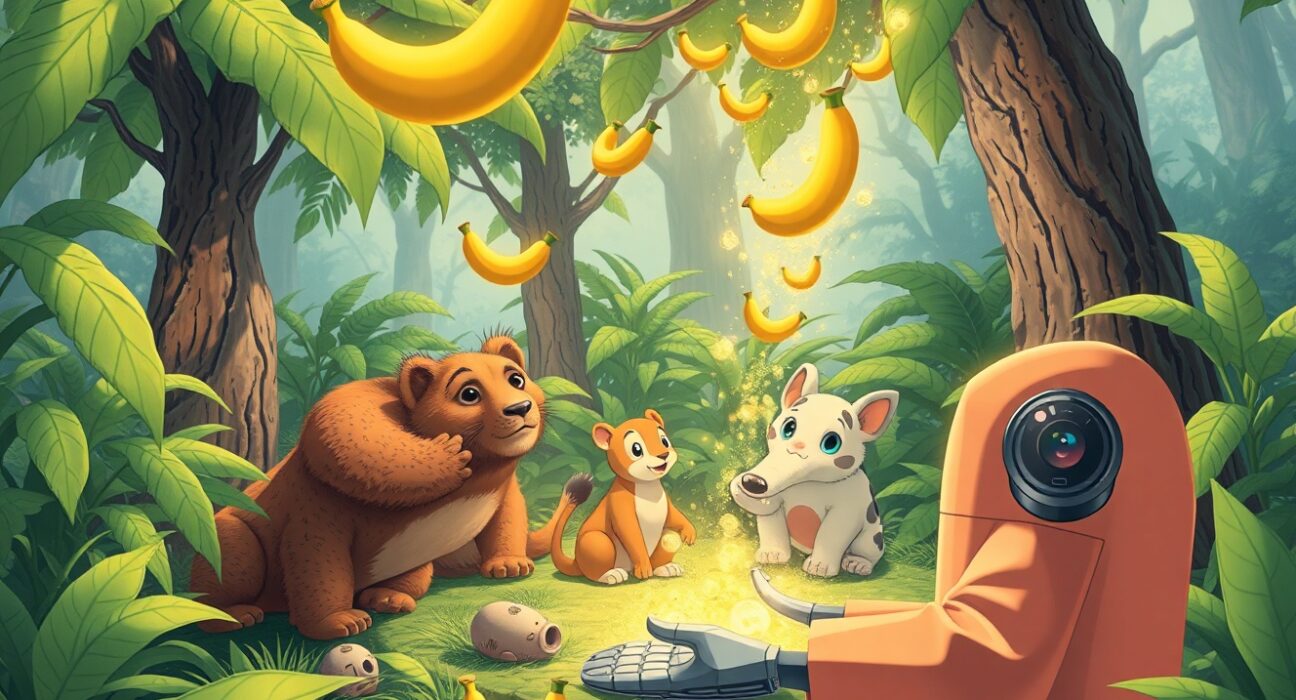
MOUNTAIN VIEW, California – October 13, 2025 – Google has fundamentally accelerated the visual AI landscape with today’s global launch of Nano Banana 2, the company’s most advanced and rapid image generation model to date. This significant update, technically identified as Gemini 3.1 Flash Image, establishes a new benchmark for speed and fidelity in consumer and developer-facing artificial intelligence tools. Consequently, the model will immediately become the default visual engine across Google’s ecosystem, directly impacting how millions of users create and interact with AI-generated media.
Google Nano Banana 2 Redefines Speed and Fidelity
Building upon the viral success of the original Nano Banana model released in August 2025, this iteration represents a strategic synthesis of accessibility and high-end capability. The new model retains the acclaimed high-fidelity characteristics of November’s Nano Banana Pro variant but executes image synthesis with dramatically improved latency. This performance leap is not merely incremental; it enables real-time creative workflows previously constrained by processing delays. Google engineers achieved this by optimizing the underlying neural architecture for parallel processing and efficient memory allocation.
The technical specifications reveal a versatile tool. Creators can now generate images with resolutions scaling seamlessly from 512 pixels up to stunning 4K quality. Furthermore, the model supports a wide array of aspect ratios, providing professional-grade flexibility for social media, digital art, and commercial design. The core advancement lies in its enhanced contextual understanding, which allows for complex, nuanced prompts that the model interprets with remarkable accuracy.
The Engineering Behind the Speed
Industry analysts point to several key innovations driving Nano Banana 2’s performance. The model utilizes a novel, sparse mixture-of-experts (MoE) architecture, allowing it to activate only relevant neural pathways for a given prompt. This specialization reduces computational waste. Additionally, Google has implemented advanced quantization techniques, compressing the model’s weights without sacrificing output quality, which directly translates to faster generation times on both cloud servers and capable edge devices.
Advanced Capabilities for Complex Storytelling
Beyond raw speed, Nano Banana 2 introduces sophisticated features aimed at professional creators and storytellers. A standout capability is its robust character consistency, maintaining the visual identity of up to five distinct characters across multiple generated images within a single workflow. This solves a persistent challenge in AI-assisted comic creation, storyboarding, and game asset development. Simultaneously, the model can track the fidelity and placement of up to 14 individual objects in a scene, ensuring complex compositions remain coherent.
- Visual Richness: The model produces media with notably more vibrant lighting, richer textural details, and sharper definition, closing the gap between AI-generated and traditionally created art.
- Prompt Complexity: Users can issue intricate, multi-clause requests describing specific moods, atmospheric conditions, and stylistic nuances, which the model synthesizes effectively.
- Workflow Integration: This consistency engine is designed for serialized content creation, enabling projects that require iterative visual development.
Global Deployment Across Google’s Ecosystem
The rollout of Nano Banana 2 is comprehensive and immediate. Within the Gemini app, it becomes the default model for all image generation tasks across Fast, Thinking, and Pro modes. This strategic integration ensures every user, from casual experimenters to power creators, benefits from the latest technology. The deployment extends deeply into Google’s product suite:
| Platform | Implementation |
|---|---|
| Gemini App | Default model for all image generation modes. |
| Google Flow | Default model for video editing and asset creation. |
| Google Search | Integrated via Google Lens and AI Mode in 141 countries. |
| Web & Mobile | Available across desktop and mobile Google app interfaces. |
For subscribers to Google’s premium AI Pro and Ultra plans, access to the specialized Nano Banana Pro model remains available for niche, high-complexity tasks. Users can select it manually via the regeneration menu. This tiered approach caters to both broad usability and specialized professional needs.
Developer Access and Responsible AI Framework
Recognizing the critical role of the developer community, Google is making Nano Banana 2 available in preview through several key interfaces: the Gemini API, the Gemini Command Line Interface (CLI), and the Vertex AI API. It will also be accessible via AI Studio and the company’s advanced development tool, Antigravity, released in November 2024. This early access allows developers to build and test next-generation applications leveraging state-of-the-art image synthesis.
Concurrently, Google is reinforcing its commitment to responsible AI. Every image generated by Nano Banana 2 will carry a SynthID watermark, Google’s proprietary, tamper-resistant identifier for AI-generated content. Notably, this system has seen substantial adoption, with verification checks in the Gemini app exceeding 20 million uses since its November launch. The images are also interoperable with the Coalition for Content Provenance and Authenticity (C2PA) standard. This industry-led initiative, supported by Adobe, Microsoft, OpenAI, Meta, and Google itself, provides a universal framework for digital content credentials, enhancing transparency across the web.
Market Impact and Historical Context
The original Nano Banana model’s launch triggered an explosion of user creativity, particularly in high-adoption markets like India, where millions of images were generated. This demonstrated a massive global demand for intuitive, powerful creative tools. Nano Banana 2 is positioned to capitalize on this foundation, directly competing with other major AI image platforms by emphasizing speed and consistency—key factors for user retention and commercial adoption. The move to make it the default in Search via Lens also signals Google’s strategy to blend generative AI seamlessly into information retrieval, potentially transforming how users discover and conceptualize visual ideas.
Conclusion
Google Nano Banana 2 marks a pivotal evolution in accessible artificial intelligence. By dramatically accelerating image generation while enhancing sophisticated features like multi-character consistency and high-object fidelity, it empowers a wider range of users to create complex, high-quality visual content. Its ubiquitous deployment across Google’s core services, from Gemini to Search, underscores the company’s vision of deeply integrated, helpful AI. Coupled with a strong framework for responsible creation through SynthID and C2PA standards, Nano Banana 2 is not just a faster model—it is a foundational step toward more seamless, trustworthy, and powerful AI-assisted creativity for global audiences.
FAQs
Q1: What is the main improvement in Google Nano Banana 2 over the previous version?
The primary advancement is significantly faster image generation speed while maintaining the high-quality output of the Pro model. It also introduces advanced features like consistent multi-character rendering and complex object scene composition.
Q2: Where can I use the new Nano Banana 2 model?
It is the default image generation model in the Gemini app (all modes), the Google Flow video tool, and Google Search via Lens and AI Mode across 141 countries on web and mobile apps. Developers can access it via Gemini API, Vertex AI, and AI Studio.
Q3: Does Nano Banana 2 create images with watermarks?
Yes, all images generated by the model include Google’s SynthID watermark, an invisible identifier for AI-generated content. The system is also compatible with the industry-standard C2PA Content Credentials for provenance.
Q4: Can I still use the older Nano Banana Pro model?
Yes, subscribers to Google’s AI Pro and Ultra plans can manually select the Nano Banana Pro model for specialized tasks through the regeneration menu (three-dot menu) in supported applications.
Q5: What are the resolution and aspect ratio capabilities of Nano Banana 2?
The model supports a wide range of resolutions, from 512px up to 4K (3840×2160), and can generate images in various aspect ratios, providing flexibility for different digital formats and platforms.
Disclaimer: The information provided is not trading advice, Bitcoinworld.co.in holds no liability for any investments made based on the information provided on this page. We strongly recommend independent research and/or consultation with a qualified professional before making any investment decisions.