

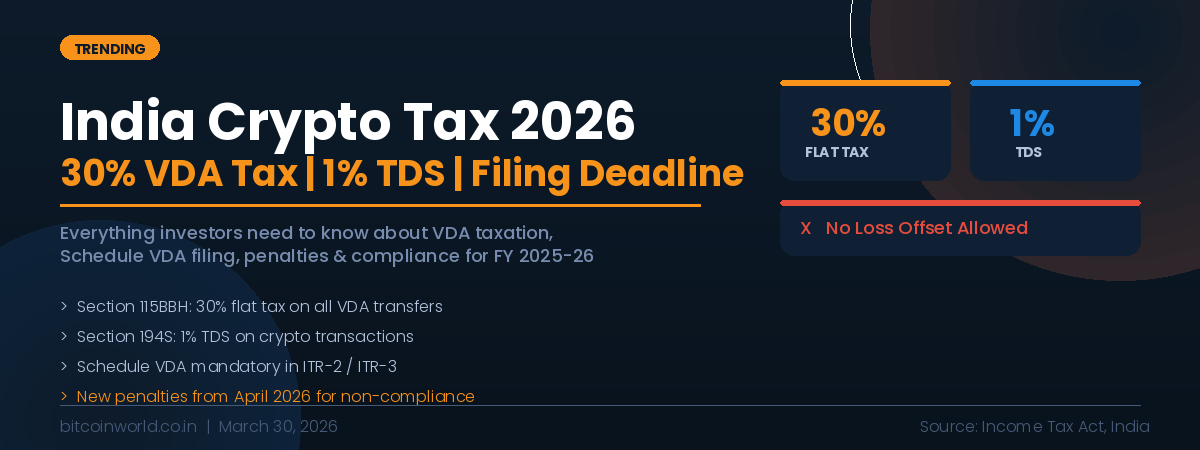
With the financial year ending on March 31, 2026, millions of cryptocurrency investors across the country are scrambling to ensure compliance with a tax regime that levies a flat 30% tax on Virtual Digital Asset (VDA) gains and a 1% Tax Deducted at Source (TDS) on every transaction. The Union Budget 2026–27 confirmed that these rules remain unchanged, while adding new penalties for non-compliance that take effect in April.
Whether you are a casual holder or a high-frequency trader, understanding the VDA taxation framework is no longer optional — it is essential to avoid scrutiny, penalties, and potential prosecution. This comprehensive guide breaks down everything you need to know about cryptocurrency taxation in India, including rates, filing procedures, penalties, and practical compliance tips.
Understanding VDA Tax Rules in India
India’s taxation framework for Virtual Digital Assets was introduced through the Finance Act 2022, which officially recognized cryptocurrencies, NFTs, and other digital tokens under the umbrella term “Virtual Digital Assets” via Section 2(47A) of the Income Tax Act. The framework rests on two legislative pillars: Section 115BBH, which governs the tax rate on VDA income, and Section 194S, which mandates TDS on VDA transfers.
The India crypto tax 2026 landscape has not changed materially from the original 2022 framework. The government has consistently maintained its strict stance through successive budgets, opting for stronger enforcement and reporting rather than rate reductions or structural concessions. Starting from FY 2025–26, mandatory reporting by crypto exchanges and designated entities has also been enforced.
The 30% Flat Tax on Crypto Gains in India
All income from the transfer of a VDA — whether through selling, swapping, or spending crypto — is taxed at a flat rate of 30%. This applies regardless of your income bracket or how long you held the asset. There is no distinction between short-term and long-term capital gains for VDAs, unlike equities or real estate.
On top of the 30% rate, a 4% Health and Education Cess applies, bringing the effective minimum rate to 31.2%. Higher-income investors may also face applicable surcharges, pushing the real cost even further.
Key Point: The only deduction permitted is the cost of acquisition. Expenses such as transaction fees, platform charges, internet costs, and advisory fees cannot be deducted. This makes India’s crypto tax regime significantly more restrictive than traditional investment taxation.
What Counts as Taxable VDA Income?
- Trading profits — Buying and selling crypto for INR or stablecoins
- Crypto-to-crypto swaps — Exchanging BTC for ETH is a taxable transfer
- Spending crypto — Using crypto to purchase goods or gift cards triggers tax
- Staking rewards — Taxed at slab rates on receipt; the 30% rate applies on subsequent sale
- Mining income — Fair market value on receipt date is taxable
- Airdrops — Treated as income upon receipt
How the 1% TDS on Crypto Transactions Works
Section 194S mandates a 1% Tax Deducted at Source on consideration paid for VDA transfers. This was introduced to create a paper trail for every crypto transaction, giving the Income Tax Department real-time visibility into trading activity.
| Parameter | Details |
|---|---|
| TDS Rate | 1% on total transaction value |
| Threshold (Specified Persons) | ₹50,000 per financial year |
| Threshold (Others) | ₹10,000 per financial year |
| Domestic Exchanges | TDS deducted automatically by the platform |
| P2P / International Trades | Buyer is responsible for deducting and depositing TDS |
| TDS Credit | Can be claimed against final tax liability in ITR |
The TDS amount is not an additional tax — it is an advance payment that can be adjusted against your final liability when filing returns. However, if you do not file an ITR, the TDS remains forfeited to the government.
No Loss Offset: India’s Strictest Crypto Tax Rule
One of the most debated aspects of India crypto tax 2026 rules is the complete prohibition on loss set-offs. Unlike most traditional asset classes, losses from one VDA cannot be adjusted against gains from another VDA or any other income source. Losses also cannot be carried forward to future assessment years.
This means that if you made ₹5,00,000 profit on Bitcoin but lost ₹4,00,000 on an altcoin in the same year, you owe 30% tax on the full ₹5,00,000 — not on the net ₹1,00,000 gain. This asymmetry has been a major point of criticism from the crypto industry and investors alike.
Schedule VDA and ITR Filing for India Crypto Tax 2026
Since FY 2023–24, the Income Tax Department has included a dedicated Schedule VDA section in ITR forms. This requires line-by-line disclosure of every VDA transaction — including date of acquisition, date of transfer, sale consideration, cost of acquisition, and computed income or loss.
Choosing the Right ITR Form
| Investor Type | Recommended ITR Form |
|---|---|
| Salaried individual with occasional crypto trades | ITR-2 |
| Active trader or crypto as a business | ITR-3 |
Steps to File Crypto Tax Returns
- Consolidate records — Download transaction histories from all exchanges and wallets
- Calculate gains — Use FIFO (First-In-First-Out) method to determine cost basis
- Fill Schedule VDA — Enter each transaction with dates, consideration, and cost
- Verify TDS — Cross-check 1% TDS entries in Form 26AS and AIS
- Claim TDS credit — Ensure all deductions are properly reflected
- E-verify — Submit and validate via Aadhaar OTP or other approved methods
The filing deadline for FY 2025–26 (AY 2026–27) is July 31, 2026 for individuals not subject to audit. However, all VDA transactions for the financial year ending March 31, 2026 must be accurately recorded before the year closes.
Penalties for Non-Compliance Under India Crypto Tax 2026
The Union Budget 2026–27 introduced stricter penalty provisions for crypto reporting failures, set to take effect from April 1, 2026. These target reporting entities under Section 509 of the Income Tax Act but also have downstream implications for individual investors.
| Violation | Penalty |
|---|---|
| Failure to submit VDA transaction statement | ₹200 per day for duration of default |
| Inaccurate or false reporting | Fixed penalty of ₹50,000 |
| Under-reporting income (Section 270A) | 50% to 200% of tax payable |
| TDS non-compliance | Penalty equal to TDS amount; potential prosecution |
| Late ITR filing | Late fees + interest under Sections 234B/C |
The government has also partnered with the National Forensic Science University (Goa) to upskill tax officers in blockchain analytics and digital forensics. From April 2026, digital records including app logs can be used in tax investigations, and authorities are authorized to inspect crypto wallets during raids.
Practical Compliance Tips for Crypto Investors
Navigating India crypto tax 2026 requirements does not have to be overwhelming if you adopt a systematic approach throughout the year rather than scrambling at deadline time.
- Maintain records year-round — Track every buy, sell, swap, and spend with timestamps, wallet addresses, and INR values at the time of each transaction
- Use crypto tax software — Platforms like Koinly, CoinDCX, and Mudrex offer automated TDS reconciliation and transaction summaries
- Check Form 26AS regularly — TDS entries visible here are the government’s record of your activity; any mismatch with your ITR can trigger notices
- Include crypto in advance tax — If your estimated crypto tax liability exceeds ₹10,000, you must pay advance tax in quarterly installments to avoid Section 234B/C interest
- Don’t ignore crypto-to-crypto swaps — Swapping 1 BTC for ETH is a taxable transfer; calculate the INR value of BTC on the swap date
- Consult a CA — A Chartered Accountant familiar with VDA taxation can help optimize your filing and catch errors
Impact on India’s Crypto Market
The India crypto tax 2026 framework has had a tangible impact on domestic market dynamics. The high tax rate combined with the no-loss-offset rule has been criticized by industry leaders as a structure that discourages retail participation and pushes trading volumes toward unregulated offshore platforms.
Industry voices have consistently lobbied for reforms. CoinSwitch co-founder Ashish Singhal has publicly stated that the current framework creates friction rather than fairness by taxing transactions without recognizing losses. The industry has specifically requested allowance of loss set-offs and a tiered tax structure similar to equities.
Despite this criticism, the government’s position has remained firm. The approach appears to prioritize revenue collection and full transaction visibility over market growth incentives. India is also moving to adopt the OECD’s Crypto-Asset Reporting Framework (CARF) by April 2027, which will enable automatic global data sharing on offshore wallets and exchange trades — further tightening the compliance net.
India vs Global Crypto Tax Regimes
India’s crypto taxation stands out as notably restrictive when compared with other major economies.
| Country | Tax Rate | Loss Offset | TDS / Withholding |
|---|---|---|---|
| India | Flat 30% + cess | Not allowed | 1% TDS |
| United States | 0–37% (based on holding period & bracket) | Allowed (up to $3,000/year against income) | None |
| United Kingdom | 10–20% CGT | Allowed | None |
| UAE | 0% (no personal income tax) | N/A | None |
| Singapore | 0% on capital gains | N/A | None |
The absence of long-term capital gains distinction, zero loss offset, and 1% TDS collectively make India’s regime one of the most burdensome globally. However, proponents argue that this structured approach is a necessary step toward legitimizing digital assets and bringing them into the formal financial ecosystem.
Frequently Asked Questions About India Crypto Tax 2026
Q: What is the tax rate on cryptocurrency in India in 2026?
All profits from the transfer of Virtual Digital Assets are taxed at a flat rate of 30% under Section 115BBH. A 4% Health and Education Cess also applies, making the effective minimum rate 31.2% plus any applicable surcharge based on your total income.
Q: Can I offset crypto losses against other income in India?
No. Losses from one VDA cannot be set off against gains from another VDA or any other income source such as salary, business, or rental income. VDA losses also cannot be carried forward to future years under the current framework.
Q: What is the 1% TDS on crypto transactions?
Under Section 194S, a 1% Tax Deducted at Source applies to VDA transfers. Indian exchanges deduct this automatically. For P2P or international trades, the buyer must deduct and deposit the TDS. The annual threshold is ₹50,000 for specified persons and ₹10,000 for others.
Q: Which ITR form should I use to report crypto income?
Most individual investors should use ITR-2. If crypto trading is your business activity, use ITR-3. Both include the dedicated Schedule VDA section for transaction-level reporting.
Q: What are the penalties for not reporting crypto taxes in India?
From April 2026, penalties include ₹200 per day for failure to file VDA statements, ₹50,000 for inaccurate reporting, and 50–200% of tax payable for under-reporting income. TDS non-compliance can lead to penalties and prosecution in severe cases.
Disclaimer: The information provided is not trading advice, Bitcoinworld.co.in holds no liability for any investments made based on the information provided on this page. We strongly recommend independent research and/or consultation with a qualified professional before making any investment decisions.
