
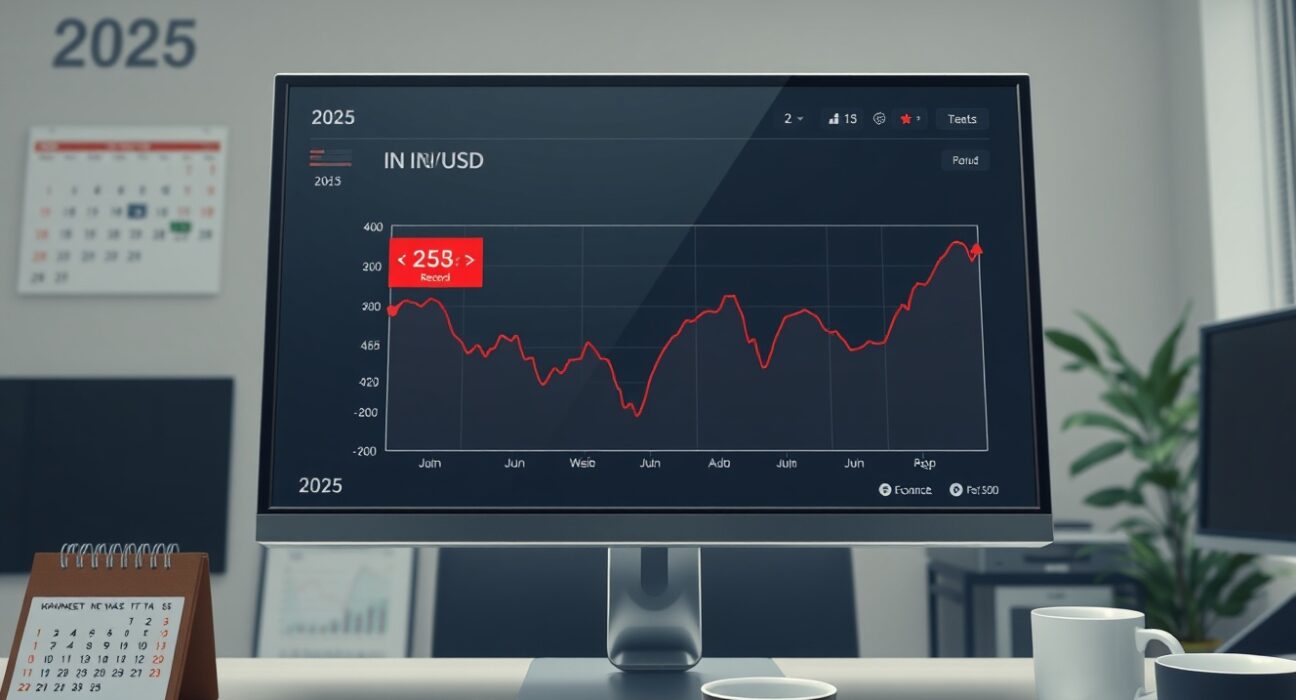
The Indian rupee plunged to a fresh all-time low against the US dollar on Thursday, March 13, 2025, as surging global oil prices and relentless dollar strength converged to create unprecedented pressure on Asia’s third-largest economy. This significant depreciation marks the currency’s weakest level in history, raising immediate concerns about inflation, import costs, and monetary policy responses from the Reserve Bank of India.
Indian Rupee Hits Record Low Against Dollar
Foreign exchange markets witnessed the Indian rupee breach the critical 85-per-dollar threshold for the first time ever. The currency settled at 85.12 against the greenback, representing a 1.8% decline from the previous session’s close. This dramatic movement follows a sustained period of weakness throughout the first quarter of 2025. Consequently, the rupee has now depreciated approximately 6.5% year-to-date, making it one of the worst-performing major Asian currencies this year.
Market analysts immediately identified two primary drivers behind this historic decline. First, Brent crude oil prices surged past $105 per barrel following renewed geopolitical tensions in the Middle East. Second, the US dollar index strengthened to its highest level in over a decade as robust American economic data reinforced expectations of prolonged higher interest rates from the Federal Reserve. These twin forces created what economists describe as a “perfect storm” for import-dependent emerging markets like India.
Oil Price Surge Intensifies Economic Pressure
India, as the world’s third-largest oil importer, faces immediate economic consequences from rising crude prices. The country imports over 85% of its crude oil requirements, making its current account particularly vulnerable to energy market fluctuations. Every $10 increase in oil prices typically widens India’s current account deficit by approximately 0.5% of GDP. Therefore, the recent surge adds significant pressure to the nation’s trade balance.
The timing of this oil price shock presents additional challenges. India’s economy had shown resilient growth throughout 2024, with GDP expanding at 6.8% in the last quarter. However, higher energy costs threaten to reverse this momentum by increasing production expenses across multiple sectors. Transportation, manufacturing, and agriculture all face rising input costs that could translate into broader inflationary pressures. The Reserve Bank of India had maintained a relatively hawkish stance on inflation, and this development complicates their monetary policy trajectory.
Historical Context and Comparative Analysis
This current depreciation episode represents the rupee’s most significant challenge since the 2013 “taper tantrum” crisis. During that period, the currency fell nearly 20% as global investors retreated from emerging markets. However, today’s situation differs in several important aspects. India’s foreign exchange reserves now stand at a robust $650 billion, providing substantial ammunition for potential intervention. Additionally, the country’s macroeconomic fundamentals show improvement in areas like tax collection and digital infrastructure.
Comparatively, other emerging market currencies have also faced pressure, though not as severely as the rupee. The following table illustrates recent performance:
| Currency | Change vs USD (YTD 2025) | Key Pressure Factors |
|---|---|---|
| Indian Rupee | -6.5% | Oil imports, dollar strength |
| Indonesian Rupiah | -4.2% | Commodity exports, capital flows |
| Philippine Peso | -3.8% | Remittances, tourism recovery |
| Thai Baht | -2.1% | Tourism, manufacturing exports |
Strong US Dollar Reshapes Global Capital Flows
The US dollar’s remarkable strength represents the second major factor pressuring the rupee. The dollar index, which measures the currency against six major peers, climbed to 108.5—its highest level since 2014. This appreciation stems from multiple reinforcing factors. First, recent US employment and inflation data exceeded expectations, suggesting the Federal Reserve may maintain restrictive interest rates longer than previously anticipated. Second, global risk aversion has increased due to geopolitical uncertainties, boosting demand for safe-haven assets like US Treasury bonds.
For emerging markets, a stronger dollar creates several immediate challenges:
- Capital outflows: Higher US yields attract investment away from riskier assets
- Debt servicing: Dollar-denominated debt becomes more expensive to repay
- Import inflation: All dollar-priced imports, not just oil, become costlier
- Competitiveness: Export advantages from weaker currencies may be offset by reduced global demand
Foreign institutional investors have already withdrawn approximately $2.5 billion from Indian equity markets in March 2025 alone. This represents the largest monthly outflow in eighteen months. Meanwhile, India’s benchmark 10-year government bond yield has risen 35 basis points this month as investors price in higher inflation risks and potential central bank action.
Reserve Bank of India’s Policy Dilemma
The Reserve Bank of India now faces a complex policy trilemma. The central bank must balance currency stability, inflation control, and economic growth simultaneously. Historically, the RBI has employed multiple tools to manage currency volatility:
- Direct intervention: Selling dollars from reserves to support the rupee
- Interest rate adjustments: Making rupee assets more attractive to foreign investors
- Administrative measures: Adjusting capital flow regulations and import restrictions
- Communication strategy: Using forward guidance to manage market expectations
Market participants widely expect some form of intervention in the coming days. However, economists debate the appropriate scale and timing. Aggressive intervention could deplete valuable foreign exchange reserves needed for future contingencies. Meanwhile, interest rate hikes to defend the currency might slow economic growth at a delicate juncture. The RBI’s next monetary policy committee meeting, scheduled for April 3-5, 2025, now takes on heightened significance.
Sectoral Impacts and Economic Consequences
The rupee’s depreciation produces varied effects across different sectors of the Indian economy. Import-intensive industries face immediate cost pressures, while export-oriented sectors may benefit from enhanced competitiveness. The information technology sector, which earns approximately 85% of its revenue in foreign currencies, typically gains from rupee weakness. However, this advantage may be partially offset if global clients reduce spending due to broader economic uncertainty.
Conversely, several sectors face significant challenges:
- Automobiles: Imported components become more expensive
- Electronics: Consumer device prices may increase
- Aviation: Fuel costs rise substantially
- Pharmaceuticals: Active pharmaceutical ingredient imports cost more
- Education abroad: Foreign tuition becomes pricier for Indian families
Consumer price inflation, which had moderated to 4.5% in February 2025, may accelerate toward the upper bound of the RBI’s 2-6% target range. Food inflation presents particular concern, as India imports significant quantities of edible oils and pulses. The government has already taken administrative measures, including reducing excise duties on petroleum products, to mitigate the impact on consumers. Further fiscal responses remain under active consideration.
Global Context and Future Trajectory
The rupee’s movement occurs within a broader global currency realignment. Major central banks worldwide are navigating divergent economic conditions and policy paths. The European Central Bank continues its gradual tightening cycle despite recession risks in Germany. Meanwhile, the Bank of Japan maintains ultra-accommodative policies despite rising inflation. This policy divergence creates additional volatility in currency markets as investors constantly reallocate capital based on relative yield expectations.
Looking forward, analysts identify several key factors that will determine the rupee’s trajectory:
- Oil price direction: Whether geopolitical tensions ease or intensify
- Federal Reserve policy: The pace and timing of any US rate cuts
- Domestic inflation: How quickly price pressures translate to consumer indexes
- Foreign investment flows: Whether India can attract stable long-term capital
- Government response: Fiscal measures to support vulnerable sectors
Historical analysis suggests that sharp currency depreciations often create buying opportunities for long-term investors once stability returns. India’s underlying growth story remains intact, with digital transformation, manufacturing expansion, and infrastructure development continuing apace. However, the immediate priority for policymakers remains stabilizing the currency while minimizing collateral damage to economic growth.
Conclusion
The Indian rupee’s descent to a fresh record low against the US dollar represents a significant economic development with far-reaching implications. Surging oil prices and relentless dollar strength have converged to create unprecedented pressure on India’s currency and economy. While the country possesses substantial foreign exchange reserves and improved macroeconomic fundamentals compared to previous crises, the current situation demands careful policy management. The Reserve Bank of India faces difficult choices between currency defense, inflation control, and growth preservation. Market participants will closely monitor both domestic policy responses and global developments in the coming weeks. Ultimately, the rupee’s trajectory will depend on a complex interplay of geopolitical events, central bank actions, and investor sentiment in volatile global markets.
FAQs
Q1: Why is the Indian rupee hitting record lows in 2025?
The Indian rupee is hitting record lows primarily due to two factors: surging global oil prices that increase India’s import bill and a strong US dollar that attracts capital away from emerging markets. These combined pressures have pushed the currency past the 85-per-dollar threshold for the first time.
Q2: How does a weaker rupee affect the common person in India?
A weaker rupee makes imported goods more expensive, potentially increasing prices for fuel, electronics, and other imported products. It also makes foreign education and travel costlier. However, it may benefit some exporters and families receiving remittances from abroad.
Q3: What can the Reserve Bank of India do to support the rupee?
The RBI can intervene directly by selling US dollars from its reserves, adjust interest rates to make rupee assets more attractive, implement administrative measures on capital flows, or use communication strategies to guide market expectations.
Q4: How does India’s current situation compare to the 2013 rupee crisis?
While both episodes involved significant rupee depreciation, India now has stronger foreign exchange reserves ($650 billion vs. $275 billion in 2013) and improved macroeconomic fundamentals. However, the global context differs, with different drivers for dollar strength and oil prices.
Q5: Which sectors benefit from a weaker rupee, and which suffer?
Export-oriented sectors like information technology, textiles, and pharmaceuticals typically benefit from rupee weakness. Import-dependent sectors like automobiles, electronics, and aviation face cost pressures. The net effect depends on each sector’s specific exposure to foreign currency transactions.
Disclaimer: The information provided is not trading advice, Bitcoinworld.co.in holds no liability for any investments made based on the information provided on this page. We strongly recommend independent research and/or consultation with a qualified professional before making any investment decisions.