

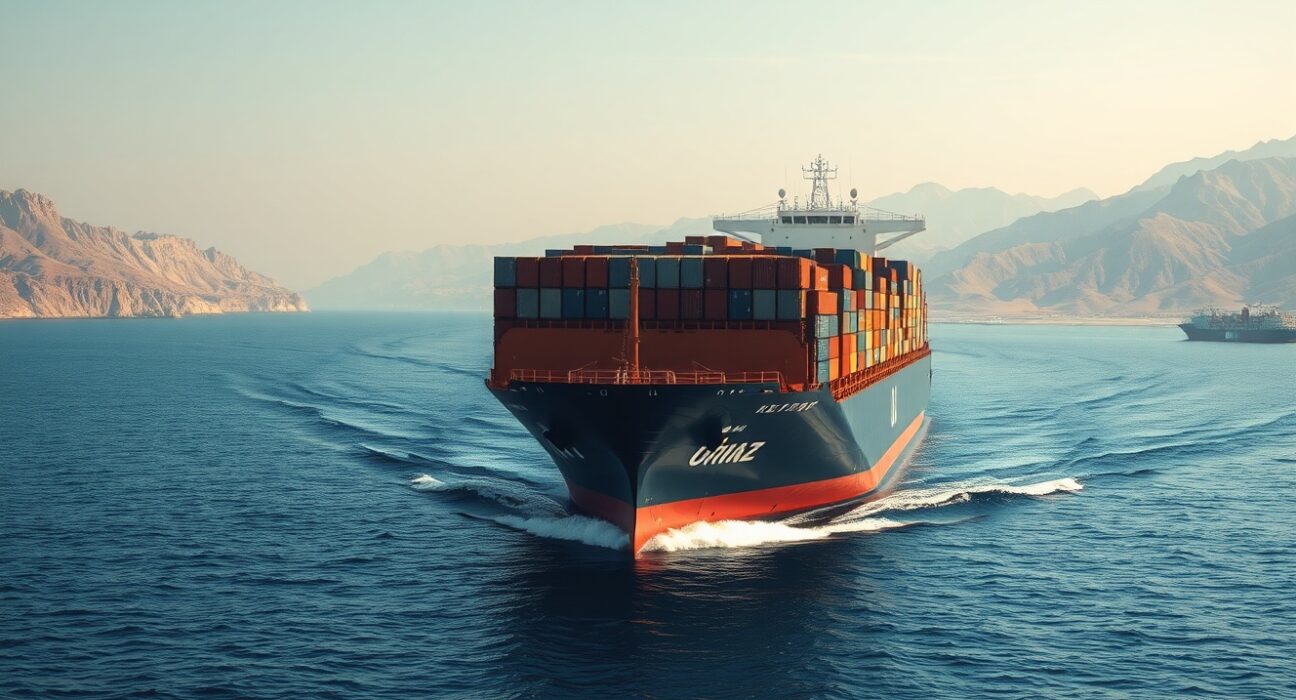
TEHRAN, Iran – In a significant development for global maritime security, Iran’s Foreign Ministry confirmed on Monday that several commercial vessels successfully transited the strategic Strait of Hormuz following direct coordination with Iranian authorities. This announcement, reported by China’s CCTV, comes amid heightened regional tensions and concerns about escalating fuel and shipping costs throughout the Gulf region. Consequently, the statement provides crucial insight into Iran’s current maritime policy and its implications for international trade.
Strait of Hormuz Passage Under Iranian Management
According to a ministry spokesperson, Iran is actively managing the passage of ships through the critical waterway. The spokesperson explicitly stated that this management applies to vessels not owned by what Iran terms “enemy nations.” Furthermore, the primary stated objective is ensuring maritime safety. This coordinated passage follows established international protocols for navigating congested and politically sensitive sea lanes. The Strait of Hormuz serves as a chokepoint for approximately 21% of global petroleum consumption, making its security a paramount concern for energy markets worldwide.
Historically, the strait has been a flashpoint for regional disputes. For instance, its narrowest point is just 21 nautical miles wide, with shipping lanes only two miles wide in either direction. This geography necessitates careful traffic management. The recent coordination efforts highlight ongoing diplomatic and logistical engagements, even amidst broader geopolitical friction. Maritime analysts note that such overt coordination can help de-escalate potential incidents and maintain the free flow of commerce, which is vital for the global economy.
Iran Denies Responsibility for Rising Regional Costs
In a pointed segment of the announcement, the Iranian spokesperson directly addressed economic concerns. The spokesperson firmly stated that Iran bears no responsibility for the increasing fuel and shipping costs observed in the Gulf region. Additionally, the official expressed that Iran does not desire populations in other countries to face pressure from higher prices for essential goods like fuel and food. This statement appears to counter international narratives often linking regional instability, for which Iran is frequently cited, to market volatility.
The global shipping industry has indeed faced substantial cost increases. Factors include higher insurance premiums for vessels operating in the Gulf, known as war risk insurance supplements, and longer routing decisions by some shippers seeking to avoid the area. For example, the price of shipping a container from Asia to the East Coast of the United States via the Suez Canal and the Strait of Hormuz has seen notable fluctuations tied to security reports. The following table outlines key cost drivers often associated with the region:
| Cost Factor | Typical Impact | Relation to Gulf Security |
|---|---|---|
| War Risk Insurance | Can increase voyage costs by thousands of dollars | Directly tied to perceived threat levels in specific zones |
| Speed & Routing | Longer routes or faster speeds increase fuel consumption | Vessels may reroute via the Cape of Good Hope to avoid the strait |
| Naval Escorts | May involve coordination fees or indirect costs | Some nations provide military escorts for flagged vessels |
| Security Equipment | Additional armed guards or anti-piracy measures | Mandatory for certain insurers in high-risk areas |
Expert Analysis on Maritime Security and Economics
Dr. Anya Petrova, a senior fellow at the Maritime Security Institute, provides context for these developments. “Iran’s public announcement of coordinated passage serves multiple purposes,” Petrova explains. “First, it projects an image of control and responsibility over a vital waterway. Second, it attempts to diplomatically separate Iran’s actions from global market reactions. The linkage between geopolitical events in the Strait of Hormuz and the Brent Crude oil price is well-documented, but attributing causality is complex.” Petrova’s analysis underscores that while incidents in the strait can trigger immediate price spikes, sustained cost increases stem from a broader matrix of supply, demand, and long-term risk assessment by traders and insurers.
Moreover, the Iranian policy of managing “non-enemy” ship passage introduces a selective element to maritime access. This policy likely references the complex web of international sanctions and diplomatic relations. Ships owned by or flagged to nations like the United States, the United Kingdom, or Israel could theoretically face different procedures. However, the spokesperson’s comments did not detail specific criteria, leaving the practical implementation subject to interpretation by shipping companies and legal experts.
Background and Geopolitical Context of the Strait
The Strait of Hormuz is not merely a shipping lane; it is a central arena for regional power dynamics. Iran borders the northern side of the strait, while the Musandam Peninsula, an exclave of Oman, borders the south. Iran has repeatedly emphasized its sovereign rights and military capabilities in these waters. Key historical context includes:
- 1980s “Tanker War”: During the Iran-Iraq War, both nations attacked oil tankers in the Gulf, severely disrupting traffic.
- 2019 Tensions: A series of attacks on commercial ships, which the U.S. attributed to Iran, raised global alarm.
- Ongoing Naval Presence: The U.S. Fifth Fleet, based in Bahrain, and various European naval missions patrol the area to ensure freedom of navigation.
This history makes any statement from Iran regarding ship management immediately significant. The recent confirmation of coordination suggests a potential channel for crisis communication, even if broader political disagreements persist. For shipping companies, clear protocols and communication lines are essential for operational planning and crew safety. Therefore, the announcement may be received as a stabilizing signal by the maritime industry, provided it translates into predictable on-water behavior.
Implications for Global Trade and Energy Security
The safe and uninterrupted flow of traffic through the Strait of Hormuz is a cornerstone of global energy security. Approximately one-third of the world’s seaborne traded oil passes through this corridor. Major exporters like Saudi Arabia, Iraq, the UAE, and Kuwait depend almost entirely on it for their crude oil exports. Any sustained disruption would force a massive and costly reconfiguration of global logistics, impacting economies far beyond the Middle East.
Iran’s latest statement, therefore, intersects with critical interests for:
- Asian Economies: China, India, Japan, and South Korea are top importers of Gulf hydrocarbons.
- Western Consumers: Fuel prices in Europe and North America are sensitive to Gulf supply shocks.
- Shipping & Insurance Firms: These entities require clarity to assess risk and set premiums.
- Regional States: GCC nations seek stability to maintain their export revenues and economic diversification plans.
Consequently, while the announcement addresses immediate passage logistics, its deeper importance lies in its contribution to—or potential subtraction from—regional predictability. A pattern of transparent coordination could help build fragile confidence, whereas a reversion to ambiguity or confrontation would achieve the opposite.
Conclusion
Iran’s confirmation of coordinated ship passage through the Strait of Hormuz represents a multifaceted development in Gulf maritime affairs. While explicitly denying any link to rising regional costs, Iran is asserting a managed approach to transit in one of the world’s most critical waterways. The long-term impact will depend on the consistency and transparency of this management and how it interacts with the security policies of other naval powers in the region. For global markets and trade routes, maintaining open and secure passage through the Strait of Hormuz remains an indispensable priority, making such diplomatic and logistical communications vital for international economic stability.
FAQs
Q1: What did Iran announce regarding the Strait of Hormuz?
Iran’s Foreign Ministry announced that several ships have passed through the Strait of Hormuz in recent days after coordinating with relevant Iranian authorities. The spokesperson emphasized Iran is managing passage for safety, specifically for vessels not from “enemy nations.”
Q2: Why is the Strait of Hormuz so important?
The Strait of Hormuz is a critical maritime chokepoint connecting the Persian Gulf with the Gulf of Oman and the Arabian Sea. It is a vital passage for global oil trade, with about 21% of global petroleum consumption transiting through it, making its security essential for world energy markets.
Q3: Is Iran responsible for rising shipping and fuel costs in the Gulf, according to its statement?
No. Iran’s Foreign Ministry spokesperson explicitly stated that Iran is not responsible for rising fuel and shipping costs in the Gulf region. The spokesperson added that Iran does not want people in other countries to suffer from higher prices for fuel or food.
Q4: What does Iran mean by managing the passage of “ships not owned by enemy nations”?
This phrasing suggests Iran applies different procedures or considerations based on the ownership or flag of a vessel, likely referring to countries with which it has hostile relations, such as the United States or Israel. The exact criteria and practical implementation were not detailed in the announcement.
Q5: How might this announcement affect global trade?
If the coordinated passage leads to greater predictability and safety, it could stabilize war risk insurance premiums and reassure shipping companies. However, the long-term effect depends on whether this represents a sustained policy of transparent coordination or a temporary measure amidst ongoing regional tensions.
Disclaimer: The information provided is not trading advice, Bitcoinworld.co.in holds no liability for any investments made based on the information provided on this page. We strongly recommend independent research and/or consultation with a qualified professional before making any investment decisions.
