

Is Crypto Actually Stored “Inside” a Wallet, or Somewhere Else?
Crypto being stored “inside” a wallet is one of the biggest misconceptions in the entire space – your coins are not actually held in the app or device at all. They live on the blockchain, and a wallet simply holds the keys that let you control them. This article explains where crypto really lives, what a wallet actually stores, why this matters when a device is lost, and what it means for Indian users choosing between self-custody and exchanges.
Is Crypto Actually Stored “Inside” a Wallet, or Somewhere Else?
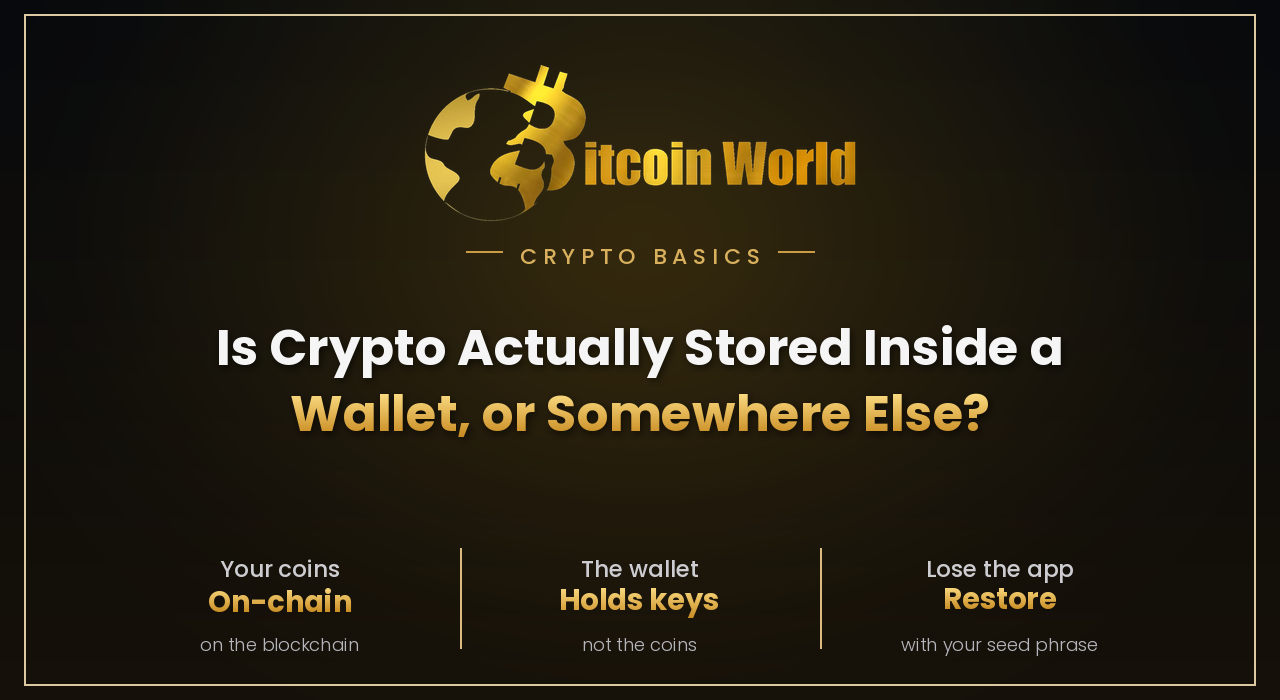
No – crypto is not stored “inside” a wallet; it exists as records on the blockchain, a shared public ledger. A wallet stores the keys that prove you own those records and let you move them.
- Coins live on-chain: Your balance is an entry on the blockchain, not a file on your phone.
- The wallet holds keys: It stores your private keys / seed phrase, which unlock access to your funds.
- Think keychain, not vault: A wallet is more like a keyring than a box of cash.
- The network keeps the record: Thousands of computers worldwide hold copies of the ledger, not your wallet app.
What Does a Crypto Wallet Actually Store, Then?
If the coins are on-chain, it helps to know exactly what’s sitting in your wallet.
- Private keys: The secret that authorizes spending from your addresses.
- Public keys and addresses: Derived from your private key, used to receive funds.
- Seed phrase: A human-readable backup that can regenerate all your keys.
- No actual coins: The wallet never contains tokens – only the means to control them on the ledger.
Why Does It Matter Where Crypto Is Really Stored?
Understanding this changes how you protect your funds and react when something goes wrong.
- Lost device, safe coins: If you lose your phone but have your seed phrase, you restore access – the coins never left the chain.
- No backup, real loss: Lose the keys with no backup, and the on-chain funds become permanently unreachable.
- App shutdown isn’t fatal: Because coins aren’t in the app, a discontinued wallet doesn’t erase your money (for non-custodial wallets).
- Hot vs cold storage: “Hot” and “cold” wallets simply describe how safely your keys are stored, online or offline.
What Does This Mean for Indian Crypto Users?
For users in India, this distinction shapes the choice between holding your own keys and trusting a platform.
- Self-custody: With a non-custodial wallet, you hold the keys, so you control the on-chain funds directly.
- Exchange custody: On an exchange, the platform holds the keys – “not your keys, not your coins.”
- Back up offline: Store your seed phrase securely offline; it’s the only thing that truly represents your access.
- Plan for the long term: For larger holdings, a hardware wallet keeps keys off the internet entirely.
Frequently Asked Questions
If crypto isn’t in my wallet, where is it actually kept?
Your crypto is recorded on the blockchain – a public ledger maintained by computers across the network – not inside your wallet app or device. The wallet only stores the keys that let you access and spend those on-chain balances. This is why understanding that crypto isn’t stored “inside” a wallet is so important for protecting it.
Will I lose my crypto if I lose my phone or wallet device?
Not if you have your seed phrase – because the coins live on the blockchain, you can restore access on a new device or compatible wallet. You only lose funds if you lose the keys and have no backup. This is exactly why backing up your recovery phrase offline is the single most important habit.
Is crypto safer in a wallet or on an exchange?
A non-custodial wallet gives you direct control of the keys to your on-chain funds, while an exchange holds those keys on your behalf. Self-custody removes reliance on any company, which is why “not your keys, not your coins” is a guiding rule; exchanges offer convenience but add custodial risk. Indian users often keep trading funds on exchanges and long-term holdings in self-custody.
Conclusion: Why “Keys, Not Coins” Is the Mindset That Protects You
Realizing that crypto is not stored “inside” a wallet but on the blockchain reframes everything about security: you’re never protecting coins in an app, you’re protecting the keys that control them. For Indian users, this means the priorities are clear – back up your seed phrase offline, understand who holds your keys, and choose self-custody for anything you can’t afford to lose. Master this one idea, and you’ll never again confuse the wallet with the wealth it unlocks.
Disclaimer: The information provided is not trading advice, Bitcoinworld.co.in holds no liability for any investments made based on the information provided on this page. We strongly recommend independent research and/or consultation with a qualified professional before making any investment decisions.
