Is Crypto-to-Crypto Trading Taxable in India?
In this article
Is Crypto-to-Crypto Trading Taxable in India?
Crypto-to-crypto trading in India is fully taxable – every swap between two cryptocurrencies constitutes a transfer of a Virtual Digital Asset under the Income Tax Act 2025 and attracts the 30% flat tax on any gain arising. No rupees need to change hands for a tax event to occur. This is one of the most misunderstood rules in India’s crypto tax framework, and one of the most consequential for active traders who swap between assets frequently. This article explains the legal basis, how the gain is calculated, the role of Fair Market Value, TDS on swaps, and what active crypto-to-crypto traders must do in their ITR. Verified against Income Tax Act 2025 and Budget 2026-27;.
Is Crypto-to-Crypto Trading Taxable in India?
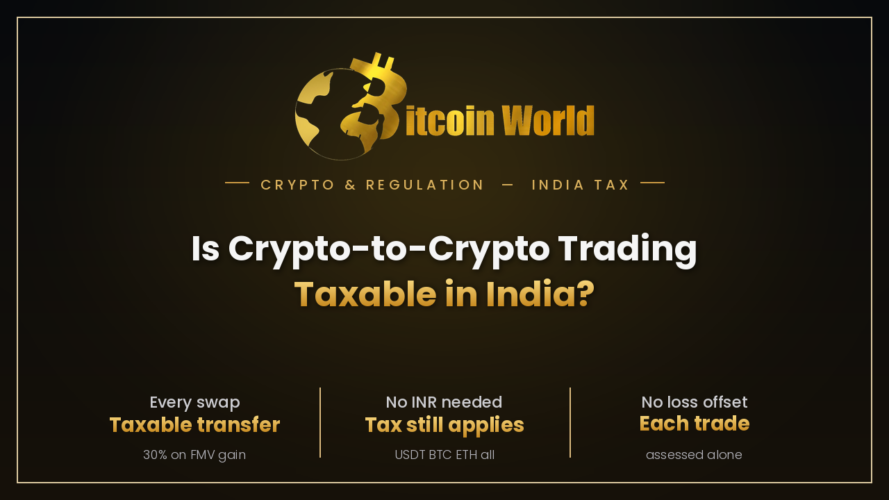
Yes – crypto-to-crypto trading in India is explicitly taxable. The word “transfer” in Section 115BBH captures every disposal of a VDA, regardless of whether the consideration received is INR or another cryptocurrency.
- No INR required: Trading Bitcoin for Ethereum, swapping USDT for Solana, or exchanging any coin for another – all are taxable transfers.
- 30% flat tax applies: Any gain arising from the swap is taxed at 30% plus 4% cess under Section 115BBH.
- Income Tax Department’s confirmed position: The ITD has explicitly stated that crypto-to-crypto exchanges constitute VDA transfers subject to tax.
- No de minimis exemption: Even small swaps are taxable – there is no minimum gain threshold below which crypto-to-crypto trades are exempt.
How Is the Gain Calculated on a Crypto-to-Crypto Swap?
The gain calculation uses the Fair Market Value (FMV) of the cryptocurrency received, expressed in INR, at the time of the swap.
- Sale consideration: The INR FMV of the crypto received on the date and time of the swap.
- Cost of acquisition: The INR price originally paid for the crypto disposed of.
- Taxable gain = FMV received (INR) − Cost of acquisition (INR)
- New cost basis: The FMV of the received crypto at the time of the swap becomes its cost of acquisition for any future disposal.
- Worked example: Buy 1 ETH at ₹1,50,000. Swap it for SOL when ETH trades at ₹2,50,000. Gain = ₹1,00,000. Tax due = ₹30,000 (30%) + ₹1,200 cess = ₹31,200 – with no INR involved.
Does the 1% TDS Apply to Crypto-to-Crypto Trades?
Yes – TDS obligations extend beyond INR-settled trades to crypto-to-crypto swaps.
- On registered Indian exchanges: The exchange deducts 1% TDS based on the INR FMV of the consideration at the time of the swap.
- On P2P and international platforms: The buyer is technically required to deduct and deposit 1% TDS manually using Form 26QE.
- On DeFi protocols: Enforcement on purely on-chain swaps via decentralised protocols remains a grey area in 2026, but the legal obligation exists.
- TDS is a credit: TDS deducted on crypto-to-crypto swaps is credited against your final 30% tax liability at the time of ITR filing.
How Does Crypto-to-Crypto Trading Interact With the No-Loss-Offset Rule?
The combination of taxable swaps and no-loss-offset creates a particularly harsh outcome for active traders.
- No netting: You cannot net a losing swap against a gaining swap in the same financial year.
- Each swap is independent: Each profitable trade is taxed in full; each loss-making trade provides zero relief.
- Practical example: Swap A: ₹50,000 gain. Swap B: ₹80,000 loss. Net position = −₹30,000. Tax owed = ₹15,000 on the ₹50,000 gain. The ₹80,000 loss is simply lost.
- Trading frequency amplifies exposure: High-frequency traders who swap between many assets accumulate multiple taxable events, each assessed independently.
Frequently Asked Questions
Is trading Bitcoin for USDT taxable in India?
Yes – trading Bitcoin for USDT is a crypto-to-crypto transfer and is fully taxable in India at 30% plus 4% cess on any gain. The gain is calculated as the INR Fair Market Value of the USDT received minus the original INR cost of acquisition of the Bitcoin. The fact that USDT is a stablecoin and that no rupees changed hands does not reduce or remove the tax liability.
How do I find the INR value of a crypto-to-crypto swap for tax purposes?
Use the INR Fair Market Value of the cryptocurrency received at the exact time of the swap – most FIU-registered Indian exchanges display this in your transaction history. For international exchange swaps, use the INR equivalent at the exchange rate applicable at the time of the trade. Crypto tax tools like KoinX or ClearTax can automate this calculation by importing exchange transaction data directly.
Do I need to declare crypto-to-crypto swaps in my ITR even if I made a loss?
Yes – all VDA transfers, including loss-making crypto-to-crypto swaps, must be declared line-by-line in Schedule VDA of your ITR-2 or ITR-3. While losses cannot be offset against gains or carried forward, the declaration of all transfers is a mandatory compliance requirement. Failure to declare transfers – even unprofitable ones – can trigger a mismatch flag from the ITD’s automated reconciliation system.
Conclusion: Why Every Swap Is a Separate Tax Event You Cannot Ignore
Crypto-to-crypto trading in India is taxable, individually assessed, and now systematically tracked through exchange reporting under Section 509 from April 2026. For Indian traders, this means every swap between assets – however routine it feels – has a 30% tax consequence if it’s profitable, and no relief if it’s a loss. The practical implication is that frequent trading across many assets is far more tax-costly in India than buy-and-hold, and that maintaining accurate INR FMV records for every swap is not optional – it is a legal compliance requirement that the ITD increasingly has the data to verify.