

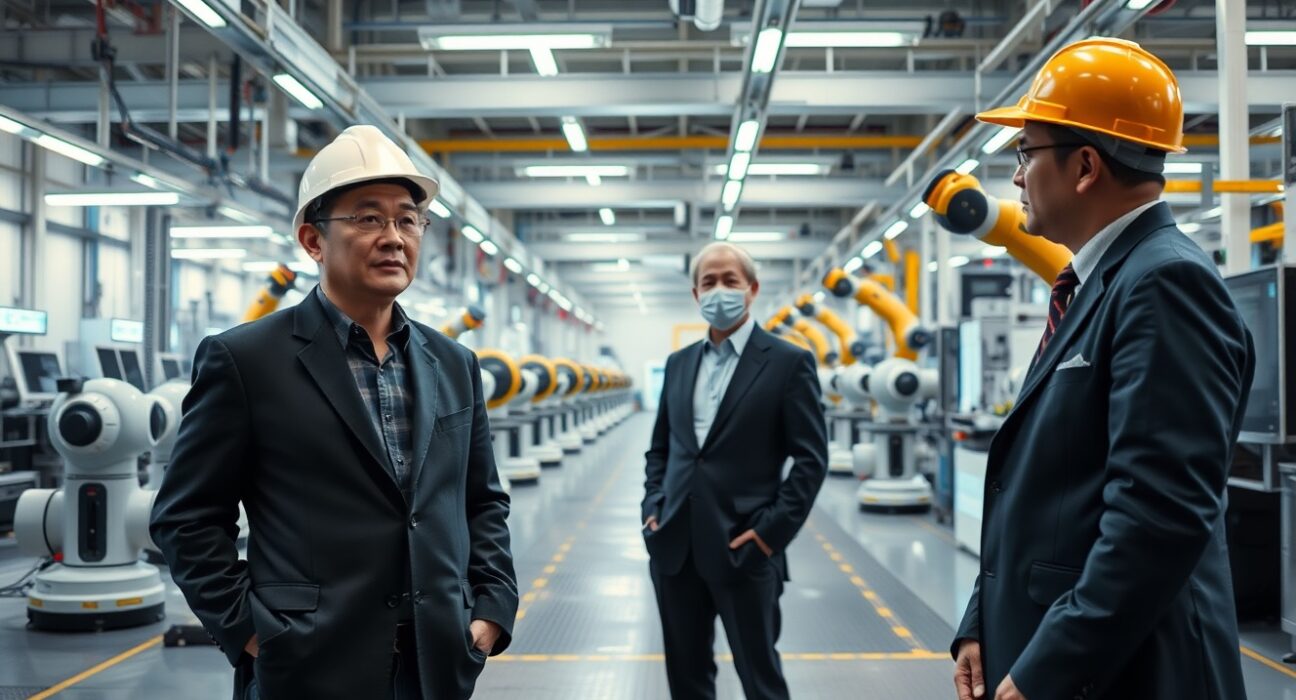
Nvidia CEO Jensen Huang concluded a two-day visit to Tokyo on July 16, securing a series of agreements that position Japan as a central hub for the company’s push into physical AI. The deals, announced alongside Japanese government and industry leaders, span a national AI factory, a robotics coalition, and deepened ties with Toyota. The visit underscores a mutual strategic shift: Nvidia is betting on factory-floor and machine-based AI as its next growth frontier, while Japan, facing a shrinking workforce, is accelerating a $65 billion plan to deploy 10 million AI-equipped robots across 18 sectors by 2040.
Noetra: Japan’s Sovereign AI Factory
The centerpiece of the visit was the formalization of Noetra, a consortium of roughly 44 Japanese firms, including SoftBank, Sony, NEC, and Honda, backed by government funding of up to 1 trillion yen ($6.2 billion) over five years. Noetra’s mission is to develop homegrown “physical AI” foundation models — software brains designed to run robots, vehicles, and factory machinery. Japan’s government has made clear it does not want its critical industrial infrastructure dependent on American or Chinese AI models.
To train these models, Nvidia is building a massive data center, dubbed the “Vera Rubin AI factory,” expected to launch in 2028. The facility will house 13,750 Vera CPUs and 27,500 Rubin GPUs, delivering 140 megawatts of computing power. Noetra’s development roadmap is structured in three phases: a reasoning model strong in Japanese-language processing by fiscal 2026; an omni-modal version handling text, images, video, and audio by 2028; and a “Real-world Native AI” system for direct robot control by 2030.
Robotics Coalition Lines Up Behind Cosmos
Nvidia also secured commitments from a broad swath of Japan’s industrial base to adopt its Cosmos AI models. Fanuc, Yaskawa, Kawasaki Heavy, Fujitsu, Hitachi, NEC, Sony, SoftBank, Kubota, and the AIRoA robotics group have all signed on to build on Cosmos, an open-model initiative Nvidia launched in May. During the Tokyo visit, Nvidia unveiled Cosmos 3 Edge, a version of the model optimized to run on its Jetson Thor chips inside machines themselves. Several companies, including Honda R&D and Omron, are already testing a shared control system built on the tools.
“The next frontier of AI is in the physical world, and this is a once-in-a-generation opportunity for Japan,” Huang said in a company statement. “Japan invented modern manufacturing. Now, it has the opportunity to reinvent it for the age of intelligent industries.”
Toyota Deepens Its Nvidia Integration
Toyota, already a major Nvidia customer, expanded its commitment during the visit. The automaker has committed its next-generation vehicles to Nvidia’s Drive platform, a decision announced at CES in January 2025. The newer agreements extend Nvidia’s role into Toyota’s manufacturing operations, where simulations are used to design production lines, into the software that runs its vehicles, and into systems that read road traffic. Toyota’s approach to advanced driver assistance remains more conservative than that of Waymo or Tesla, focusing on systems that assist the driver rather than replace them.
Why It Matters: Sovereignty and Demographics
Huang’s visit placed physical AI at the center of Japan’s industrial strategy, and Tokyo is backing that strategy with significant funding. The government’s AI Robotics Strategy, released in March, aims to capture more than 30% of the global AI robotics market by 2040, a market Tokyo values at roughly ¥20 trillion, or about $133 billion. The Ministry of Economy, Trade and Industry (METI) is funding the domestic foundation model, and Noetra’s Nvidia-powered factory is where models of that scale would be trained.
Underneath the industrial case is a sovereign one. As the United States and China pull ahead in large-scale AI, Tokyo wants its own data, its own compute, and less dependence on infrastructure it does not control. Huang appeared on July 16 alongside trade minister Ryosei Akazawa at the government’s physical-AI launch, with Prime Minister Sanae Takaichi joining by video. The Takaichi administration has made AI and semiconductors the centerpiece of a growth plan chasing ¥370 trillion ($2.3 trillion) in public and private investment by 2040. Noetra’s factory — which Nvidia bills as “the world’s first national AI infrastructure” — is the clearest bet yet. Japan’s push for independence, at least for now, rests on American chips.
Conclusion
Jensen Huang’s two days in Tokyo produced a clear blueprint for Nvidia’s next chapter in Asia. By tying its hardware and software roadmaps to Japan’s sovereign AI ambitions, the company has secured a beachhead in a market that is both a major manufacturing hub and a committed investor in physical AI. For Japan, the deals offer a path to building its own AI infrastructure and addressing a demographic crisis through automation. The partnership is a strategic alignment of mutual need, built on a foundation of government backing, industrial scale, and a shared vision of a machine-driven AI future.
FAQs
Q1: What is Noetra?
Noetra is a Japanese consortium of roughly 44 domestic firms, including SoftBank, Sony, NEC, and Honda, formed to develop homegrown physical AI foundation models. It is backed by up to 1 trillion yen ($6.2 billion) in government funding over five years.
Q2: What is Nvidia building in Japan?
Nvidia is building a “Vera Rubin AI factory,” a massive data center packed with its next-generation chips, expected to launch in 2028. It will house 13,750 Vera CPUs and 27,500 Rubin GPUs, delivering 140 megawatts of computing power.
Q3: Why is Japan investing so heavily in physical AI?
Japan faces a shrinking workforce and wants to deploy 10 million AI-equipped robots across 18 sectors by 2040. The government is targeting more than 30% of the global AI robotics market by 2040, valued at roughly ¥20 trillion ($133 billion). The investment is also driven by a desire for technological sovereignty, reducing dependence on U.S. and Chinese AI infrastructure.
Disclaimer: The information provided is not trading advice, Bitcoinworld.co.in holds no liability for any investments made based on the information provided on this page. We strongly recommend independent research and/or consultation with a qualified professional before making any investment decisions.
