

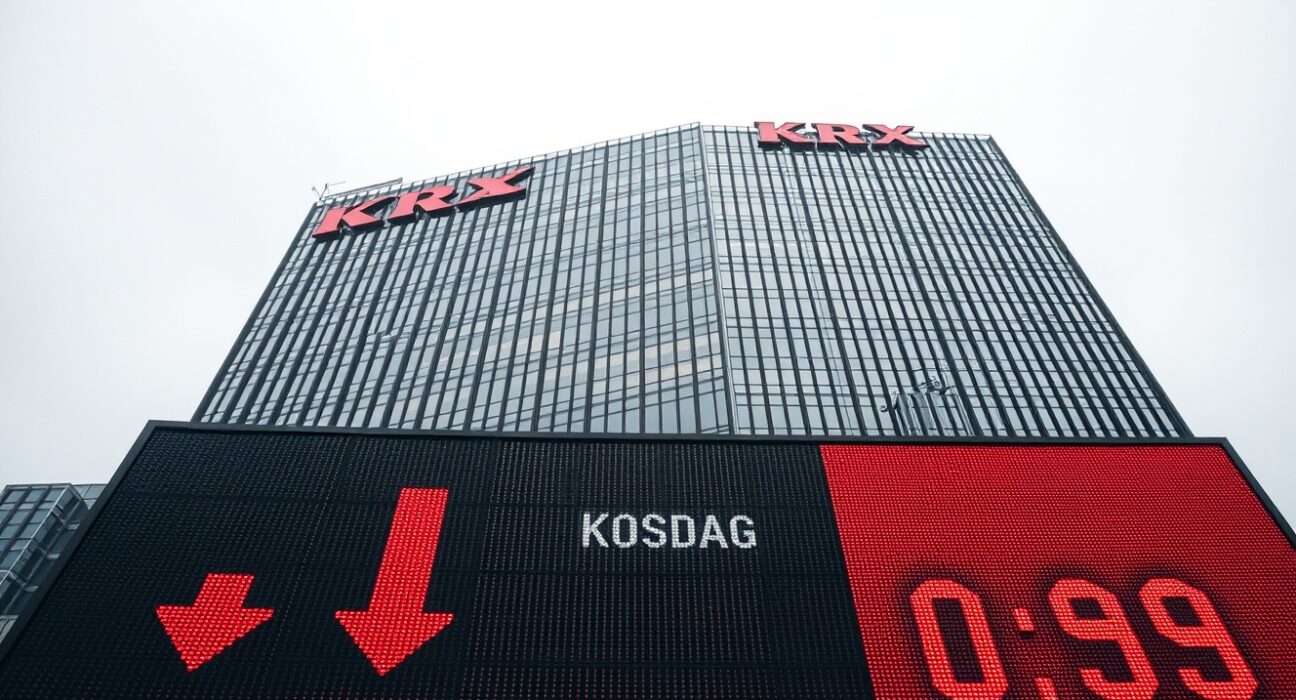
South Korea’s exchange operator triggered a circuit breaker on the Kosdaq market on Thursday after the index fell more than 8%, following a similar sharp decline in the KOSPI. The move temporarily halted trading on the tech-heavy Kosdaq, which is home to many of the country’s smaller and mid-cap companies.
Understanding the Circuit Breaker Mechanism
A circuit breaker is a market-wide mechanism designed to prevent panic selling and provide a cooling-off period during extreme volatility. On the Korea Exchange (KRX), the system operates in three stages. A first-stage circuit breaker is activated when the KOSPI or Kosdaq index drops more than 8% from the previous day’s close and maintains that decline for at least one minute. Once triggered, trading is suspended for approximately 20 minutes.
This is not the first time such measures have been used. South Korea’s markets have seen circuit breakers triggered during past global financial shocks, including the 2008 financial crisis and the 2020 COVID-19 pandemic sell-off. The mechanism is a standard safeguard in many global exchanges, including the New York Stock Exchange and the Tokyo Stock Exchange.
Market Context and Implications
The simultaneous decline in both the KOSPI and Kosdaq suggests broad-based selling pressure rather than sector-specific issues. The KOSPI, which includes major blue-chip companies like Samsung Electronics and Hyundai Motor, fell sharply earlier in the session before the Kosdaq decline triggered the halt.
While the exact catalyst for Thursday’s sell-off is still emerging, traders are pointing to a combination of global macroeconomic headwinds, including rising U.S. interest rates, geopolitical tensions, and weaker-than-expected export data from South Korea. The country’s economy is heavily reliant on semiconductor and electronics exports, making it sensitive to shifts in global demand.
What This Means for Investors
For retail and institutional investors, a circuit breaker provides a brief window to reassess positions and market conditions. However, it does not prevent further declines once trading resumes. The 20-minute halt allows for the dissemination of information and can help reduce the likelihood of erroneous trades or flash crashes.
Market participants should remain cautious. Historically, circuit breakers have been followed by continued volatility, though they often prevent more severe intraday crashes. The KRX may also consider additional measures, such as expanding the daily price fluctuation limits, if volatility persists.
Conclusion
The triggering of a circuit breaker on the Kosdaq underscores the severity of the current market downturn in South Korea. While the mechanism is a standard protective measure, it signals deep investor anxiety. As global economic conditions remain uncertain, further market disruptions cannot be ruled out. Investors are advised to stay informed and monitor official statements from the Korea Exchange and financial authorities.
FAQs
Q1: What exactly is a circuit breaker in the stock market?
A circuit breaker is a regulatory mechanism that temporarily halts trading on an exchange when a major index falls by a specific percentage within a short period. Its purpose is to prevent panic selling and allow time for information to reach all market participants.
Q2: How long does the trading halt last on the Kosdaq?
When a first-stage circuit breaker is triggered, trading is suspended for approximately 20 minutes. After that, trading resumes with a normal auction process.
Q3: Does a circuit breaker mean the market will recover?
No, a circuit breaker does not guarantee a market recovery. It only provides a temporary pause. After trading resumes, the market can continue to fall or stabilize depending on the underlying factors driving the sell-off.
Disclaimer: The information provided is not trading advice, Bitcoinworld.co.in holds no liability for any investments made based on the information provided on this page. We strongly recommend independent research and/or consultation with a qualified professional before making any investment decisions.
