

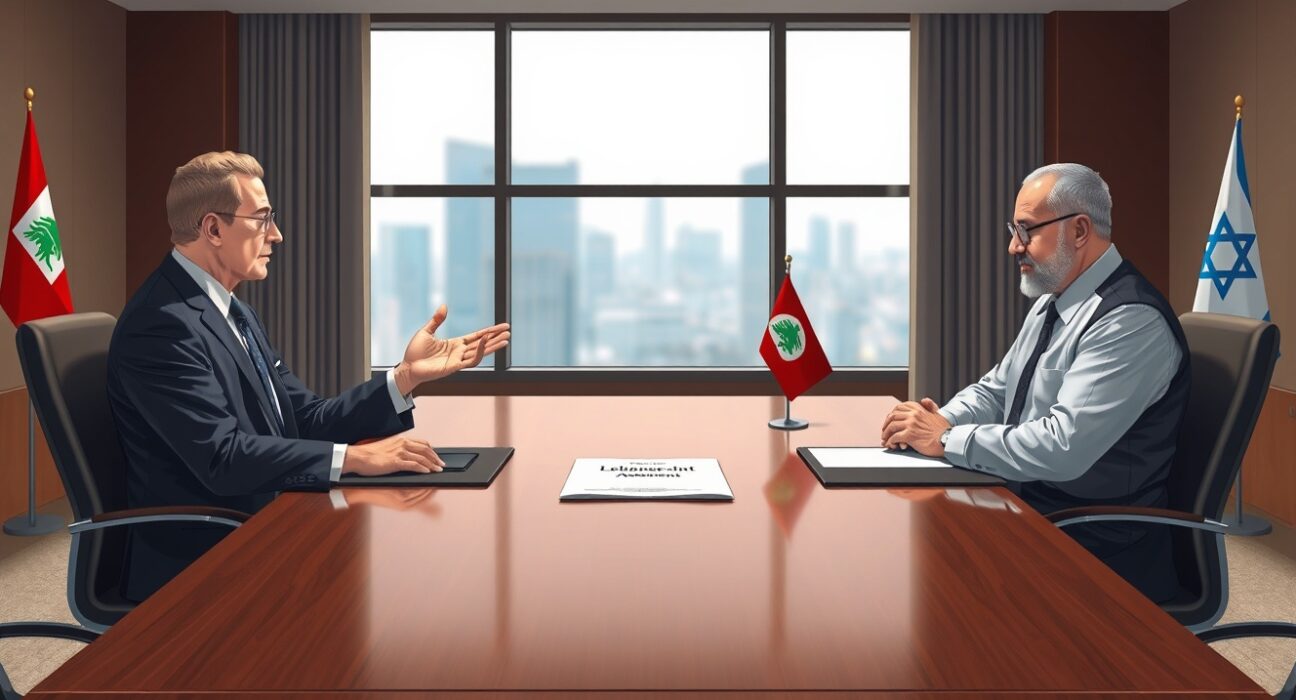
BEIRUT, Lebanon – In a pivotal move for regional stability, Lebanese officials are preparing to formally request an extension of the current ceasefire during imminent diplomatic talks with Israel, sources close to the negotiations confirm. This development follows months of tense calm along the shared border and underscores the fragile nature of the truce that has prevented wider conflict. The upcoming dialogue, mediated by international actors, represents a critical test for diplomacy in a region fraught with historical grievances and complex security challenges.
Lebanon Seeks Ceasefire Extension Amid Delicate Calm
Lebanese authorities will table the extension request as their primary objective. Consequently, the talks aim to solidify the temporary peace that has held since the last escalation. The current arrangement, while halting overt hostilities, has failed to address several underlying issues. Therefore, Beirut views a longer-term agreement as essential for allowing reconstruction and economic recovery in southern border areas. Furthermore, a stable ceasefire could create the necessary space for more comprehensive political discussions, which all parties currently deem impossible during active tensions.
Analysts point to several factors driving Lebanon’s position. First, the country faces profound internal political and economic crises. Second, maintaining quiet on the southern border remains a paramount security priority for the government. “The Lebanese state has a vested interest in de-escalation,” notes Dr. Layla Hariri, a professor of Middle Eastern Studies at the American University of Beirut. “An extended ceasefire provides a buffer, allowing the government to focus on its monumental domestic challenges without the added pressure of a military front.”
The Israeli Perspective and Security Calculations
Israeli officials have acknowledged the upcoming talks but remain publicly cautious. The Israeli security establishment consistently emphasizes the threat posed by Hezbollah’s military buildup in southern Lebanon. Jerusalem’s calculus will likely hinge on concrete security guarantees and verification mechanisms. For instance, any agreement must include robust provisions to prevent weapon transfers to non-state actors. Historically, Israel has favored arrangements that enhance its deterrence while minimizing risks to northern communities.
A short comparison of core positions highlights the negotiation landscape:
| Lebanon’s Key Aims | Israel’s Likely Conditions |
|---|---|
| Long-term, renewable ceasefire | Strict adherence to UN Resolution 1701 |
| Withdrawal of Israeli forces from disputed points | Guaranteed disarmament of Hezbollah near the border |
| International guarantees for sovereignty | Advanced surveillance and early-warning mechanisms |
| Focus on humanitarian and reconstruction aid | Clear repercussions for treaty violations |
Historical Context and the Path to Negotiations
The road to these talks is paved with a long history of conflict and short-lived truces. The 2006 war between Israel and Hezbollah ended with UN Security Council Resolution 1701, which called for a ceasefire and the disarmament of militias in southern Lebanon. However, implementation has been inconsistent and a source of continuous friction. Subsequent years have seen periodic flare-ups, often contained but each threatening to spiral. The present ceasefire stems from a delicate understanding brokered after the last significant exchange of fire, which itself caused casualties and displacement on both sides.
International mediation, primarily led by the United States and France, has been instrumental in bringing the parties to the table. These actors perform a dual role: they facilitate communication between states that do not maintain formal diplomatic relations, and they provide a framework for discussions that might otherwise collapse under the weight of mutual distrust. The mediation team has reportedly shuttled between capitals for weeks, crafting an agenda that addresses immediate security concerns while leaving the door open for broader issues.
Potential Impacts on Regional Stability
A successful negotiation leading to a sustained ceasefire extension would have significant ripple effects. Primarily, it would reduce the immediate risk of a devastating two-front conflict, a scenario that has concerned military planners given tensions elsewhere in the region. Additionally, it could marginally improve the humanitarian situation for civilians in border villages, who have lived under the threat of sudden violence for decades. Economically, stability could encourage much-needed investment in Lebanon’s ravaged south.
Conversely, a breakdown in talks carries severe risks. Failure could be interpreted by hardliners on either side as proof that diplomacy is futile, potentially legitimizing a return to military action. It could also weaken the position of moderate political factions within Lebanon who stake their credibility on delivering peace and security through dialogue. The international community, therefore, views these talks as a crucial pressure valve for regional tensions.
The Mechanics of the Coming Dialogue
The talks are expected to follow a structured, indirect format. Lebanese and Israeli delegations will likely meet in a neutral European capital, communicating through mediators rather than face-to-face initially. The agenda will be narrow and technical at the outset, focusing on:
- Ceasefire Duration: The specific length of the proposed extension.
- Verification Protocols: How compliance will be monitored and by whom.
- Communication Channels: Establishing direct hotlines to prevent miscalculation.
- Confidence-Building Measures: Possible prisoner exchanges or remains repatriation.
This incremental approach aims to build small successes before tackling more politically charged subjects like border demarcation or the future of Hezbollah’s arsenal. Experts argue that managing expectations is key. “The goal is not a grand peace treaty,” explains former diplomat Aaron Miller. “The goal is a workable, sustainable security arrangement that saves lives and buys time for political conditions to evolve.”
Conclusion
The decision by Lebanon to request a ceasefire extension in the coming talks with Israel marks a critical juncture for Middle Eastern diplomacy. While the path to a lasting agreement remains fraught with obstacles, the very act of sustained negotiation provides a glimmer of hope. The outcome will hinge on pragmatic security compromises, robust international oversight, and the political will to prioritize stability over escalation. The world will be watching closely as these high-stakes Lebanon-Israel ceasefire talks unfold, understanding that their success or failure will resonate far beyond the border region.
FAQs
Q1: What is the current status of the ceasefire between Lebanon and Israel?
The region is observing a tense, informal ceasefire that followed the last period of significant cross-border hostilities. It is not a formal treaty but a mutual understanding to avoid escalation, which Lebanon now seeks to extend and formalize through diplomacy.
Q2: Who are the main mediators in these talks?
United States and French diplomats are playing lead roles in facilitating the indirect negotiations. The UN Special Coordinator for Lebanon also provides crucial logistical and political support to the process.
Q3: Why does Lebanon want to extend the ceasefire now?
Lebanon faces a severe economic crisis and political paralysis. Securing a stable southern border allows the government to focus on these domestic emergencies and facilitates the delivery of aid and reconstruction to border areas affected by past conflicts.
Q4: What are Israel’s main security concerns in these negotiations?
Israel’s primary concerns are the military activities of Hezbollah in southern Lebanon, specifically precision-guided missile projects and border tunnel networks. Any agreement will need to address these threats with verifiable disarmament or monitoring mechanisms.
Q5: Could these talks lead to full diplomatic relations between Lebanon and Israel?
Full normalization is not on the current agenda. The talks are narrowly focused on security and ceasefire arrangements. While a successful long-term truce could build minimal trust, major political breakthroughs would require resolving deeper issues like the Palestinian question and Lebanon’s official state of war with Israel.
Disclaimer: The information provided is not trading advice, Bitcoinworld.co.in holds no liability for any investments made based on the information provided on this page. We strongly recommend independent research and/or consultation with a qualified professional before making any investment decisions.
