

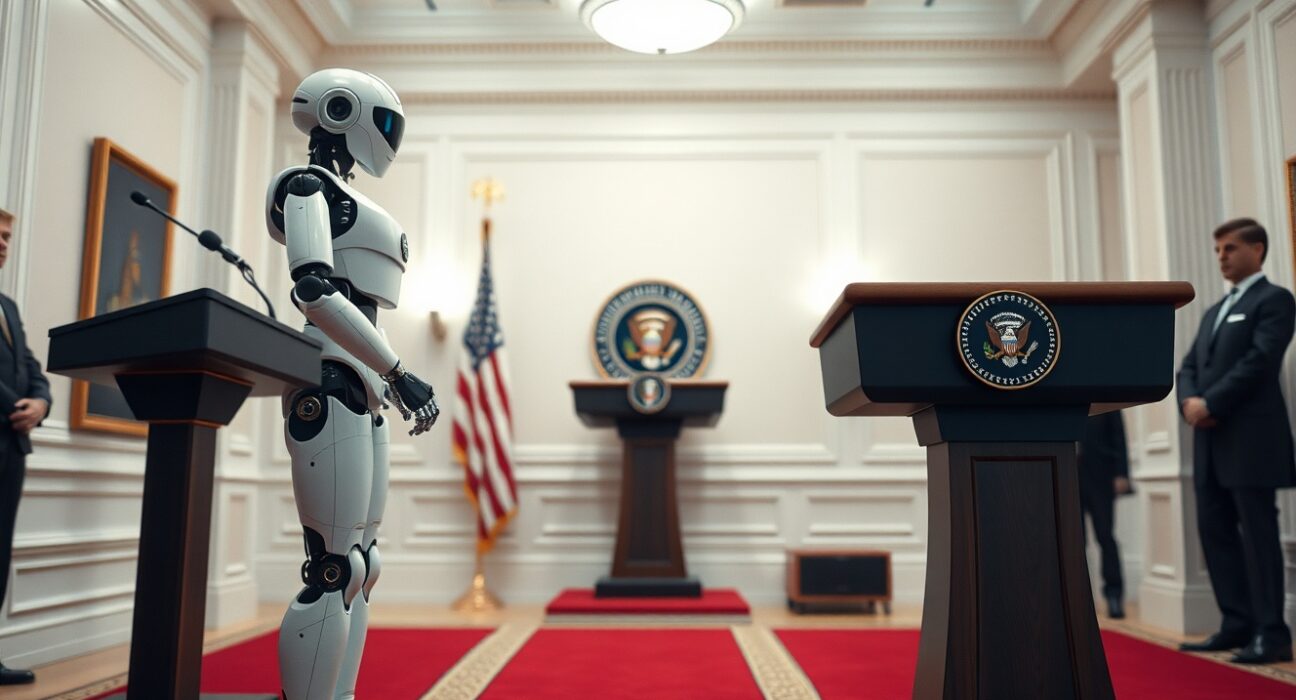
WASHINGTON, D.C. — In a striking demonstration that blended political theater with technological ambition, First Lady Melania Trump unveiled a humanoid robot on Wednesday, March 25, 2026, proposing a future where such machines could become the primary educators for children globally. The event, part of her “Fostering the Future Together” global summit, immediately ignited a complex debate about the role of artificial intelligence in shaping young minds and the fundamental nature of education itself.
Melania Trump’s Robot Homeschool Vision
The Figure AI humanoid robot, named in concept as “Plato,” shared the stage with the First Lady at the White House. Consequently, the machine delivered a brief, pre-programmed statement about empowering children through technology. Moreover, Melania Trump’s remarks painted a detailed picture of an AI-driven educational future. She described a personalized, patient, and perpetually available robotic tutor. This tutor would grant instantaneous access to humanity’s entire corpus of knowledge. Therefore, the vision explicitly aims to develop deeper critical thinking in students. However, this futuristic proposal stands in stark contrast to current educational technology capabilities.
The administration’s embrace of this concept is not isolated. Simultaneously, the White House announced a separate tech council staffed by Silicon Valley executives. This move signals a coordinated push to integrate private-sector innovation into public policy. Secretary of Education Linda E. McMahon has actively visited experimental institutions like the Alpha School network. These schools utilize AI to accelerate learning. The administration praises them for preparing students for a technology-driven workforce. This consistent advocacy highlights a clear philosophical direction.
The Current State of Robotics and EdTech
Experts quickly noted the significant gap between the presented vision and present-day reality. Today’s educational technology focuses on supplemental tools, not replacement. For instance, adaptive learning software personalizes quiz difficulty. Similarly, language apps use AI for pronunciation feedback. However, a fully autonomous humanoid educator requires advances in several key areas:
- General Artificial Intelligence (AGI): Current AI is narrow, excelling at specific tasks but lacking the generalized understanding, empathy, and contextual reasoning of a human teacher.
- Social-Emotional Learning (SEL): Robots cannot currently model or teach complex human emotions, conflict resolution, or ethical reasoning through lived experience.
- Physical Dexterity and Safety: While Figure AI demonstrates walking and simple manipulation, the fine motor skills needed for hands-on science experiments or art instruction remain a formidable challenge.
- Cost and Accessibility: The development and production costs of advanced humanoid robots are currently prohibitive for widespread home or school use.
A comparative analysis reveals the scale of the ambition:
| Capability | Current EdTech (2026) | “Plato” Robot Vision |
|---|---|---|
| Instruction Method | Software-assisted, human-led | Fully autonomous robot-led |
| Personalization | Algorithmic content adjustment | Holistic adaptive learning experience |
| Social Interaction | Human-to-human, peer-based | Human-to-machine primary interaction |
| Deployment Scale | Classrooms & individual devices | Individual robot per student/home |
Expert Analysis and Educational Philosophy
Dr. Anya Sharma, a professor of Learning Sciences at Stanford University, provided context. “The vision conflates information delivery with education,” she explained. “Education is a profoundly human interaction involving mentorship, inspiration, and modeling social behavior. A robot can deliver data, but can it inspire a love of learning or help a child navigate complex social dynamics?” This critique strikes at the core of the debate. Proponents argue that AI tutors could free human teachers for higher-value mentorship. Conversely, critics fear the devaluation of human connection in child development.
The political context is equally critical. The Trump administration has consistently championed private-sector solutions and critiqued traditional public education structures. This robot initiative aligns with that broader agenda. It frames educational innovation as a technological challenge best solved by industry, not necessarily by pedagogical experts. Furthermore, the timing coincides with a growing “parental rights” movement favoring homeschooling and educational choice. A robotic tutor could, in theory, make high-quality, structured homeschooling accessible to more families.
Broader Implications and Industry Trajectory
The White House event acts as a powerful signal to the technology and venture capital sectors. It validates investment in AI-driven education and humanoid robotics. Figure AI’s immediate social media post highlights the public relations value for startups in this space. Subsequently, we can expect increased capital flow into educational robotics. However, this also raises urgent ethical and regulatory questions. What data would such a robot collect on children? How would its curriculum be governed? Who is accountable for its pedagogical decisions?
Historical parallels exist. The 1960s saw predictions of robot teachers by the 1980s. Clearly, technological forecasting often underestimates social and practical hurdles. The current trajectory suggests a hybrid future. In this future, AI handles personalized drill and practice. Meanwhile, human teachers focus on project-based learning, creativity, and social-emotional development. The “Plato” concept serves as a polarizing provocation. It forces a necessary conversation about what we value most in the education of future generations.
Conclusion
Melania Trump’s presentation of a humanoid robot for homeschooling is less a practical blueprint and more a visionary statement of principle. It underscores the administration’s commitment to privatized, technology-centric education reform. While the technical feasibility of a fully robotic educator remains distant, the event successfully catalyzes a vital debate. This debate concerns the balance between technological efficiency and human touch in learning. The path forward will likely involve augmented classrooms, not replaced teachers. However, the First Lady’s “Plato” proposal ensures that the question of AI’s ultimate role in education will remain at the forefront of policy and innovation discussions for years to come.
FAQs
Q1: What is the “Plato” robot announced by Melania Trump?
The “Plato” robot is a conceptual humanoid educator presented by First Lady Melania Trump. Developed by Figure AI, it represents a vision for a future where autonomous robots provide personalized, home-based education using AI to access and teach humanity’s entire knowledge base.
Q2: Is this robot currently available for homeschooling?
No. The robot demonstrated was a prototype, and the vision described is aspirational. Current technology does not support a fully autonomous humanoid educator with the generalized intelligence, empathy, and pedagogical skill of a human teacher. The proposal outlines a potential future direction, not an available product.
Q3: How does the Trump administration’s education policy relate to this robot?
The initiative aligns with the administration’s broader support for private-sector educational innovation and school choice. It coincides with critiques of traditional public education and visits by officials to experimental AI schools like Alpha School, emphasizing a tech-driven approach to learning.
Q4: What are the main criticisms of using robots as primary educators?
Critics argue that education requires human connection, mentorship, and social-emotional learning that machines cannot replicate. Concerns also include data privacy for children, the high cost of advanced robotics, the lack of accountability for AI-driven curriculum, and the potential devaluation of the teaching profession.
Q5: What is the realistic near-term impact of AI on education?
In the near term, AI will continue to serve as a supplemental tool in classrooms. It will power adaptive learning software, provide tutoring in specific subjects, automate administrative tasks for teachers, and offer new ways to visualize complex concepts. The human teacher will remain central, augmented by technology, not replaced by it.
Disclaimer: The information provided is not trading advice, Bitcoinworld.co.in holds no liability for any investments made based on the information provided on this page. We strongly recommend independent research and/or consultation with a qualified professional before making any investment decisions.
