
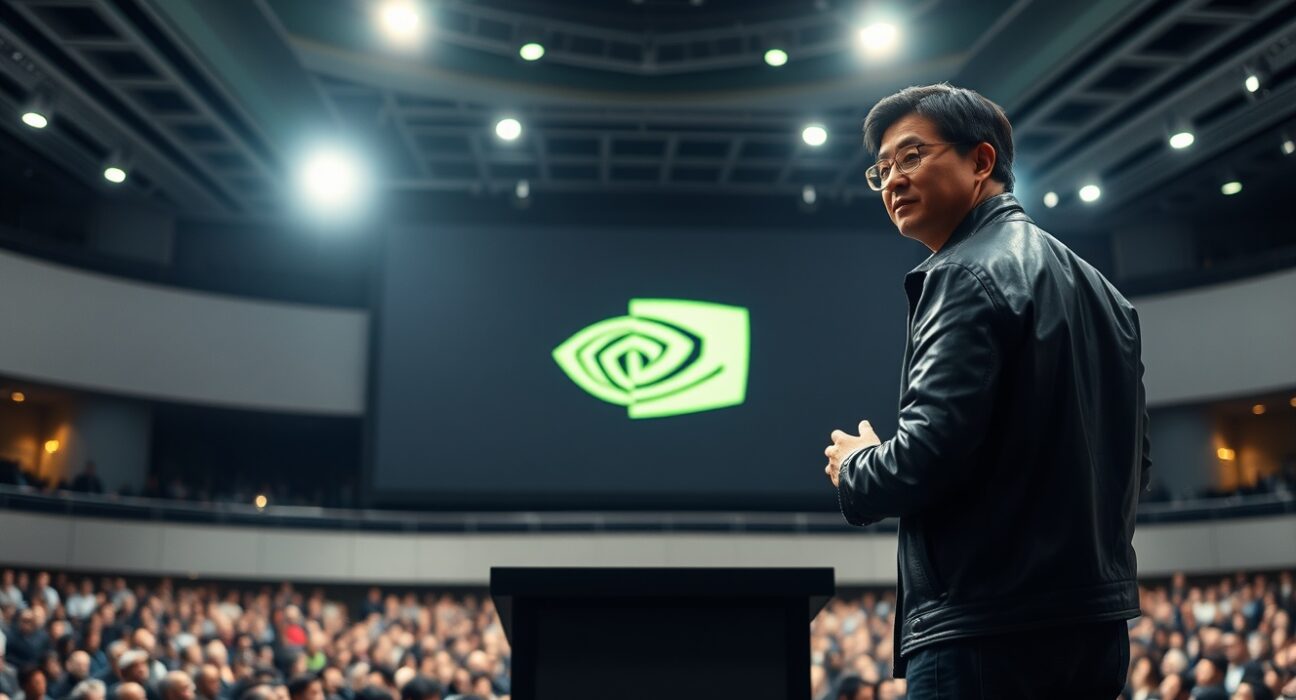
In San Jose, California, on March 18, 2025, Nvidia CEO Jensen Huang framed the next era of computing during his marathon GTC keynote, projecting a staggering $1 trillion market for AI chips by 2027 and introducing pivotal technologies like NemoClaw and an experimental robot named Olaf.
Nvidia GTC Sets a $1 Trillion Stage
Nvidia’s GPU Technology Conference (GTC) has consistently served as a bellwether for the artificial intelligence industry. Consequently, this year’s event carried immense weight. CEO Jensen Huang’s two-and-a-half-hour presentation immediately established the scale of his vision. He projected the total addressable market for AI data center chips would reach $1 trillion annually within two years. This forecast, while ambitious, builds upon Nvidia’s established dominance in training complex large language models. Industry analysts from firms like Gartner and IDC have previously noted the exponential growth in compute demand, which validates the underlying trend. However, Nvidia’s projection specifically quantifies the anticipated commercial scale of this shift.
Decoding the OpenClaw Strategy Mandate
A central theme of the keynote was Huang’s declaration that every company now needs an “OpenClaw strategy.” This concept represents a strategic framework for enterprise AI deployment. Essentially, OpenClaw advocates for a hybrid approach. It combines open-source AI model foundations with proprietary, domain-specific data and tools—the “claw”—to create unique competitive advantages. For instance, a healthcare provider could leverage an open-source medical LLM but fine-tune it with its own patient data and clinical workflows. Huang argued this method balances innovation speed with strategic control. Furthermore, it directly counters the trend of relying solely on closed, monolithic AI platforms from a handful of large tech companies. This strategy underscores a broader industry movement toward modular and customizable AI stacks.
The Technical Pillars: NemoClaw and Beyond
The OpenClaw philosophy was materialized through several technical announcements. The most significant was NemoClaw, a new suite of tools within the Nvidia Nemo platform. NemoClaw is designed specifically to help enterprises build, customize, and deploy their own “claws.” It provides optimized workflows for data curation, model fine-tuning, and secure deployment across cloud and on-premises environments. Alongside this, Nvidia unveiled its next-generation data center GPU architecture, codenamed “Blackwell.” Early benchmarks suggest a 5x performance increase for AI inference tasks compared to the current Hopper architecture. These releases collectively provide the hardware and software backbone required to execute an OpenClaw strategy at scale.
The Olaf Robot and Nvidia’s Embodied AI Push
The keynote’s memorable conclusion featured a demonstration of “Robot Olaf,” a humanoid prototype developed in Nvidia’s research labs. Powered by the company’s GR00T foundation model for humanoid robots, Olaf attempted to describe its own capabilities on stage. The demonstration, which ended with the robot’s microphone being cut after a rambling monologue, highlighted both the progress and persistent challenges in embodied AI. Significantly, this showcase was not merely a spectacle. It served as a tangible proof point for Nvidia’s expansion into robotics and autonomous systems, a market leveraging the same underlying AI compute and simulation technologies. The company’s Isaac robotics platform, combined with its Omniverse simulation environment, aims to become the standard for training and deploying intelligent machines in physical worlds.
Market Context and Competitive Landscape
Nvidia’s announcements arrive amid intensifying competition. Rivals like AMD, Intel, and a host of custom silicon startups are aggressively pursuing the AI accelerator market. Additionally, major cloud providers—Amazon AWS, Google Cloud, and Microsoft Azure—are developing their own in-house AI chips. Huang’s $1 trillion forecast, therefore, acts as both a market sizing and a defensive claim. It asserts that the market will grow large enough to support multiple winners while reinforcing Nvidia’s intention to capture a leading share. Financial analysts immediately scrutinized the projection. Many noted that it depends on continued massive investment from global corporations and governments into AI infrastructure, a trend currently showing no signs of abatement.
Immediate Industry Reactions and Implications
The reaction from the technology and financial sectors was swift and measured. Enterprise software CEOs expressed cautious optimism about the OpenClaw framework, seeing it as a viable path to adopting AI without vendor lock-in. Meanwhile, semiconductor analysts focused on the execution risks associated with such rapid market expansion, including supply chain constraints for advanced packaging. The broader implication is a clear acceleration of the AI industrialization phase. Nvidia is no longer just selling chips; it is selling a full-stack blueprint for how organizations should architect their AI future. This move positions the company as a strategic partner rather than a mere component supplier.
Conclusion
The 2025 Nvidia GTC conference delivered a coherent and ambitious vision for the next phase of artificial intelligence. Through the dual lenses of a staggering $1 trillion market forecast and the strategic OpenClaw framework, Jensen Huang outlined a future where AI becomes deeply customized and integrated into every enterprise. The introductions of NemoClaw tools and the experimental Robot Olaf provided concrete examples of this direction. Ultimately, the event underscored Nvidia’s pivotal role in shaping not just the hardware, but the very methodologies of modern AI development and deployment.
FAQs
Q1: What was the main announcement at Nvidia GTC 2025?
The core announcement was a projected $1 trillion annual market for AI data center chips by 2027, alongside the introduction of the “OpenClaw” enterprise strategy and new products like NemoClaw.
Q2: What is Nvidia’s OpenClaw strategy?
OpenClaw is a strategic framework advocating that companies combine open-source AI models with their own proprietary data and tools (the “claw”) to build unique, competitive AI applications without relying solely on closed platforms.
Q3: What is NemoClaw?
NemoClaw is a new suite of software tools within Nvidia’s Nemo platform. It is designed to help enterprises implement the OpenClaw strategy by providing workflows for customizing, fine-tuning, and deploying large language models securely.
Q4: What was the purpose of the Robot Olaf demonstration?
Robot Olaf showcased Nvidia’s progress in embodied AI and robotics, powered by its GR00T foundation model. It demonstrated the company’s expansion beyond data centers into intelligent machines that interact with the physical world.
Q5: How does Nvidia’s $1 trillion forecast compare to other market analyses?
While aggressive, the forecast aligns with independent analyses that predict massive growth in AI compute demand. It reflects Nvidia’s expectation that spending on AI infrastructure will accelerate rapidly across all major industries.
Disclaimer: The information provided is not trading advice, Bitcoinworld.co.in holds no liability for any investments made based on the information provided on this page. We strongly recommend independent research and/or consultation with a qualified professional before making any investment decisions.