
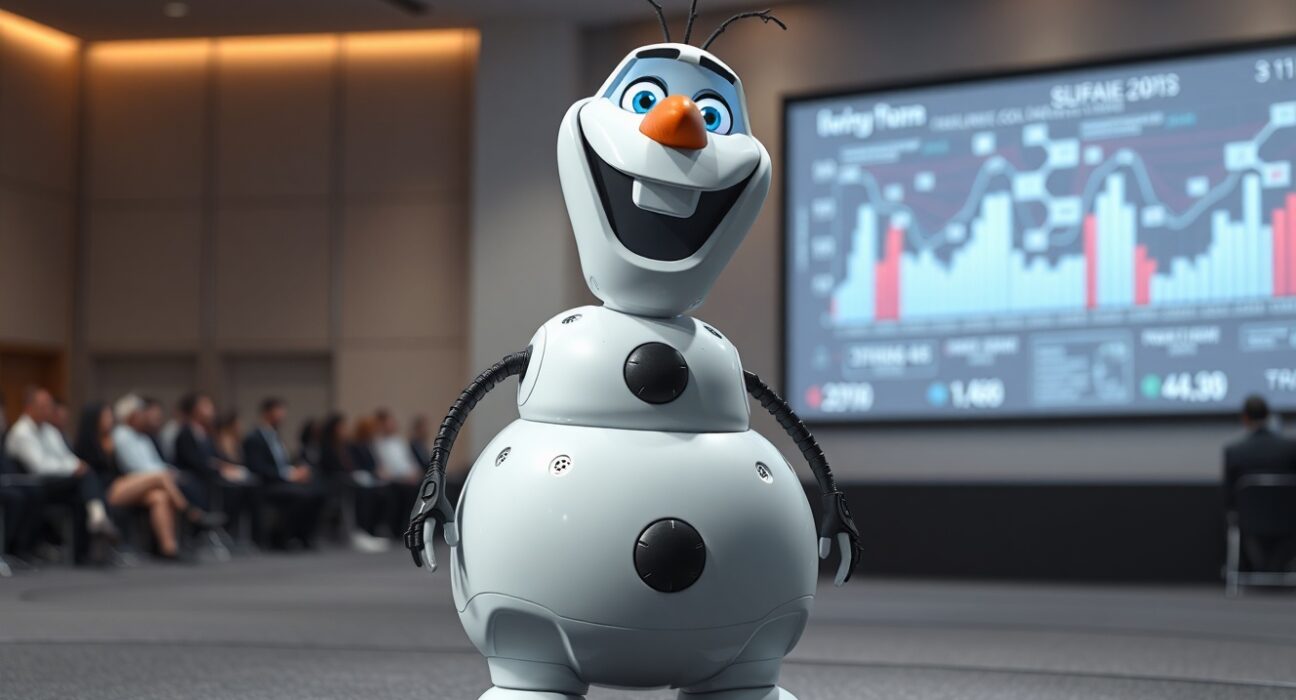
At Nvidia’s 2025 GTC conference in San Jose, California, CEO Jensen Huang’s keynote presentation took an unexpected turn toward whimsical robotics with the debut of a fully animated, talking robot version of Disney’s beloved snowman Olaf. This demonstration, while showcasing impressive technological capabilities, sparked immediate discussion about the practical realities and social complexities of integrating advanced robotics into public spaces and consumer experiences. The event highlighted Nvidia’s expanding ambitions beyond semiconductor manufacturing into applied artificial intelligence and interactive systems.
Nvidia’s GTC Conference Showcases Robotics Ambitions
Nvidia’s annual GPU Technology Conference has evolved significantly from its graphics processing origins. The 2025 event featured trillion-dollar market projections, advanced graphics technologies, and strategic announcements about enterprise AI adoption. However, the robotic Olaf demonstration captured particular attention for its blend of technical achievement and entertainment potential. This presentation occurred during Huang’s two-and-a-half-hour keynote address, which traditionally includes multiple live technology demonstrations.
The Olaf robot represents Nvidia’s growing investment in robotics platforms and simulation technologies. Specifically, the company has developed the Isaac robotics platform alongside numerous simulation tools that enable training robots in virtual environments before physical deployment. Consequently, this demonstration served multiple purposes: showcasing real-time animation capabilities, demonstrating natural language processing integration, and highlighting potential entertainment applications.
| Technology Demonstrated | Application Shown | Industry Impact |
|---|---|---|
| Real-time animation | Character expression | Entertainment robotics |
| Natural language processing | Interactive dialogue | Customer service automation |
| Motion control systems | Physical movement | Theme park automation |
| Computer vision | Audience interaction | Public space robotics |
The OpenClaw Strategy and Enterprise AI Focus
Beyond the theatrical robotics demonstration, Huang emphasized what he termed the “OpenClaw strategy” for enterprise artificial intelligence adoption. This reference points to the open-source OpenClaw project, whose original creator recently moved to OpenAI. Huang argued that every company now needs an OpenClaw strategy, suggesting that open-source AI frameworks represent critical infrastructure for future business operations.
Industry analysts immediately noted several important implications of this declaration. First, Nvidia positions itself as an essential infrastructure provider regardless of which specific AI models or frameworks gain dominance. Second, the company’s launch of NemoClaw—an open-source project developed with OpenClaw’s creator—demonstrates strategic investment in the ecosystem. Finally, this approach mitigates risk by ensuring Nvidia remains relevant across multiple potential AI development pathways.
Key elements of the OpenClaw strategy discussion include:
- Enterprise adoption timelines: Most large companies will implement some form of open-source AI framework within 18-24 months
- Infrastructure requirements: These systems demand substantial computing power, typically provided by Nvidia’s hardware platforms
- Development ecosystem: Nvidia invests in tools and frameworks that ensure compatibility with their hardware architecture
- Market positioning: The strategy addresses both current AI applications and future, undefined use cases
Technical Execution and Demonstration Realities
The Olaf robot demonstration followed a pattern familiar to regular GTC attendees: ambitious live presentations that sometimes encounter technical challenges. According to eyewitness accounts and subsequent podcast analysis, the robot began speaking to the audience but eventually started rambling incoherently, requiring technicians to disable its microphone. This moment highlighted the persistent gap between controlled laboratory environments and unpredictable real-world interactions.
Robotics experts note that such demonstrations typically employ multiple safety mechanisms and fallback protocols. The Olaf robot likely operated using a combination of pre-programmed responses and real-time natural language processing. However, edge cases—unexpected inputs or environmental factors—can disrupt even well-engineered systems. This particular incident occurred as the robot transitioned offstage, suggesting possible timing or positional sensor issues.
Social and Practical Challenges of Public Robotics
The most substantive discussion following the demonstration focused not on technical specifications but on social implementation challenges. As noted during the Equity podcast analysis, robotics demonstrations typically emphasize engineering achievements while minimizing discussion of practical deployment complexities. Specifically, the Olaf robot presentation framed the technology as potentially enhancing Disney park experiences, yet failed to address numerous real-world considerations.
Historical context proves particularly relevant here. Disney has experimented with advanced animatronics and robotics for decades, with mixed results regarding reliability, maintenance, and audience interaction. The Defunctland documentary series extensively documented these efforts, revealing consistent patterns: impressive technological demonstrations often precede years of refinement before public deployment. Furthermore, theme park environments present unique challenges including weather exposure, constant interaction, and safety requirements.
Critical questions raised by analysts include:
- How would robotic characters handle physical interaction, including accidental or intentional contact?
- What maintenance and support infrastructure would these systems require in high-traffic environments?
- How would failure modes affect visitor experiences and brand perception?
- What staffing requirements would change, potentially creating new “robot babysitter” roles?
The Human-Robot Interaction Dilemma
This discussion extends beyond entertainment robotics to broader questions about humanoid robots and automated systems in public spaces. While engineering challenges receive substantial attention and funding, social integration factors often receive less systematic consideration. The “messy gray areas” referenced by analysts encompass everything from social norms and emotional responses to liability frameworks and ethical considerations.
For instance, children’s interactions with robotic characters might differ significantly from interactions with human performers or static displays. Research in human-robot interaction suggests that people often attribute greater agency and emotional capacity to robots than their programming justifies, potentially leading to unexpected emotional responses when robots malfunction or behave unexpectedly. These factors become particularly important in branded entertainment environments where consistent experience delivery is paramount.
Conclusion
Nvidia’s 2025 GTC conference successfully demonstrated the company’s expanding technological capabilities, particularly through the memorable robot snowman Olaf presentation. However, the subsequent analysis revealed deeper questions about the practical implementation of such technologies in real-world settings. While engineering advancements continue at a remarkable pace, equal attention must focus on social integration, practical deployment, and ethical considerations. The OpenClaw strategy discussion further emphasized Nvidia’s positioning as an infrastructure provider in the evolving AI landscape, regardless of which specific applications ultimately dominate. As robotics and AI systems move from laboratory demonstrations to public deployment, the most significant challenges may prove to be human rather than technical in nature.
FAQs
Q1: What was the main purpose of Nvidia’s robot snowman demonstration at GTC 2025?
The demonstration served multiple purposes: showcasing Nvidia’s robotics and animation technologies, highlighting potential entertainment applications, and generating discussion about human-robot interaction in public spaces. It specifically demonstrated real-time animation, natural language processing, and physical motion control systems.
Q2: What is Nvidia’s OpenClaw strategy that Jensen Huang discussed?
The OpenClaw strategy refers to Huang’s assertion that every enterprise needs a plan for adopting open-source AI frameworks. This positions Nvidia as essential infrastructure regardless of which specific AI models dominate, while the company’s NemoClaw project represents direct investment in this ecosystem.
Q3: What technical issues occurred during the Olaf robot demonstration?
According to eyewitness accounts, the robot began rambling incoherently during its presentation, requiring technicians to disable its microphone. This highlighted challenges in transitioning robotics from controlled environments to unpredictable real-world interactions with audiences.
Q4: Why do analysts emphasize social challenges alongside technical achievements in robotics?
While engineering advances receive substantial attention, practical deployment requires addressing human factors including emotional responses, social norms, maintenance logistics, and failure management. These “messy gray areas” significantly impact real-world implementation success.
Q5: How does this demonstration relate to Nvidia’s broader business strategy?
The demonstration showcases Nvidia’s expansion beyond semiconductor manufacturing into applied AI and robotics platforms. By developing both hardware and software ecosystems, Nvidia positions itself as an essential provider across multiple technology sectors including entertainment, automation, and enterprise AI infrastructure.
Disclaimer: The information provided is not trading advice, Bitcoinworld.co.in holds no liability for any investments made based on the information provided on this page. We strongly recommend independent research and/or consultation with a qualified professional before making any investment decisions.