

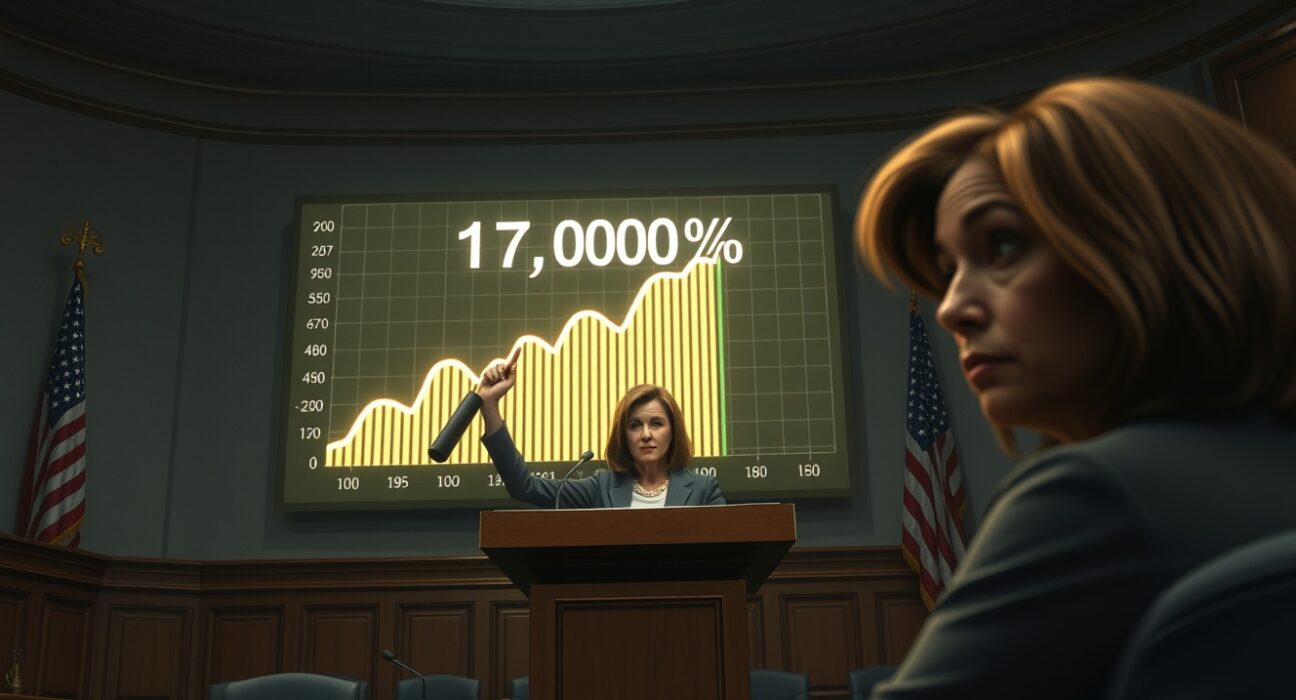
U.S. Representative Anna Paulina Luna (R-FL) has leveled a serious accusation against former House Speaker Nancy Pelosi (D-CA), alleging a pattern of insider trading. Luna claims that Pelosi’s personal investment portfolio has surged by an extraordinary 17,000% since she entered Congress. This accusation, reported by BeInCrypto, reignites a long-running debate over the ethics of congressional stock trading. The core of the allegation focuses on trades made by Pelosi’s husband, Paul Pelosi, particularly in tech stock options.
Congressional Insider Trading Accusation: The Core Claims
Representative Luna’s accusation centers on a specific timeline. She alleges that Paul Pelosi executed trades in tech stock options just before Congress passed relevant legislation. These trades, Luna argues, suggest the use of non-public information. Luna contrasts this with the current regulatory framework, the STOCK Act. This law requires members of Congress to disclose stock trades. However, the penalty for a violation is only a $200 fine.
Luna finds this penalty woefully inadequate. She compared it to a separate case involving a special forces soldier. That soldier faces up to 50 years in prison for profiting from prediction markets related to military operations. This stark difference in punishment, Luna argues, highlights a double standard. The accusation has quickly become a major political flashpoint.
The 17,000% Portfolio Surge: A Closer Look
The claim of a 17,000% portfolio surge is a central pillar of Luna’s argument. Such a return would significantly outperform the S&P 500 index over the same period. While Nancy Pelosi herself does not manage the trades, her financial disclosures list her husband’s activities. These disclosures show a heavy concentration in big tech stocks like Apple, Microsoft, and Nvidia. The timing of some of these trades has previously drawn scrutiny from financial analysts and ethics watchdogs.
For example, in 2022, Paul Pelosi purchased millions of dollars in Nvidia call options. This occurred shortly before the CHIPS and Science Act, which provided billions in subsidies for semiconductor manufacturing, was set to pass. The timing of this trade was widely noted. Luna’s current accusation builds on this and other similar instances. She frames it as a systemic issue requiring immediate reform.
The STOCK Act: A Weak Deterrent Against Insider Trading?
The Stop Trading on Congressional Knowledge (STOCK) Act of 2012 was designed to curb insider trading by members of Congress. It explicitly stated that members are not exempt from insider trading laws. It also mandated public disclosure of stock trades within 45 days. However, critics argue the law has been ineffective. The $200 fine for late disclosures is often seen as a negligible cost of doing business.
This penalty is far less than the potential profits from a well-timed trade. A report from the Campaign Legal Center found that dozens of members of Congress have violated the STOCK Act’s disclosure requirements. Yet, very few have faced significant consequences. Luna’s accusation uses this fact to argue that the system is rigged. She claims that the wealthy and powerful, like Pelosi, face no real risk.
- Disclosure Requirements: Members must report trades within 45 days.
- Penalty for Violation: A maximum fine of $200.
- Enforcement: The House Ethics Committee handles complaints, but action is rare.
- Loopholes: Blind trusts and mutual funds can be used to avoid scrutiny.
Luna’s History of High-Profile Complaints
This is not Luna’s first high-profile legal complaint. Last July, she filed a criminal complaint against Federal Reserve Chair Jerome Powell. That complaint accused Powell of failing to regulate the banking system properly. It also questioned the Fed’s role in the collapse of several regional banks. This history suggests a pattern of Luna using formal complaints to challenge powerful figures in Washington. Her latest move against Pelosi follows this same strategy.
The complaint against Powell did not result in any formal charges. However, it generated significant media coverage. Luna’s accusation against Pelosi appears designed to achieve a similar effect. It places the issue of congressional stock trading back in the national spotlight. It also positions Luna as a leading voice for ethics reform within the Republican party.
Political and Market Implications of the Accusation
The accusation carries significant political weight. Nancy Pelosi remains a powerful figure in the Democratic party. Any suggestion of corruption or ethical lapse can be used as a political weapon. For Republicans, it reinforces a narrative of a corrupt Washington elite. For Democrats, it puts pressure on party leaders to address the issue. Some Democratic members, like Rep. Alexandria Ocasio-Cortez, have already called for a ban on individual stock trading by members of Congress.
The market implications are more nuanced. If the accusation leads to a renewed push for a stock trading ban, it could impact how members of Congress manage their personal finances. A ban would force them to divest from individual stocks and move to blind trusts or index funds. This could reduce the volume of information-driven trading from a small group of well-connected individuals. However, the immediate market impact is likely to be minimal.
Expert Analysis on the Legal Merits
Legal experts are divided on the strength of Luna’s accusation. To prove insider trading, one must show that a trade was made based on material, non-public information. Simply trading before a bill passes is not enough. The timing must be directly linked to a specific piece of information. Luna’s accusation relies on a pattern of trades, but proving intent is difficult.
Furthermore, the trades are made by Paul Pelosi, not Nancy Pelosi herself. While she benefits from the portfolio growth, she may not have direct control over every trade. The burden of proof in a criminal insider trading case is high. Many legal analysts believe this accusation is more of a political statement than a viable criminal case. However, it successfully raises public awareness about the issue.
Timeline of Key Events in the Congressional Stock Trading Debate
| Year | Event |
|---|---|
| 2012 | STOCK Act signed into law by President Obama. |
| 2020 | Reports of lawmakers trading stocks after COVID-19 briefings. |
| 2022 | Pelosi’s Nvidia trades draw scrutiny before CHIPS Act. |
| 2023 | Bipartisan bill to ban congressional stock trading introduced. |
| 2024 | Luna files complaint against Fed Chair Powell. |
| 2025 | Luna accuses Pelosi of insider trading. |
Conclusion: The Future of Congressional Stock Trading Reform
The Pelosi insider trading accusation by Representative Luna serves as a powerful catalyst for a long-overdue debate. The 17,000% portfolio surge, while not proof of a crime, raises legitimate questions about fairness. The STOCK Act’s $200 fine is clearly an insufficient deterrent. The contrast with the 50-year sentence facing a soldier for a similar offense highlights a deep inequality in the justice system. Whether this accusation leads to actual reform or remains a political talking point is yet to be seen. However, it has undeniably brought the issue of congressional stock trading back into the public eye. The pressure on lawmakers to address this conflict of interest is now greater than ever.
FAQs
Q1: What is the STOCK Act?
The STOCK Act is a law passed in 2012 that prohibits members of Congress from using non-public information for personal profit. It requires them to disclose stock trades within 45 days.
Q2: What is the penalty for violating the STOCK Act?
The penalty for a late filing is a maximum fine of $200. There is no criminal penalty for a first-time disclosure violation, though insider trading itself is a crime.
Q3: Who is Anna Paulina Luna?
Anna Paulina Luna is a U.S. Representative from Florida. She is a Republican known for filing high-profile complaints against figures like Fed Chair Jerome Powell and now Nancy Pelosi.
Q4: Has Nancy Pelosi been charged with insider trading?
No. While she has faced repeated accusations, no formal charges have been filed against her. The trades in question are made by her husband, Paul Pelosi.
Q5: What is the 17,000% portfolio surge based on?
The figure is based on an analysis of Nancy Pelosi’s financial disclosures. It compares the value of her disclosed assets at the start of her congressional career to their current estimated value.
Q6: Could this accusation lead to a ban on congressional stock trading?
It increases political pressure. A bipartisan bill to ban individual stock trading by members of Congress has been introduced but has not passed. The accusation may revive interest in this legislation.
Disclaimer: The information provided is not trading advice, Bitcoinworld.co.in holds no liability for any investments made based on the information provided on this page. We strongly recommend independent research and/or consultation with a qualified professional before making any investment decisions.
