

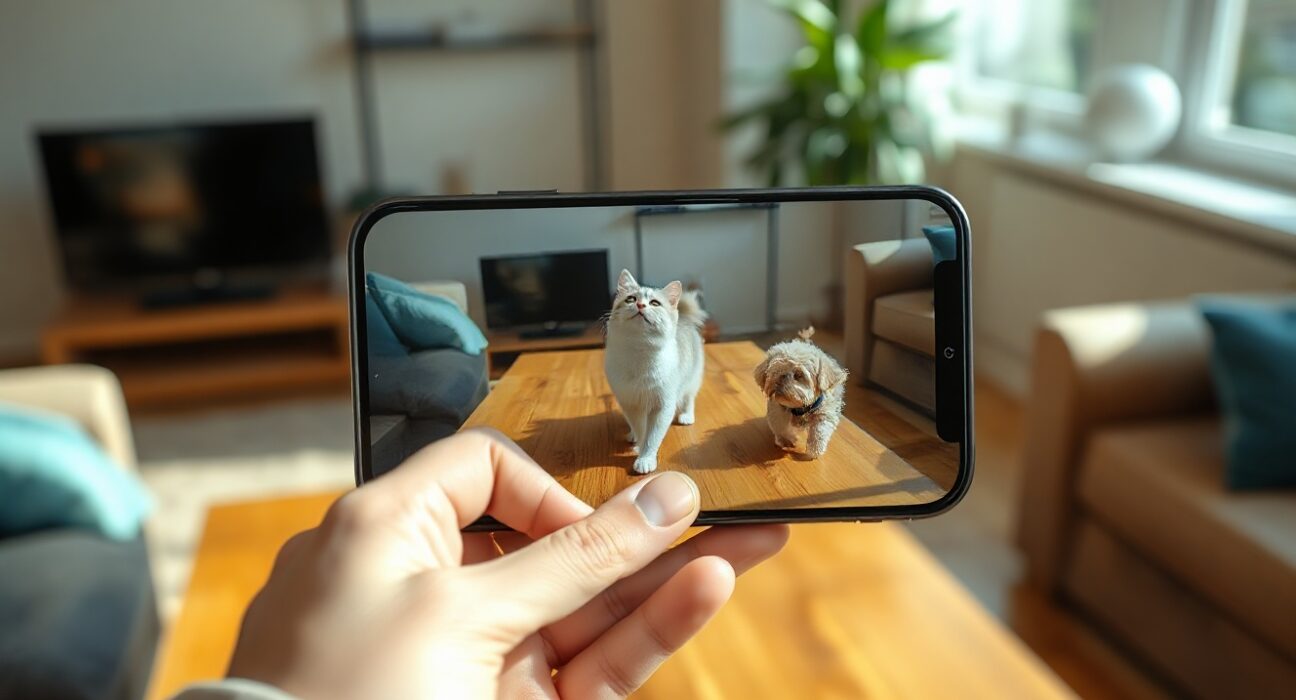
Stickers, GIFs, and emoji reactions have dominated casual messaging for years. But a new app called Pixi is betting that the next meaningful shift in how we communicate digitally will come through interactive augmented reality (AR). Launched on the App Store this week, Pixi allows users to send AI-powered AR characters through iMessage that come to life through the recipient’s iPhone camera, reacting to their surroundings and even responding to facial expressions in real time.
How Pixi works: on-device AI meets AR messaging
Unlike conventional AR filters or lenses that overlay static effects on a user’s face or environment, Pixi’s characters are designed to be context-aware. The company combines augmented reality with on-device artificial intelligence, enabling characters to perceive and respond to what is happening around them. For example, a virtual cat character can react when a real dog walks into the frame, or an animated envelope may chase a friend playfully as they move. According to the company, all visual and audio processing remains on the device, meaning no data is sent to external servers — a deliberate design choice aimed at preserving user privacy.
Pixi founder Mark Drummond, whose background includes stints at DreamWorks Animation and Apple, describes the app as a way to bring a greater sense of presence and spontaneity to digital conversations. Rather than sending a simple text to wish someone a happy birthday, users can send characters that create a shared, interactive experience. Drummond calls this approach ‘creative gifting’ or ‘pebbling’ — sharing tokens of affection that feel more like a digital gift than a static message. ‘We can do something that’s digitally native and uses everything we learned about AR on the iPhone,’ he said.
Launch lineup and future marketplace plans
At launch, Pixi offers three characters: a robot, a cat, and an animated envelope. The cat, for instance, can perform stand-up jokes and appears to respond to the user’s facial expressions — smiling, for example, can end the performance. The envelope character reacts to voice and can chase friends in a playful manner. The app also includes simple games like tic-tac-toe and whack-a-mole.
Pixi’s longer-term vision extends beyond a handful of characters. The company plans to open a marketplace where studios, brands, and independent creators can share their own AR characters. Drummond cited potential use cases such as movie premieres or product launches — for instance, a character tied to a new M&M’s flavor. He also mentioned the possibility of offering characters based on open intellectual property, like Alice in Wonderland, whose behavior would be designed to react to objects in a user’s environment in a way consistent with the character’s personality.
Down the road, Pixi hopes to let users create their own characters using generative AI prompts. ‘Part of our plan is to open up those generative AI capabilities to our users, so they can prompt their way to something like, “I want a blue blob that threatens my friend and growls at them and keeps chasing them on the phone,”’ Drummond explained.
Availability, device requirements, and business model
To send a Pixi character, users must download the iOS app and access it through iMessage by tapping the plus sign button in the lower left corner of the chat interface. No installation is required on the recipient’s end to view the AR experience. Initially, the app supports iPhone models 11 and newer, with plans to expand to Android devices and messaging platforms like WhatsApp and Instagram in the future.
The app is free for consumers. However, brands will have the option to charge for their characters if they choose. Drummond noted that the company will encourage free distribution, arguing that users become brand ambassadors when they share characters organically with friends.
Why this matters for messaging and AR
While AR filters and lenses are not new — Snapchat has offered them for years — Pixi’s approach is distinct in its focus on interactive, AI-driven characters that can perceive and react to real-world context. This moves AR messaging beyond static overlays and into the realm of shared, dynamic experiences. The combination of on-device AI and AR also addresses growing privacy concerns, as sensitive data like video feeds never leave the phone.
For consumers, the app offers a novel way to express affection, humor, or spontaneity in digital conversations — a shift from text-based or static media reactions. For brands and creators, the planned marketplace could open new avenues for promotional engagement that feels more like play than advertising.
Conclusion
Pixi is attempting to carve out a new niche in messaging by merging augmented reality with on-device artificial intelligence. Its initial offering is limited in scope — three characters and iPhone-only availability — but the company’s roadmap suggests ambitions to become a platform for interactive, character-driven communication. Whether users embrace AR characters as a meaningful evolution of texting or as a novelty remains to be seen, but Pixi’s focus on privacy, context-awareness, and creative gifting gives it a distinctive angle in a crowded messaging landscape.
FAQs
Q1: Do both people need the Pixi app installed to use it?
No. Only the sender needs the Pixi iOS app. The recipient receives the AR experience directly through iMessage without any additional installation.
Q2: Is Pixi available on Android or other messaging platforms?
Not yet. The app currently supports iPhone 11 and newer models. The company has announced plans to expand to Android and platforms like WhatsApp and Instagram in the future.
Q3: How does Pixi protect user privacy when using the camera?
All visual and audio processing happens on the device itself. No video or audio data is sent to external servers, which is intended to keep user interactions private and secure.
Disclaimer: The information provided is not trading advice, Bitcoinworld.co.in holds no liability for any investments made based on the information provided on this page. We strongly recommend independent research and/or consultation with a qualified professional before making any investment decisions.
