

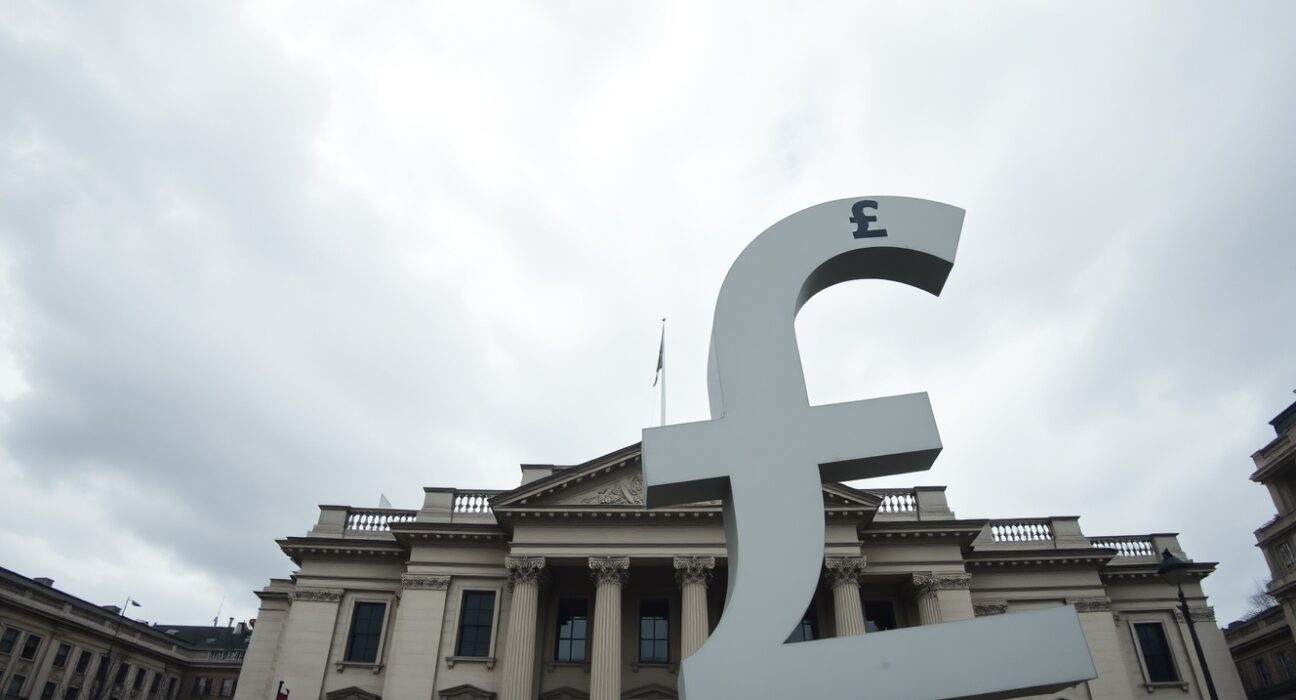
The Pound Sterling faces renewed selling pressure after the Bank of England (BoE) left its benchmark interest rate unchanged at 3.75%, a decision widely anticipated by financial markets. This status quo on UK monetary policy signals the central bank’s cautious stance amid persistent inflation and a slowing economy. Investors now scrutinize the BoE’s forward guidance for clues on future rate moves.
BoE Interest Rates Unchanged: What It Means for the Pound
The Bank of England’s Monetary Policy Committee (MPC) voted to maintain the base rate at 3.75% for the first time since November 2024. This decision follows a series of rate hikes totaling 325 basis points over the past 18 months. The central bank cited the need to assess the lagged effects of previous tightening on the economy.
Market participants had fully priced in this hold, yet the GBP/USD pair dropped by 0.6% immediately after the announcement. The British pound now trades near 1.24 against the US dollar, its lowest level in two weeks. Analysts attribute this weakness to the BoE’s cautious language and the lack of a clear path for further tightening.
Key Factors Driving Pound Sterling Pressure
Several macroeconomic factors contribute to the Pound Sterling’s current vulnerability:
- Inflation persistence: UK CPI remains above the BoE’s 2% target, standing at 4.2% in February 2025. Core inflation, excluding energy and food, hovers at 3.8%.
- Growth stagnation: The UK economy contracted by 0.1% in Q4 2024, raising fears of a technical recession.
- Labor market tightness: Wage growth remains elevated at 6.1%, adding to domestic cost pressures.
- Global headwinds: A stronger US dollar, driven by hawkish Federal Reserve rhetoric, weighs on GBP.
Market Reaction and Immediate Outlook
Following the BoE’s decision, the yield on the 10-year UK gilt edged lower by 5 basis points to 3.82%, reflecting reduced expectations for further rate hikes. The FTSE 100 index, however, rose by 0.4%, as lower borrowing costs support equities. Currency traders now focus on the BoE’s quarterly Monetary Policy Report, due next week, which will include updated GDP and inflation forecasts.
According to a Reuters poll of 45 economists, 32 expect the next rate move to be a cut in August 2025. This dovish sentiment keeps the Pound Sterling under sustained pressure.
GBP Forecast: Analyst Views and Scenarios
Major investment banks have revised their GBP forecasts downward:
| Institution | GBP/USD Forecast (Q2 2025) | Rationale |
|---|---|---|
| Goldman Sachs | 1.22 | BoE on hold, US economy outperforms |
| JPMorgan | 1.20 | UK recession risk rising |
| HSBC | 1.25 | Inflation stickiness supports GBP |
These projections highlight the divergence between the BoE and the Federal Reserve. The US central bank maintains a higher terminal rate, attracting capital flows into the dollar. Consequently, the Pound Sterling may face further depreciation in the near term.
Historical Context: BoE Rate Decisions and GBP Volatility
Since the start of the tightening cycle in December 2021, the BoE has raised rates 14 times. Each decision has triggered notable GBP volatility:
- December 2021: First rate hike to 0.25% – GBP surged 1.2%.
- September 2022: Mini-budget crisis – GBP hit all-time low of 1.03 against USD.
- November 2024: Final hike to 3.75% – GBP fell 0.8%.
- March 2025: Hold at 3.75% – GBP drops 0.6%.
This pattern shows that markets often sell the Pound after the BoE pauses, as the focus shifts to economic weakness rather than inflation control.
Impact on UK Businesses and Consumers
The unchanged rate provides some relief to mortgage holders, but the overall cost of living remains high. Average two-year fixed mortgage rates now stand at 5.2%, down from a peak of 6.8% in 2023. However, businesses face elevated borrowing costs that dampen investment. The British Chambers of Commerce reports that 58% of firms cite interest rates as a top concern.
Exporters benefit from a weaker Pound, as UK goods become cheaper abroad. The Office for National Statistics shows that export volumes rose 2.1% in January 2025, partly due to GBP depreciation. Conversely, importers suffer from higher costs, feeding into domestic inflation.
Expert Analysis: BoE’s Dilemma and Future Path
Economists at the Institute for Fiscal Studies note that the BoE faces a difficult balancing act. Raising rates further risks deepening the economic slowdown, while cutting too early could reignite inflation. The MPC’s split vote—7-2 in favor of holding, with two members advocating a 25-basis-point cut—reveals internal divisions.
“The BoE is trapped between a rock and a hard place,” says Dr. Sarah Green, a monetary policy expert at the London School of Economics. “Inflation is not yet defeated, but the economy is clearly weakening. The market expects a cut later this year, but the BoE is signaling patience.”
Conclusion
The Pound Sterling faces sustained pressure after the Bank of England left interest rates unchanged at 3.75%, as widely anticipated. While the decision provides short-term stability, the lack of a hawkish commitment weighs on GBP. Investors now watch for the BoE’s next moves, with a potential rate cut in August 2025. The currency’s trajectory will depend on inflation data, UK growth figures, and global monetary policy divergence. For now, the Pound Sterling remains vulnerable, and market participants should prepare for continued volatility.
FAQs
Q1: Why did the Pound Sterling fall after the BoE held rates at 3.75%?
The market had fully priced in the hold, but the BoE’s cautious language and lack of clear guidance on future hikes disappointed investors. This triggered selling of the Pound as traders adjusted expectations for a potential rate cut later in 2025.
Q2: What is the current GBP/USD exchange rate?
As of March 20, 2025, GBP/USD trades near 1.24, down from 1.25 before the BoE decision. The rate fluctuates based on economic data releases and central bank commentary.
Q3: Will the Bank of England cut interest rates in 2025?
Most economists expect the first rate cut in August 2025, with a total reduction of 50 basis points by year-end. However, this depends on inflation falling sustainably below 3% and the economy avoiding a deep recession.
Q4: How does the BoE decision affect UK mortgage rates?
The hold at 3.75% provides some stability for mortgage rates, which have fallen from 2023 peaks. However, new fixed-rate deals remain above 5%, keeping borrowing costs high for homeowners.
Q5: What should investors do with GBP now?
Investors should monitor UK inflation data and the BoE’s quarterly report. A weaker Pound may benefit UK exporters but hurts importers. Diversifying currency exposure and hedging strategies are advisable during this period of uncertainty.
Disclaimer: The information provided is not trading advice, Bitcoinworld.co.in holds no liability for any investments made based on the information provided on this page. We strongly recommend independent research and/or consultation with a qualified professional before making any investment decisions.
