
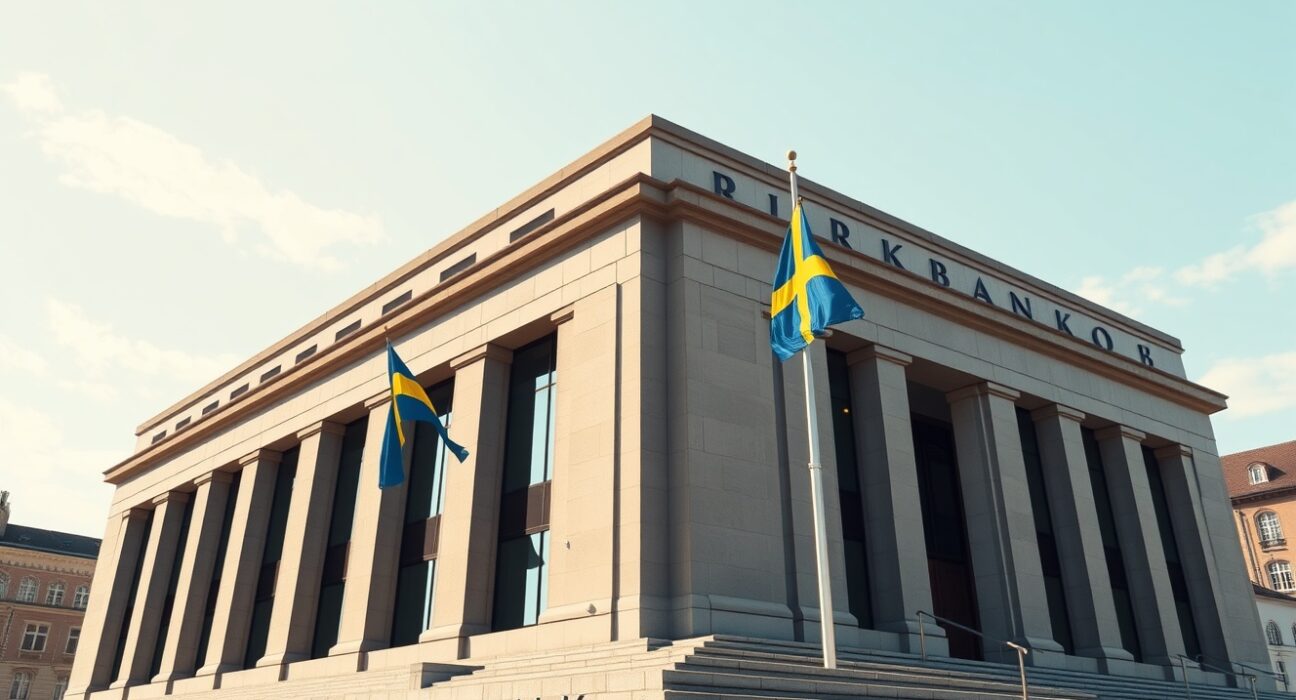
Stockholm, Sweden – The Swedish Riksbank faces mounting pressure to maintain its current monetary policy stance as Danske Bank analysts predict interest rates will remain on hold through the coming quarter. This crucial decision directly impacts the Swedish krona’s stability and Sweden’s economic trajectory amid global financial uncertainty. Market observers now closely monitor inflation data and employment figures that will shape the central bank’s next move.
Riksbank Interest Rates Face Critical Decision Point
Danske Bank’s latest analysis suggests the Riksbank will keep its benchmark interest rate unchanged at 4.00%. This prediction comes amid mixed economic signals from Sweden’s economy. The central bank previously implemented aggressive rate hikes to combat inflation, achieving some success in stabilizing prices. However, recent economic data shows slowing growth in key sectors, creating a complex policy environment.
Sweden’s inflation rate currently stands at 2.3%, slightly above the Riksbank’s 2% target. Meanwhile, unemployment remains relatively stable at 7.8%. These conflicting indicators present challenges for policymakers. The Riksbank must balance inflation control with economic growth concerns. Market participants generally expect the current policy stance to continue through year-end.
Economic Context Behind the Hold Prediction
Several factors support Danske Bank’s forecast for unchanged interest rates. First, Sweden’s housing market shows signs of stabilization after previous declines. Second, manufacturing activity indicates moderate expansion. Third, consumer confidence has improved slightly in recent months. These developments reduce pressure for immediate policy changes.
The table below shows key economic indicators influencing Riksbank decisions:
| Indicator | Current Value | Trend | Policy Impact |
|---|---|---|---|
| Inflation Rate | 2.3% | Declining | Moderate |
| Unemployment | 7.8% | Stable | Neutral |
| GDP Growth | 0.4% | Slowing | Significant |
| Manufacturing PMI | 52.1 | Expanding | Positive |
Swedish Krona Faces External Pressure Factors
The Swedish krona (SEK) remains sensitive to Riksbank policy decisions. Currency traders monitor central bank communications for guidance. A hold decision typically supports currency stability, while unexpected changes create volatility. The SEK currently trades at approximately 10.75 against the euro and 9.20 against the US dollar.
External factors also influence the krona’s performance. Global risk sentiment affects demand for Sweden’s export-oriented economy. Additionally, European Central Bank policies create spillover effects. The Riksbank must consider these international dynamics when setting domestic rates. Currency stability supports Sweden’s important export sectors.
Key factors affecting the Swedish krona include:
- Global risk appetite for emerging market currencies
- European Union economic policies and their regional impact
- Commodity price movements affecting Swedish exports
- Interest rate differentials with major trading partners
Expert Analysis of Monetary Policy Trajectory
Financial institutions generally align with Danske Bank’s assessment. SEB analysts similarly expect unchanged rates through autumn. Handelsbanken projects moderate cuts beginning early next year. These forecasts reflect consensus about Sweden’s economic position. The Riksbank maintains cautious optimism about inflation control.
Historical context illuminates current policy considerations. The Riksbank raised rates aggressively during 2022-2023 to address soaring inflation. Those increases successfully cooled price growth without causing recession. Now policymakers face different challenges. Economic growth requires support while inflation remains above target.
Global Central Bank Coordination Challenges
International monetary policy divergence creates complications for Sweden. The Federal Reserve maintains higher rates than European counterparts. This disparity affects capital flows and currency valuations. The Riksbank must consider these global dynamics when setting domestic policy. Coordination challenges increase during economic uncertainty.
European central banks generally follow similar trajectories. However, Sweden’s unique economic structure creates different requirements. The export-dependent economy benefits from competitive currency valuations. Meanwhile, household debt levels remain elevated. These factors create complex policy trade-offs for decision-makers.
Market Reactions and Forward Guidance Importance
Financial markets respond strongly to Riksbank communications. Forward guidance provides crucial signals about future policy. Clear communication reduces market uncertainty and volatility. The central bank’s transparency supports economic stability. Market participants analyze statements for policy clues.
Recent Riksbank communications emphasize data dependence. Policymakers avoid committing to specific future actions. Instead, they highlight responsiveness to economic developments. This approach provides flexibility amid uncertainty. However, it also creates interpretation challenges for market participants.
Conclusion
The Riksbank faces critical decisions about Swedish krona stability and economic management. Danske Bank’s prediction of unchanged interest rates reflects current economic realities. Sweden’s central bank must balance inflation control with growth support. Market participants await official decisions with careful attention. The coming months will reveal whether current policies achieve desired outcomes without requiring adjustments.
FAQs
Q1: What is the current Riksbank interest rate?
The Riksbank maintains its benchmark rate at 4.00% following previous increases to combat inflation.
Q2: How does Riksbank policy affect the Swedish krona?
Interest rate decisions directly influence currency valuation through capital flows and investor sentiment toward SEK-denominated assets.
Q3: When will the Riksbank announce its next decision?
The central bank follows a regular meeting schedule with announcements typically occurring six times annually.
Q4: What economic indicators most influence Riksbank decisions?
Inflation data, employment figures, GDP growth, and housing market conditions receive primary consideration.
Q5: How do Swedish rates compare to other European countries?
Sweden maintains moderately higher rates than the Eurozone average, reflecting different economic conditions and policy approaches.
Disclaimer: The information provided is not trading advice, Bitcoinworld.co.in holds no liability for any investments made based on the information provided on this page. We strongly recommend independent research and/or consultation with a qualified professional before making any investment decisions.